
Stay informed
'Our NATO allies are despairing': Retired general says Trudeau government failing on defence
This is a conversation series by Donna Kennedy-Glans, a writer and former Alberta cabinet minister, featuring newsmakers and intriguing personalities.
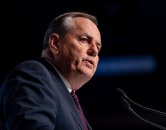
Lt.-Gen. (ret’d) Andrew Leslie is keen to talk about the embarrassing state of Canadian military preparedness.
“The current prime minister of Canada is not serious about defence. Full stop. A large number of his cabinet members are not serious about defence. Full stop,” the former Liberal MP tells me.
“Our NATO allies are despairing. Our American friends are frustrated.
“But because NATO and Norad (North American Aerospace Defense Command) are both essentially voluntary organizations, in which other people cannot give Canada orders,” the retired general explains, “all the officers are extraordinarily polite in public. But in private, the conversations are quite brutal.”
I have asked Andrew to explain our federal government’s foot-dragging on military spending — despite significant changes in risk — and what we should expect from our allies. This 35-year veteran of the Canadian Armed Forces (CAF), former chief of staff of the Canadian Army and one-time MP for Orleans is well-placed to decipher what’s really going on and in our frank conversation, he doesn’t pull any punches. I connect with Andrew at his home in Ottawa; behind him, the walls of his spacious office are sheathed in medals and awards, testimony to decades of decorated service in places like Afghanistan and Yugoslavia.
We get to the heart of the matter. Canada’s allies are pressuring Prime Minister Justin Trudeau’s government to get serious about military spending. And with a relentless war in Ukraine, a thawing and more vulnerable Arctic, unrest in the Middle East, and a general shakeup of the world order, Canadians are waking up to the risks of not being ready to defend ourselves.
Recently, U.S. Air Force Gen. Gregory Guillot (who took over leadership of Norad in February) has put his Canadian counterparts on notice that he aims to have U.S. troops training, not just in Alaska, but in the Canadian Arctic. A good idea, or the thin edge of a wedge?
It’s totally sensible, Andrew replies, because Canada has “no permanently stationed combat capability in the Arctic.” After a pause to let that sink in, he repeats that fact and elaborates. “Just in terms of numbers, there’s about 22,000 professional men and women in the U.S. Armed Forces based in the Arctic, mainly in Alaska. There’s about 30,000 to 35,000 Russian armed forces based in the Arctic. Canada has about 300 people.”
The stark facts, articulated by Andrew in a way that leaves no room for doubt, make me wince. It’s all so embarrassing. It’s increasingly difficult for the federal government to publicly extol our Arctic capabilities, the general continues. “Thank goodness Norad wants to exercise their American troops in Canada’s Arctic,” Andrew concludes, “someone’s got to be out there (in the Arctic) to show presence, and we are not. We are undefended.”
Deterrence is critical, right now, he says, “Putin and President Xi are both ambitious about the Arctic. We know this because they’ve said so.” Andrew’s not suggesting there will be armed conflict in the Arctic right away, but why wouldn’t they show up with drilling rigs to challenge Canada’s sovereignty in contested areas?
Over the last two to three years, other countries have volunteered to come and give Canada a hand with training in the Arctic, Andrew reports, his tone growing increasingly agitated. “The commander of the Royal Navy has said, you know, if you want my submarines to come up and help with trying to figure out what’s going on underneath the ice, I’m willing to do so. The Americans have said, how can we help? Nudge, nudge.”
The new commander of Norad is doing the right thing, Andrew believes, including building on existing relationships with Norway, Denmark, Finland and Sweden, other NATO countries with significant landmass inside the Arctic Circle. These countries also have combat capabilities that they deploy to their northern climates, on a regular basis, to maintain training and deterrence.
One would think the Trudeau government would be unnerved by these overtures from our allies — not just to protect our Arctic but to beef up our military spend to at least two per cent of GDP, in line with other NATO members. Yet the point man on Canada’s military preparedness, Defence Minister Bill Blair, sounds like he’s given up on the battle. Not only is he on record saying it’s hard to convince the cabinet and Canadians that meeting NATO’s “magical threshold of two per cent” on defence spend is a worthy goal, he’s also said the Canadian Forces is facing “a death spiral” when it comes to recruitment. If any CEO of a company said that, employees would be updating their LinkedIn profiles.
“Well, it’s not a minister’s job, per se, to sell something nationally,” Andrew shrugs, “that’s actually the job of the entire cabinet. But it points to the problems we have.”
And then Andrew repeats what he’s said before, this time more forcefully: “I’ll say it again, the Liberal government has no intention of meeting two per cent (by 2030) and no intention of meeting 1.76 per cent (as promised in the April 2024 budget) because they rest confident in the smug knowledge that the Americans will always defend us.”
There’s a backstory. During the run-up to the 2015 election, Andrew was asked by Trudeau, then a Liberal leadership candidate, to help craft a defence and security policy, which he did. The policy was articulated in its most detailed form in 2017, in a document called Strong, Secure and Engage. “It actually reads really well,” Andrew attests, “It promises a whole bunch of money, specific timelines for equipment, an annex of deliverables. I think there were 110 or 111, of which they’ve met almost none.”
And then matter-of-factly, Andrew enumerates the failures: “Since 2015, the Trudeau government has not spent, re-profiled, re-allocated, deferred, or lapsed $20 billion that was promised for defence. The impact of that is that ship fleets have not been replaced, aircraft are extraordinarily old, as are helicopters; the army is in a state of despair.”
When Andrew ran for election in 2015, under the Liberal banner, many expected he’d be named minister of defence. Trudeau named him government whip instead.
Both Andrew’s grandfathers were former ministers of defence in Canada. His paternal grandfather, Andrew McNaughton served from 1944 to 1945 under Prime Minister William Lyon Mackenzie King, a time when conscription was contentious. And his maternal grandfather, Brooke Claxton, served post-Second World War, under King and Louis St. Laurent, a time when the Canadian government was forced to weigh the political and financial cost of maintaining sovereignty with the need to defend against the Soviet threat to North America.
Andrew’s not convinced pressure from allies or the Canadian public will stimulate Trudeau’s government to change course on military spending. But interestingly, he points to a pivot by Trudeau’s father, Pierre Elliott Trudeau — who for years was determined not to spend a lot on defence because he’d rather fund social programs.
“(Pierre Trudeau) was counselled bluntly and ferociously by the chancellor of Germany, the prime minister of England, and the president of the United States on his lack of defence spending, and coldly told that trade is a function of how much and how willing you are to participate as a team,” Andrew recants. “Trudeau then went out and bought new ships, new tanks, new jet fighters, new artillery guns, new small arms, and he did it really quickly.”
Liberal government intransigence on military spending isn’t stopping Andrew from keeping up the pressure for change. He’s talking to Pierre Poilievre’s team about defence strategy and finds them, “receptive, aware and focused.” And, he adds, “you can quote me on that.”
If you have story ideas, get in touch at dkennedyglans@gmail.com.
Our website is the place for the latest breaking news, exclusive scoops, longreads and provocative commentary. Please bookmark nationalpost.com and sign up for our daily newsletter, Posted, here.

Unpublished Newswire

Comments
Be the first to comment