
Stay informed



'You have to be very, very strong': Freed October 7 hostage describes 491 days in captivity in new memoir
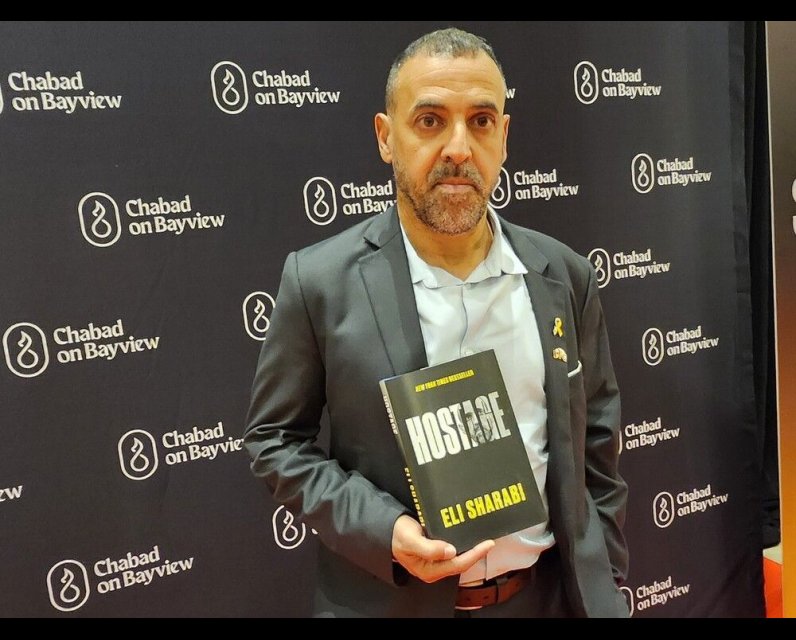
After seeing phone messages and videos that kibbutzim were being ravaged on October 7, Eli Sharabi thought surrendering himself to Hamas terrorists would save his British-born wife and two daughters. Instead, he spent 491 days as a hostage in Gaza and, upon his release in February 2025, learned they had been murdered minutes after he was dragged from their Kibbutz Be’eri home.
In Hostage, the first full-length memoir by a released hostage from that day’s massacre, the Yemenite-Moroccan Israeli recounts starvation, beatings and underground captivity in Hamas’s tunnels, alongside improvised quiet acts of defiance to keep other prisoners alive in spirit.
“I didn’t choose to be famous, you know, and unfortunately, it’s become like that. I would prefer not to be,” Sharabi told the Post on Tuesday, prior to a Toronto-area speaking event, which was organized by the Chabad on Bayview synagogue.
“But then it was very important for me to speak for the remaining hostages when I was released, and after that to write my testimony, the book, so nobody can in the future change the facts in the history. I think that was the best way to cherish my loved one’s memories for me.”
For him, the “hardest part” came when he heard of the death of his wife, Lianne, and his daughters, Noyia and Yahel, “and the part where I’m going to the graveyard to apologize, and to promise them that nobody will forget them,” he told the Post.
At the Chateau Le Jardin Event Venue, in Woodbridge, Ont., Sharabi told the audience that in writing the book, it was not difficult to recall every aspect of being a hostage. That will “be with me all of my life. It’s not something you forget,” he said.
Though conceding he was “not religious,” he began to say Jewish prayers while being held in the terrorists’ car, and continued to say prayers each day he was captive, including special Sabbath prayers and rituals.
“All these ceremonies just remind us how we are Jewish, which gave us lots of strength as a group,” he told the audience. “I found God again 50 metres underground. I felt someone protecting me,” he said, adding that there were at least ten examples of where he believed he was near death but “felt something keeping me alive. I’m really grateful for that.”
Sharabi, because of his fluency in Arabic, played translator between other hostages and the terrorists.
“It’s a very delicate relationship. They can change their minds in a second,” he said. “You have to start to learn how they react to everything.” He described “psychological terror” used against the hostages, including when they were told the government abandoned them, and that Israel had been destroyed. “You have to be very, very strong, day after day, to not pay attention to things like that.”
While in the tunnel, he saw “dozens of boxes of humanitarian aid” that he believes were stolen. His captors ate four to five times a day, though he only had one meal a day – consisting of a pita and a half, or a bowl of pasta, or a bowl of rice. On the day of his capture, he weighed 70 kilograms; at the day of his release, 44 kg.
After returning to Israel, during his first hot shower in 16 months, he “used probably all the shampoo bottles, and all the soap, and it was amazing. I will never forget this shower.”
In the days since his release, he said he gained a greater perspective about life.
“Appreciate everything, all the basic things in your life. Fifty metres underground, you understand what is really, really important in life. And it’s never material things. It’s never if you have a big house or a small house. If you have a flashy car or just a simple car. You don’t miss your bank account. You don’t care if you have a thousand dollars or a million dollars. You just want another five minutes with your family, with your friends. And you’re willing to pay anything for that,” he told the audience.
“Freedom is priceless,” he said, “to be able to wake up in the morning and not to ask any permission to go to a toilet, or have a shower, or open a fridge, or speak. You never forget after you lose that. When I’m in Israel, I try to open my day in the morning with a walk on the beach for an hour, and just look at that blue water. It’s just amazing for me.”
The lessons Sharabi carried out of the tunnels are not only about gratitude, but balancing hope for the Jewish people, against the rising tide of hatred.
“I know it’s not looking good for us now around the world, this rise in antisemitism. Sometimes it feels like 1940, not 2026,” he said.
After meeting members of Parliament, prime ministers and foreign ministers in various parts of the world, his message to them is: “They need to speak up with a stronger voice against antisemitism and every hate crime that happens against Jews around the world. It is their responsibility. I’m trying to wake them up.”

Comments
Be the first to comment