

Unpublished Opinions

Clinton is an accredited writer for numerous publications in Canada and a panelist for talk radio across Canada and the United States
Canada’s Quiet Trump Card
"The bigger, longer-term danger for the petrodollar system is psychological. Once a reliable, democratic, high-standard producer proves you can step outside the USD tent and actually come out ahead, the spell breaks."
Most people still picture Saudi Arabia or Russia when they think of oil superpowers. Look again. Once you add the bitumen in Alberta’s oil sands to conventional crude, Canada sits on the second-largest proven oil reserves on earth - roughly 170 billion barrels recoverable today, 1.7 trillion in the ground. Only Venezuela has more. That is not trivia. That is latent geopolitical muscle most of the world has politely ignored.
Now imagine Canada starts flexing it. If I were advising Mark Carney, Prime Minister of Canada, here is what I would be telling him. What if every barrel and every cargo of LNG leaving the country had to be priced and settled exclusively in Canadian dollars - and deliberately discounted a few bucks below WTI and Brent?
The effects would cascade faster than most people think. Oil is still the original petrodollar commodity. Every barrel traded anywhere creates demand for U.S. dollars. When a G7 country controlling ten per cent of the world’s proven reserves suddenly says “loonies only, please” (a move the Canadian author Gordon Korman once titled No Coins, Please), a meaningful slice of daily forex volume simply exits the USD circuit.
It won’t end dollar hegemony tomorrow, but it quietly erodes one of the structural pillars that has propped it up for fifty years. Importers, Midwest refineries, Japanese utilities, and Chinese traders would scramble for Canadian dollars. Basic supply and demand would send the loonie sharply higher.
For ordinary Canadians, the payoff would be instant and delicious: cheaper iPhones, cheaper winter tires, cheaper everything on the shelves. After a decade of a weak currency inflating the grocery bill, households would pocket a windfall. Inflation would cool, interest rates could stay lower for longer, and the Bank of Canada would get breathing room it hasn’t seen in years.
Beyond the checkout line, the signal would be deafening. A currency visibly backed by decades of stable energy revenue would make Canada a magnet for global capital. Pipelines, LNG plants, refineries, data centres, factories - money would pour in. A virtuous cycle that most commodity nations only dream about would finally kick in.
If the Prime Minister and his advisors really wanted to twist the knife, he could quietly start selling a portion of Canada’s U.S. Treasury holdings - roughly $475 billion worth, perfectly legal, perfectly deniable, and perfectly capable of nudging U.S. borrowing costs higher while adding one more brick of downward pressure on the dollar.
The bigger, longer-term danger for the petrodollar system is psychological. Once a reliable, democratic, high-standard producer proves you can step outside the USD tent and actually come out ahead, the spell breaks. Other exporters start asking why they’re still paying tribute to one currency. Washington would scream, of course. Four million barrels a day flow south; half the refineries in the Midwest are physically plumbed for heavy Canadian sour and nothing else.
Threats of CUSMA violations and border choke-points would fly fast.
But something fundamental has changed in the last year. Repeated American threats of 25 per cent tariffs, "kinetic action" talk on US television panels, and loose talk of annexation have done what decades of constitutional warfare never could: they have united Canada. From St. John’s to Victoria, from Québec City to Calgary, the country finally agrees on one thing - enough.
That unity converges in one locked room, one weekend, no leaks. A single First Ministers’ Meeting becomes the moment Canada decides who it actually is. In 48 hours, they settle four existential questions:
- Political buy-in: unanimous consent or the plan dies.
- Risk sharing: who eats the pain if Washington retaliates?
- Revenue expectations: exact royalty and sovereign-wealth-fund formulas, with Alberta’s sovereignty lock and no-clawback clause carved in stone.
- Canada’s international ask: the unified list of demands we will now make - permanent CUSMA exemptions, Arctic security guarantees, investment treaties with Japan and Europe, a real seat at the grown-up table.
When they walk out speaking with one voice - an event that happens roughly once every half-century - the Rubicon is crossed.
Pre-signed and waiting would be confidential letters of intent from Tokyo and Seoul. Desperate for energy molecules sourced outside of Russia and the Middle East, they are eager to buy in a G7 currency other than the U.S. dollar. The dominoes would begin to fall swiftly: That same day, the Bank of Canada would receive its new monetary mandate, and the Toronto Stock Exchange would immediately start drafting the benchmark CAD contract. The package, which would include export controls, mandatory CAD settlement, tax capture of the currency windfall, and the immediate creation of a trillion-dollar sovereign wealth fund seeded by energy royalties, then passed by the Parliament of Canada in a single confidence vote. This forces the Canadian Conservatives into a clear, high-stakes choice: to defend Canadian national interest, or to align with Trump and Vance.
Look at Norway. A country with one-third of Canada’s population took its North Sea oil windfall and built the world’s largest sovereign wealth fund - US$1.8 trillion and counting. Every Norwegian citizen is theoretically a millionaire in krone terms. They did it with cross-party consensus, an iron-clad rule that only the real return can be spent, and a national narrative that the oil under the seabed belongs to every generation, not just the one alive today.
Canada has triple Norway’s proven reserves, a bigger landmass, and a far more diversified industrial base. If little Norway can turn black gold into a perpetual-motion retirement machine, there is exactly zero excuse for Canada to keep giving its resource rents away to foreign refiners and watching the profits leak south forever. The new Canadian fund would be seeded the same way: every extra dollar the loonie gains from mandatory CAD pricing, every royalty dollar that used to be priced in a 72-cent currency, every cent of windfall profit tax on producers who suddenly face a stronger exchange rate - straight into an untouchable, professionally managed fund that belongs to every Canadian from Nunavut to Niagara Falls. Within fifteen years, it could be the largest sovereign wealth fund on earth. Within twenty-five, every Canadian gets an annual “resource dividend” cheque the way Alaskans do - only bigger. And the principal keeps growing, because unlike Norway, we still have the overwhelming majority of our oil in the ground.
That is what “playing the same hand” actually looks like when you stop apologising for winning. Private-sector CEOs from Suncor to Shell fall into line once they realize the entire country is finally playing the same hand.
Having the Manitoba Hudson Bay Energy Export Terminal proceed, the Trans Mountain Expansion Project, with the recently announced 2nd line going forward, plus Energy East, would give Canada the chance to make all of this happen.
The very fact that Canada could now credibly sit down at that table - and watch Washington scramble for the first time anyone can remember - says everything. Beneath the polite neighbour act sits a country with more energy leverage than almost anyone has bothered to notice. As Henry Kissinger once said, "It may be dangerous to be America's enemy, but to be America's friend is fatal" - And Canadians have learned that lesson in the last 12 months.
In March 2025, U.S. Representative Carlos Gimenez (R-FL) used the term "kinetic action" (a military term for lethal force) in a CNN interview to contrast potential military options with then-President-elect Donald Trump's use of economic action (tariffs) against Canada to "protect American lives".
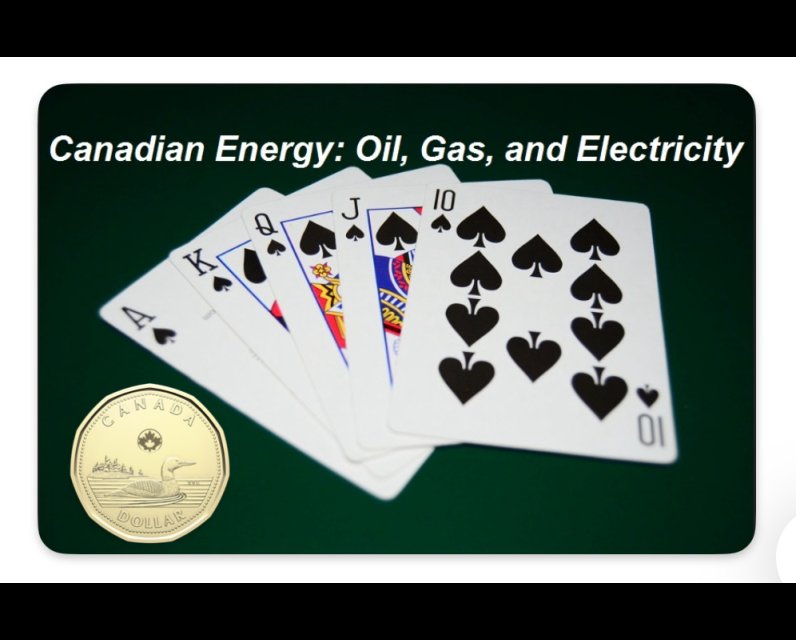
In a world desperate for secure, rule-of-law barrels, Canada isn’t just along for the ride any longer. It’s holding a royal flush. And thanks to a few reckless and unhinged tweets from Mar-a-Lago and JD Vance, the table could get very, very quiet.
Maybe it’s time to push the stack forward - remind me again who has the cards?
References

Comments
Great points. If, as you suggest, the American economy is over valued because its currency is used as the world currency to trade commodities like oil and gas, then removing the US dollar as the currency of choice will crash their economy faster than you can shake a stick.
I’m surprised the economic genius that is Donald Trump hasn’t realized the US is more exposed to economic attack than Canada as a result…
Trump's insulting quips about Canada becoming their "51st state" and how America "needs nothing Canada makes" because they can make it themselves were just brought into sharp focus with his National Security Strategy this week. I hear that no NSS has ever accurately predicted what the US would do. Let's hope that applies double for this one because it sure appears to be a direct challenge to Canadian sovereignty since it implies that - as Belarus is to Russia - Canada is a mere vassal state within America's "sphere of influence". We're just a vassal state with huge reserves of heavy, sour crude and and abundance of cheap hydroelectricity - none of which America needs, right?
The US has been able to run massive deficits for decades because the greenback became the international currency of trade after World War Two.
If Canada did what you suggest, that could indeed have threaten the value of their dollar and their ability to fund their humongous national debt with US Bonds. Canada could expect swift retaliation - perhaps even more than we might anticipate by replacing the purchase of 72 Lockheed Martin F-35A fighter bombers with a whole new aerospace industry based on the SAAB JAS-39 Gripen E/F (assuming we can replace the American GE F414G engines). I could imagine Trump proclaiming Canada demanding its oil be purchased in CAD rather than USD as a hostile act which could be the excuse to significantly expand his economic war against us (forget CUSMA) or even open a whole new military front. Let's start by declaring the airspace of Alberta a no-fly zone, followed by a rapid aerial and ground assault that takes control of the oil sands and pipelines, which will now be controlled on behalf of the US by some member of the Trump family. Given the demoralized, poorly equipped state of our military, neglected for decades, this would be the perfect time to strike.
Sounds ridiculous doesn't it? Then again the whole Trump regime would have sounded implausible 15 years ago.
Alternatively they seem to be establishing a pretext based on lies about illegal drug exports to take control of Venezuelan oil, a heavy sour crude like ours and ship it to the American Gulf refineries where Canadian crude is refined now. They have sent a carrier task force down there - not generally something they would do unless they had something serious in mind. Whatever income we made from discounted US crude oil sales would be gone, so we would have to rely on Asian markets to replace - not supplement it.
Except Trump would make it known the US would seize tankers on the high seas carrying Canadian crude to Asia, as they have currently done with one from Venezuela, because Canada was being "nasty" toward them. Maybe Trump will claim it was carrying cocaine? It doesn't actually have to be true, it seems most people down there just accept whatever he says or is at least powerless to challenge it, thanks to his buddies on the Supreme Court.
If I were Carney, I would tread carefully on a proposal like this - at least until we have some hope of defending ourselves from the backlash.