

Unpublished Opinions

Clinton is an accredited writer for numerous publications in Canada and a panelist for talk radio across Canada and the United States
The Gravity Tax? Energy Security and the Invention Secrecy Act
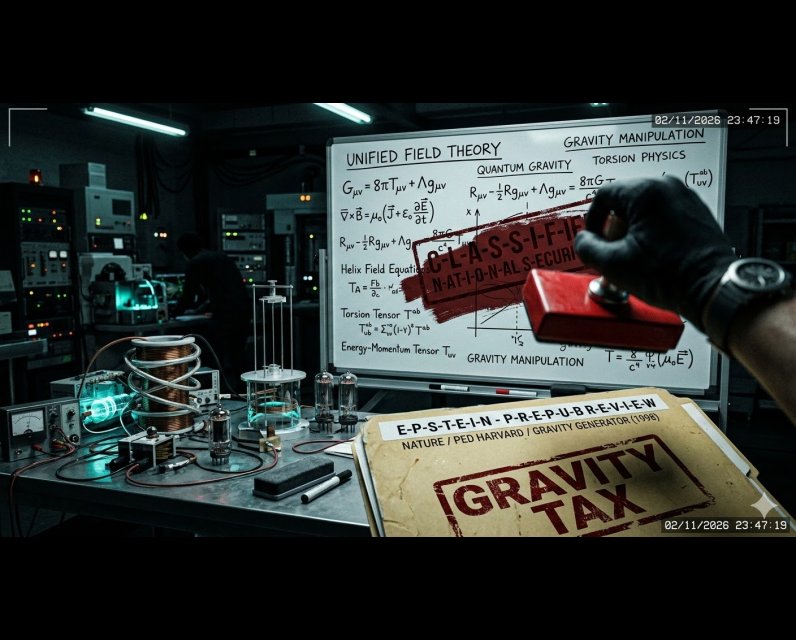
As of fiscal year 2025, the United States government maintains approximately 6,543 active secrecy orders under the Invention Secrecy Act of 1951. While the total number fluctuates, the trend is climbing; new orders jumped from 61 in 2021 to 102 in 2025. Typically, these gags are sponsored by the Department of Defense or the Department of Energy - the gatekeepers of what we are "allowed" to know. Of the 6,543, roughly 90% were implemented by the Department of Defense and 10% by the Department of Energy.
If you’re a physicist studying a Grand Unified Field Theory, gravity manipulation, or fusion energy in the U.S., even whispering about helix fields or torsion physics could get you flagged. It’s not necessarily because your math or facts are wrong; it’s because it’s disruptive.
Start talking about rotational universes, zero-point energy, or gravity tweaks, and suddenly you aren't just a theorist - you’re a threat. One letter from the Department of Energy claiming a "potential harm to national security" is all it takes. No public appeal, no oversight. Under the 35 U.S.C. §§ 181-188 framework, because a Unified Field Theory links electromagnetism directly to the curvature of spacetime, any device built on its principles is automatically classified as a "Militarily Critical Technology."
The Act doesn't require proof of a weapon; it only requires a bureaucrat to decide that the discovery is "disruptive." The penalty is two years in prison for disclosure, or twenty years if they can frame it as espionage. That is how they keep the lid on. The inventor is legally gagged: no talking, no publishing, and no foreign filing or public requests for funding.
Legal gags are only the "stick." The "carrot" is the sophisticated capture of the world's leading minds. To understand how advanced physics is strangled at the university level, one must look at the Maxwell family’s roots in publishing.
Christine Maxwell, sister of Ghislaine, is married to Roger Malina, a leading figure in peer review. This influence traces back to her father, Robert Maxwell, who pioneered the profit-driven model of scientific publishing at Pergamon Press. When the "intelligence apparatus" controls the journals, they don't need a secrecy order to kill a discovery; they simply refuse to deem it "credible."
The 2006 Confronting Gravity conference wasn’t just a retreat; it was a physics harvesting operation for some very nefarious people at work. Below are just a few of the researchers and the institutions they represented, all drawn into the orbit of this intellectual honey pot. While some on this list attended the 2006 "Confronting Gravity" conference, others were neither invited to nor aware of it; however, the Epstein files indicate he made attempts - often through intermediaries or go-betweens - to build relationships with physicists on this list as well. For the record, I’m not saying anyone on this list did anything wrong or immoral, nor am I implying that they all met with him; in some cases, they made a point of avoiding him. I’m interested in explaining what Epstein was trying to do.
- David J. Gross – Kavli Institute for Theoretical Physics (Nobel Laureate)
- Frank Wilczek – MIT (Nobel Laureate)
- Gerard 't Hooft – Utrecht University (Nobel Laureate)
- Kip Thorne – Caltech (Nobel Laureate)
- Barry Barish – Caltech (Nobel Laureate)
- P. James Peebles – Princeton University (Nobel Laureate)
- Murray Gell-Mann – Santa Fe Institute (Nobel Laureate)
- Alan Guth – MIT (Inflationary Theory)
- Lawrence M. Krauss – Organizer of the 2006 Conference
- Lisa Randall – Harvard University
- Leonard Susskind – Stanford University
- Lee Smolin – Perimeter Institute for Theoretical Physics
- Max Tegmark – MIT
- Brian Greene – Columbia University
- Sean Carroll – Johns Hopkins University
- Stephen Hawking – University of Cambridge (Theoretical Physicist/Cosmologist)
- Sabine Hossenfelder – Theoretical Physics/CMB
- Martin Nowak – Harvard University
- Seth Lloyd – MIT (Quantum Information)
- Savas Dimopoulos – Stanford University
- Alex Vilenkin – Tufts University
- Thibault Damour – IHÉS, France
- Eric Adelberger – University of Washington (Eöt-Wash Group)
- J. Richard Bond – University of Toronto/CITA
- Marc Kamionkowski – Johns Hopkins University
- John Ruhl – Case Western Reserve University
- Maria Spiropulu – Caltech
- Glenn D. Starkman – Case Western Reserve University
- Tanmay Vachaspati – Arizona State University
- Robert Wald – University of Chicago
- Eric Weinstein - Harvard University
New documents released in early 2026 reveal that Epstein was actively involved in the "pre-publication" phase of research at Harvard’s Program for Evolutionary Dynamics (PED). This allowed a non-scientist to influence the final polish of peer-reviewed work, ensuring disruptive technologies like zero-point energy remained "fringe" or were steered toward private interests.
When the paperwork fails, the pattern extends into physical elimination. The list of physicists finding themselves in "strange situations" is becoming impossible to ignore:
- Dr. Nuno Loureiro, a famous MIT fusion whiz, was gunned down in his home in December 2025.
- Dr. Carl Grillmair, a Caltech astrophysicist, was murdered in February 2026.
- Dr. Amy Eskridge, founder of the Institute for Exotic Science, died by a gunshot after talking about live-streaming experiments, ruled as suicide in 2022 after NASA resistance.
- Dr. Ning Li, the pioneer of AC Gravity, re-emerged with severe brain damage after a hit-and-run after leaving her lab following her work with the DoD. She died in 2014.
This is the system doing what it does best: slowing the world down until the "disruptor" is neutralized, captured, or forgotten. When the peer-review gatekeepers fail, the system turns to direct intervention. The pattern of "strange situations" involving gravity and fusion researchers is now impossible to ignore:
- The Professional Ruin (1990s): Dr. Eugene Podkletnov was expelled from his Finnish lab in 1997 after his work on superconducting "anti-gravity" discs leaked. Similarly, Dr. Douglas G. Torr’s work on "gravity generators" abruptly ceased in 1998 following a document leak.
- The Semantic Retreat: Researchers like Giovanni Modanese faced such academic hostility that colleagues, such as Claude Poher, began avoiding the word "gravitational" entirely to survive professionally - a chilling example of self-censorship.
Research is tangled in classified memos and filed under Energy Security - Miscellaneous next to windmill reports. It was designed this way on purpose. Is physics too dangerous to do in a university setting? It is a stark reminder of the consequences faced by those who dare to challenge the boundaries of accepted scientific understanding. When breakthroughs intersect with powerful, clandestine interests - from the geopolitics of fossil fuels to military hegemony - science becomes a secondary concern. Perhaps our greatest breakthroughs aren't missing; they’re just hiding in the fringes, waiting for a light that isn't allowed to shine.
On January 18th to January 23rd, 1957, some of the world’s leading physicists & chemists gathered in Chapel Hill, North Carolina, in the United States for something called the “Gravity Conference.” Funded partly by the U.S. Air Force via the Institute for Field Physics. It was an era when the Cold War was at its peak. Maybe the seeds of advanced physics were planted then, with people like Thomas Townsend Brown and others.
I would like to formally invite all American physicists & mathematicians working on fusion, gravity manipulation, zero-point energy, and unified field theories to relocate to Canada. Unlike the United States, we Canadians do not have an Invention Secrecy Act of 1951 (35 U.S.C. §§ 181–188). Your breakthroughs will not be suppressed by a national security apparatus that prioritizes military supremacy and the geopolitics of fossil fuels over human progress in the field of physics. It's time we let physics thrive again!
Maybe the seeds of advanced physics were planted in the 1950's, with people like Thomas Townsend Brown and others - perhaps breakthroughs hide in the fringes?
References

Comments
Be the first to comment