Advanced AI is already producing documented harms of its own, prompting growing calls for regulation, restrictions, and stronger governance.
There is a deeper pattern hiding beneath both.
Again and again, the same sequencing error is repeated:
Build. Deploy. Scale. Entrench. Discover consequences. Attempt governance. The questions come last.
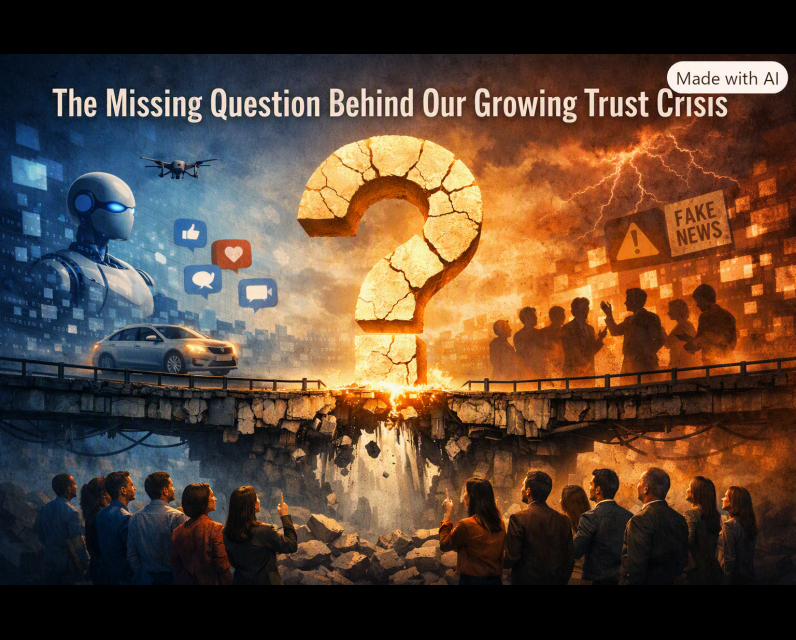
We do not build bridges and ask safety questions after they are carrying traffic. We do not establish air traffic control systems and only later decide who has authority during an emergency. We do not allow hospitals to improvise accountability structures after patients have already been harmed.
In mature systems, the fundamental questions come first.
Who is responsible?
Who has authority?
Under what conditions may action occur?
What happens when uncertainty appears?
Only then do performance and scale follow.
Yet our increasingly consequential digital systems continue to reverse this sequence. Capability, adoption, and growth come first; legitimacy is reconstructed later. The result is not simply policy disagreement.
It is a growing trust crisis.
The reason this question can no longer be deferred is that we are moving beyond systems that merely recommend and toward systems that increasingly act.
AI agents, autonomous vehicles, automated decision systems, and machine-operated infrastructure already exercise delegated authority in the real world. As these systems become more capable and autonomous, relying on implicit authority becomes unsustainable.
Safety therefore becomes a governance question, not simply an engineering question.
A system is not safe simply because it performs well most of the time. Safety must depend, in part, on whether it is clear who has authority when uncertainty appears, when confidence breaks down, and when the system should pause rather than proceed.
Trust depends on more than whether systems are useful, accurate, or efficient. It depends on whether people believe there are legitimate structures of authority governing how those systems operate when they become uncertain or consequential.
This is the central question our public debates continue to avoid:
Who is authorized to decide when the system doesn’t know?
What happens when information is incomplete? When recommendations conflict? When confidence breaks down? When there is no obvious right answer?
Does the system proceed?
Does it pause?
Does it escalate?
Who decides?
These questions are not obstacles to innovation.
They are the conditions that allow innovation to remain trustworthy, governable, and sustainable over time.
The lesson from other mature systems is remarkably consistent. Legitimacy and authority do not emerge because systems become successful and widely adopted. They are among the reasons those systems become durable in the first place.
Our growing trust crisis is not the result of technologies moving too quickly.
It is the result of deploying increasingly consequential systems before establishing who has authority when uncertainty appears.
As autonomous systems increasingly operate alongside humans, that question becomes unavoidable.
Ben Marshall is the founder of Ahead of the Curve Solutions and originator of the Authority-First Architecture framework, a governance architecture for consequential systems operating under uncertainty.
Ahead of the Curve Solutions
https://aheadofthecurveconsulting.ca
Further reading
Visit Ben's Substack for additional essays on Authority-First Architecture:
https://benmarshallto.substack.com/archive




Comments
Be the first to comment