
Stay informed


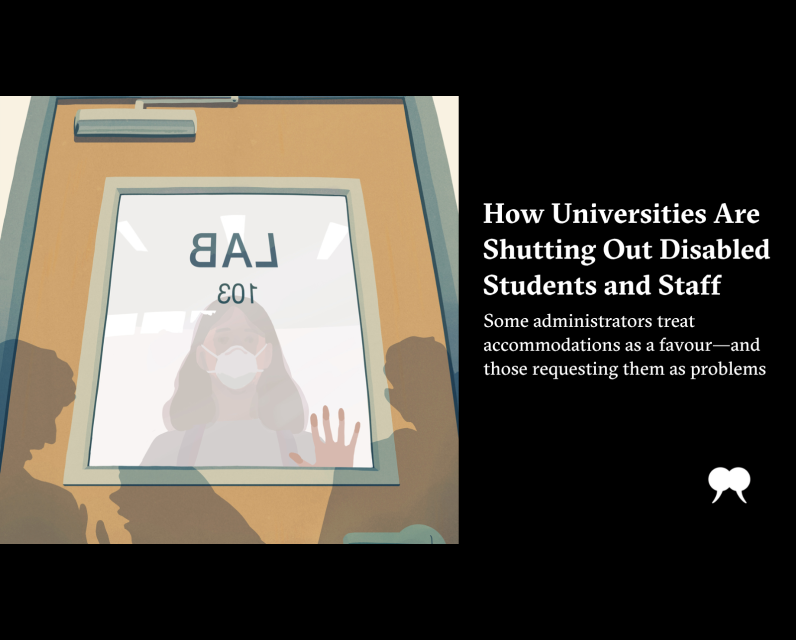
How Universities Are Shutting Out Disabled Students and Staff
.main_housing p > a { text-decoration: underline !important; }
.th-hero-container.hm-post-style-6 { display: none !important; }
.text-block-underneath { color: #333; text-align: center; left: 0; right: 0; max-width: 874.75px; display: block; margin: 0 auto; } .text-block-underneath h4{ font-family: "GT Sectra"; font-size: 3rem; line-height: 3.5rem; } .text-block-underneath h2{ font-size: 0.88rem; font-weight: 900; font-family: "Source Sans Pro"; } .text-block-underneath p { text-transform: uppercase; } .text-block-underneath h3{ font-family: "Source Sans Pro"!important; font-size: 1.1875rem; font-weight: 100!important; }
.flourish-embed { width: 100%; max-width: 1292.16ppx; }
.th-content-centered .hm-header-content, #primary.content-area { width: auto; } .entry-content p, ul.related, .widget_sexy_author_bio_widget, .widget_text.widget_custom_html.widget-shortcode.area-arbitrary { margin-left: auto; margin-right: auto; } .hitmag-full-width.th-no-sidebar #custom_html-45.widget { margin: auto; } @media only screen and (max-width: 768px) { .img-two-across-column{ flex-direction: column; } .img-two-across-imgs{ width: auto !important; max-width: 100%!important; padding:0px!important; } .main_housing, .text-block-underneath { margin-left: 25px !important; margin-right: 25px !important; } .text-block-underneath h4{ font-family: "GT Sectra"; font-size: 35.2px; line-height: 38.7167px; } } @media only screen and (min-width: 2100px) { .main_housing, .text-block-underneath { /* margin-left: 32% !important; margin-right: 32% !important; */ } } @media only screen and (max-width: 1200px) { .main_housing, .text-block-underneath { /* margin-left: 25px !important; margin-right: 25px !important; */ } } @media only screen and (max-width: 675px) { .main_housing, .text-block-underneath { margin-left: 10% !important; margin-right: 10% !important; } } .hero-tall {display: none;} .hero-wide { display: block; } @media (max-width:700px) { .hero-wide { display: none; } .hero-tall { display: block; } } EDUCATION / MARCH/APRIL 2026 How Universities Are Shutting Out Disabled Students and Staff Some administrators treat accommodations as a favour—and those requesting them as problems BY LYGIA NAVARRO ILLUSTRATION BY PATRICK LÉGER
Published 6:30, JANUARY 16, 2026
This article contains discussions of suicide. If you or someone you know is having a suicide crisis, please call Talk Suicide Canada (1-833-456-4566). There is also the Hope for Wellness Helpline for Indigenous people across Canada (1-855-242-3310).
NAOMI HAD ALWAYS hated school, so much so that she cried for hours when school breaks ended. She hadn’t always considered herself disabled, though. Sure, she’d felt lucky to have discovered her autism and learning disabilities relatively early—and to have started getting accommodations in junior high— given that most autistic women aren’t diagnosed until adulthood, if at all. But until her second semester of university, Naomi hadn’t realized how much autism impacted her life. Then, just before semester’s end, COVID-19 crashed in.
Before lockdown, Naomi had been planning to skip classes for a couple of weeks because she felt herself hurtling into autistic burnout. The phenomenon looks different to every person affected by it, but for her, it includes stress responses like difficulty maintaining personal hygiene, being almost too exhausted to leave bed, nausea, lack of interest in life, and brain fog.
When her Toronto university moved online, Naomi initially felt happy. Excited, even. (I’m not using Naomi’s real name nor that of the university.) The sudden freedom from the intense sensory overload of campus brought a realization: she had been ignoring the effects of her disabilities throughout her education, suppressing and hiding her autism—what autistic people call “masking”—to fit into neurotypical classrooms. “I didn’t realize how stressed I was,” she says, “and how much I was overexerting myself all the time.” Previously, it’d never occurred to Naomi to request remote-learning accommodation, nor had her university’s accessibility adviser ever suggested it. In lockdown, Naomi grasped that it was crucial for her survival. She saw what she describes as “a window into: Things can be different. Life can be better.”
But in the fall of 2021, Naomi’s university announced that most classes would be in person as of the following January. Naomi wrote to the accessibility services office to kickstart the accommodations process, hoping she could continue to attend classes remotely, through a livestream or via lecture recordings. (Naomi knew that her university allows its disability studies program to hold classes remotely.) Since disability accommodations are protected under human rights law, the only way an entity like a university can legally deny a disability accommodation request is by proving that granting it would pose an undue hardship—mainly, that it would be prohibitively expensive to enact. A recorded lecture wouldn’t pose any significant additional cost to the university. Nonetheless, Naomi’s request was denied.
For a time, Naomi tried to fit into non-disabled academic spaces without the remote-learning accommodation. The first day of school in September 2022 was one of her worst. Naomi hadn’t been on campus for two and a half years. But she had to complete a degree-requirement course offered only in person.
Naomi strapped on a white N95 mask. (She’s keenly aware that disabled people face higher rates of long COVID and continues wearing a mask to protect herself and others, though that day, she noticed nobody else on campus seemed to be taking the same precautions.) Despite a deep sense of dread, she marched to class. Even made it to the door. But then, deluged with sensory overwhelm, she panicked and fled. Once off campus, she disenrolled from the course. She had a 4.0 GPA, yet the university’s resistance to her needs made her wonder: Would she ever be able to graduate?
For decades before the pandemic, disabled people in academia had pleaded for the very accommodations nearly everyone enjoyed during lockdown, including remote attendance, asynchronicity, and lecture transcripts. “There is lots of irony there. [Disabled people] were always told this was impossible,” says University of Waterloo professor Jay Dolmage, founding editor of Canadian Journal of Disability Studies. “We have had an opportunity, over the past five years, to redesign higher education in ways we never have before.”
That opportunity has been largely squandered. Aspects of Naomi’s story echo the experiences of other undergraduate and graduate students I spoke with across three provinces, at least two of whom dropped out due to their universities’ hostility toward the accommodations that would allow them to study on a level playing field alongside their peers.
In interviews with students and employees, I’ve heard variations of the same tale: universities tout themselves as victorious leaders in equity, diversity, and inclusion, with websites trumpeting their commitments to human rights. Yet many I spoke to encountered intransigent administrations with, at best, a lack of training in disability rights—and, at worst, entrenched dogmas about disability not belonging in the academy.
To wit, some non-disabled people consider disability accommodation akin to a favour, an unfair advantage. The rationale for legal protections of disability accommodation disproves that: society is designed for non-disabled people—which inherently disadvantages disabled people. That’s why it is illegal for employers and service providers to deny reasonable, necessary disability accommodation under human rights law. In academia, however, a cynical skepticism abounds: Are too many people receiving disability accommodation? Do those receiving accommodation actually need it? Does disability accommodation decrease a university education’s quality? Are people faking disability to get an easier ride?
In December 2025, for example, The Atlantic published a piece arguing that rich kids, especially at elite US colleges and universities, were “taking advantage of an easily gamed system” by racking up diagnoses for disabilities they didn’t actually have so as to “gain an unfair edge.”
In 2024, in a Chronicle of Higher Education article originally entitled “Do Colleges Provide Too Many Disability Accommodations?” US religion professor Alan Levinovitz wrote, “Students and instructors are rightfully concerned about fairness and compromised rigor,” and said “students who don’t need them” were skating by with accommodations. This set off the Twittersphere; Levinovitz lashed out at disabled leaders who criticized his piece, and then defended himself with an offensive descriptor, asking whether one critic knew if his parents “suffered from” disabilities. (The article title was changed following the protests.)
Around the same time, in this magazine, University of Toronto instructor Simon Lewsen wrote about his worry that “university bureaucracies are robbing instructors of their academic freedom by compelling them to offer accommodations,” and that by granting “too many [accommodation] requests, I’ll create a class without stress or friction—the stuff that makes learning happen.”
The reality is that a large corps of disabled people in academia is already overly familiar with stress and friction. In his 2017 book Academic Ableism: Disability and Higher Education, Dolmage charts academia’s historic hostility toward disability, highlighting how universities were built to bar disabled people from participating as scholars—think steep staircases leading up to ivory towers—while the field exploited them as research subjects or shunted them to shadow institutions such as asylums. Dolmage writes: “Disability has always been constructed as the inverse or opposite of higher education.”
This is only heightened during pandemics and their aftermath. Starting in the late 1800s in the United States, cities passed what became known as “ugly laws,” making it a criminal offence for disabled people—including those disabled by the 1918 flu pandemic—to be seen publicly. If disabled people couldn’t go out in public, they were most definitely kept out of schools and universities.
The last ugly law wasn’t repealed until 1974, amid the US disability rights movement, which was being led in part by Judy Heumann and Ed Roberts, founding members of the world’s first Center for Independent Living. Both were post-polio wheelchair users who’d initially been denied access to education because of their disabilities. At my alma mater, the University of California, Berkeley, an administrator famously told Roberts, “We’ve tried cripples before, and it didn’t work.”
“People with visible signifiers of disability have historically, post-pandemic, been driven out of institutions like universities,” says former Toronto Metropolitan University instructor and PhD graduate Tanya Pobuda. “Nobody wants to be reminded of the plague. They want to move on.”
That erasure isn’t just history—it’s unfolding in real time. The World Health Organization still categorizes COVID-19 as a pandemic. But because governments lifted public health restrictions, much of society thinks of COVID-19 only in the past tense and has transitioned into a 2019-style existence. Over more than a year of reporting, it’s become clear many administrations deem the accessibility widely available in 2020 and 2021 to be inconceivable and unfeasible now.
For several semesters, Naomi emailed faculty and administrators, asking for assistance. Meanwhile, she signed up for the few classes still offered online. She said the head of the accommodations office asked her if she ever ventured outside her home, the implication being that Naomi was irrationally afraid of the world. (Much of the university’s communication during the clash, Naomi says, felt like gaslighting, “trying to convince me that this is not disability related, this is mental health related. I’m telling them that this is my need,” Naomi says, and “they heavily implied that it’s anxiety.” Regardless, mental health disabilities legally qualify for accommodation.) Another administrator recommended retreat as a tactical solution: Naomi should just transfer.
An associate dean wrote to Naomi: “[W]e are hopeful that there may be general improvements to your health and that this may influence your ability to come to campus.” (Disabled current and former employees at various universities I’ve spoken with mentioned facing this same rhetoric of “go away until your disability is fixed.”) As if autism—or any disability—needs curing.
In the spring of 2024, Naomi was trying to make it through the required in-person course. By then, she’d escalated her outreach, requesting aid from more accommodation bigwigs, such as the vice president for equity and inclusion and the university’s internal human rights office. (Disabled students and employees face such bureaucratic futility constantly; University of British Columbia law student Sophie Harrison calls it a “multi-headed dragon.”) The university didn’t budge. Naomi sighed. “I’m everyone’s problem, but also nobody’s problem.”
Navigating the sensory overstimulation for a single on-campus class left Naomi unable to do anything for days. She’d sit at her computer but couldn’t concentrate and sometimes nearly fell asleep. Then, once she’d semi-recovered, she scrambled to finish work for her other classes. The next week, the same cycle began anew. Eventually, she dropped the class again.
Existing in Canadian academia is a feat in itself for disabled people. A 2024 Canadian University Survey Consortium survey of over 12,000 graduating students from thirty-eight universities found that 35 percent were disabled, a rate higher than the national average. But in a telling mismatch, only 10 percent of survey respondents accessed services for disabled students.
Deeper within academia, the needs of disabled university faculty, temporary instructors, and non-teaching staff are largely invisible: employees—including tenured professors—are petrified of losing their jobs if they’re outed as disabled. Benefits, insurance, and pensions are on the line, and in the rare academic departments with open positions, tenure-track faculty are typically appointed just once a year. (The poverty rate among people with disabilities is almost twice that of the rest of the population.)
In 2019, according to Statistics Canada, 35 percent of disabled university faculty and researchers “experienced unfair treatment or discrimination in the past 12 months,” and over that same period, 47 percent were “subjected to at least one type of harassment.” Only 6.7 percent of university faculty and researchers were disabled. This means there’s limited representation at the upper levels of academia: as of September 2025, less than 10 percent of Canada research chairs—a prestigious, high-paying honour for “a diverse cadre of world-class researchers”—are disabled. For tier one Canada research chairs, whose universities receive $200,000 annually, that number drops to 7.8 percent. This is drastically lower than the national rate: 27 percent of Canadians over fifteen are disabled.
Employees who were denied accommodation were eager to talk but terrified of repercussions, their trauma near the surface, raw and sharp. To reassure sources about my cultural competency, I detailed my own disabilities. To protect their identities, we devised workarounds to shield their real names, genders, institutions, and even provinces.
Academia is “a very individualistic, very competitive environment based on overwork—and sometimes cruelty,” says a professor in Western Canada, describing fifty-hour weeks as being the minimum. “Expectations of very high productivity already make it an ableist environment,” they continue. “There are only some people who can succeed. What gets celebrated is the most productive—the most abled.”
A University of Calgary Faculty of Arts professor says “generic ableism” coexists alongside an inaccessible work culture: “The view is, if you need any kind of disability accommodations, you should not be an academic,” they say. “I’ve had faculty say that to me, especially about graduate students, ‘Well, if they have a disability’—including something like autism—‘they shouldn’t be in grad school.’”
Pobuda, the TMU graduate and former instructor, told me of a professor laughing when she asked about remote work during a career counselling seminar, and of other professors who urged her not to disclose being disabled since it would make it harder to get a job after graduation. (In an emailed statement, TMU said it could not comment on “confidential HR matters,” but that “TMU has robust policies in place and, in applying these policies, we uphold the core values of the university, and also take the appropriate steps to consider processes thoughtfully, ensuring procedural fairness, and allowing for action.”)
The disabled employees I interviewed have seen dramatic changes since 2021, with pre-pandemic factors only exacerbated. Internal or public communiqués stressing that classes and work must take place in person, full stop—even in universities which offered online courses pre-2020. Skimpier accessibility budgets. High accessibility officer turnover. Few institutions with staff accessibility offices. The shifting of responsibility between multiple administrative officers seemingly lacking medical or disability and human rights knowledge. The vulnerability employees feel at the whims of changing leaders with control over their accommodations.
Two professors, including one from the University of Calgary, said that when new deans arrived, their formerly seamless accommodation approval processes became antagonistically dysfunctional. (An email from the University of Calgary stated that while the institution cannot comment on individual cases, it has “comprehensive policies and procedures for employees and students who require accommodations based on a protected ground and does not tolerate acts of discrimination in our work or learning environments.” It encourages employees and students “experiencing challenges navigating the accommodations process” to contact human resources or the school’s student accessibility services, respectively, for support.)
At TMU, Pobuda repeatedly spoke out, in faculty meetings and letters to university officials, about what she views as insufficient campus COVID-prevention measures, and about the tally she kept of potentially COVID-related deaths among students and faculty. Soon after, her opportunities for remote teaching evaporated. (My partner works at TMU and is involved in a legal dispute with the university but is not connected to this story.) At another Ontario institution, a staffer was allegedly told in a meeting, “Oh, just come in [to work] and get COVID. Get it over with.” Despite the fact that, because of the staffer’s disability, the virus could kill them.
Poet and creative writing instructor Jacob Scheier describes being broken by the accommodation process. “There’s this disbelief,” Scheier says, “of, Yeah, but are you really that immunocompromised?” In his final semester teaching a class slated to be in-person, Scheier received a partial accommodation, which meant teaching part of the class online while the other part was taught by an in-person instructor. But it also meant getting paid less.
Almost everyone I spoke with recounted their private health information being dissected and debated through invasive medical documentation processes—information which, in at least one case, allegedly spread amongst colleagues in an illegal version of office gossip. (Employers are allowed to require proof of need for accommodation, with privacy limits that are nearly unenforceable.) Employees told me they feel their disabilities are “weaponized” against them; their bodies are “being surveilled.” Multiple people called the process “authoritarian.” One said that, at a certain point, they had to provide medical proof of disability every three months, as if their disabilities might spontaneously disappear or were made up all along. Disabled employees spend unpaid hours chasing specialist appointments to get forms filled out, and by the time one form is submitted, they have to do it all again.
Employees say universities often don’t grant accommodations that doctors have recommended, and when employees have to push for accommodation, they’re treated like “a problem” or “a troublemaker.” Multiple people feel forced to beg, a common reality for most disabled people trying to access accommodations, even outside academia.
When universities do relinquish even partial accommodation, employees are treated as if they’ve been granted “a little present,” as the professor in Western Canada put it—not a legally mandated human right. This same professor has been refused the full accommodations recommended by their doctor for four years. “Can you imagine,” the professor says, “the number of hours of [administrators] being paid high salaries to deny accommodations that cost them almost nothing? That’s how determined they are.”
“The system is effectively telling disabled staff and faculty not to seek help,” disability studies scholar Dolmage says. “And we are losing them.”
The institutions where my sources study or work seem more invested in sidestepping human rights law than abiding by it. Some sources say university administrators often refuse to follow the accommodation processes listed on their institution’s own websites; Trista King, a former Lakehead University staff member, calls it “smoke and mirrors.” Many of the institutions insist on verbal accommodation discussions—read: no paper trail. In one case, an employee believed that their university allowed administrators with power over them to deny their accommodation requests as a form of professional vendetta.
Dolmage says universities know well that disabled employees and students have little recourse. For those who are unionized, federal law dictates that they cannot take their employers to court, with limited exceptions. The employees I spoke with said that, despite purported autonomy, unions are often unwilling to back employees’ accommodation campaigns.
Seeking help in provincial and territorial human rights tribunals entails years of waiting. Universities can easily spend thousands on external lawyers (who produce scores of pages in documents), exhausting their disabled opponents. The rare disabled employees or students who do take legal action must endure the excavation of their trauma over and over again.
And a legal claim is certainly no guarantee of success. King, who was the sole university employee I interviewed who had filed a human rights case, did so only because she’d already been forced out of her job: she’d worked successfully with accommodations for seven years until, in 2022, Lakehead suddenly denied them. Without accommodations, King had to resign. (As part of an emailed statement, Lakehead University said that while it cannot comment on individual cases, “each accommodation request is considered individually through a collaborative process. Employees play an active role in this process, working with the University to ensure that accommodations are responsive to their needs, within the framework of what is reasonable under the law.”)
In a narrow statute of limitations, Ontario residents like King have one year to report human rights abuse to the Human Rights Tribunal of Ontario (despite trauma and ongoing accommodation battles often making this difficult). Lakehead’s lawyer asked the tribunal to dismiss King’s case outright. Based on a technicality its adjudicator found, the tribunal did.
To fall within the tribunal’s time limit, King would have had to file within a year of Lakehead’s denial of her accommodations. She did not realize that the discrimination she faced while trying to appeal the university’s decision before going to the tribunal would not count, putting her past the statute of limitations. King couldn’t afford a lawyer—she’s in her thirties and barely surviving on government disability benefits for the indefinite future.
In 2025, the HRTO was clearing its pandemic-induced backlog; in the first quarter of the year, more than 95 percent of decisions were case dismissals. In March, the month the tribunal decided on King’s case, it dismissed three cases against Lakehead University and nine against other Ontario universities. Of the handful of cases that month decided in an applicant’s favour, none were related to higher education.
After dropping her in-person lab class partway through the semester in early 2024, Naomi continued emailing with her university’s internal human rights office, which the faculty union has shown often conducts investigations so slowly that students and employees end up outside the time limit to file cases with the HRTO. The office rescheduled her intake appointment twice. Finally, Naomi secured an appointment—with a law student, instead of the human rights resolutions officer she was supposed to meet with. By the summer, Naomi’s internal mediation process was stalled.
Naomi knew she wouldn’t survive another semester without accommodation. In late July, the university required that Naomi meet with the academic accommodations support department’s two most senior officials (although she’d been appealing to the department for help for nearly three years). In a video call, Naomi read from a statement about the “darkest” period of her life, saying she was “grateful to have made it out of that chapter alive.” Naomi later would tell me that the years fighting for accommodation brought about “frequent suicidal ideations” and her “most intense period of depression.”
“The university presents itself as a leader in diversity, equity and inclusion,” Naomi read to the administrators. “It is clear that upholding this image is more important than actually delivering on the commitment to provide students equitable access to education. I am not the student this school wants. I am certain that I am not the first victim, nor will I be the last.” At the end of the meeting, she still had not received her needed accommodation.
One business day before school started, in August 2024, Naomi woke up in her pink-flower-walled childhood bedroom, clothes scattered on the floor. She scrolled a bit before getting up, putting off discussing the ongoing saga with her parents. An email from the university pinged: the university would grant her “alternatives to in-person participation and in-person assessment, where possible subject to the essential learning outcomes and requirements of the course/program and academic integrity.”
Naomi believes the only reason this happened is that she enlisted a secret weapon: her dad. For weeks, he’d emailed the president of the university (of which he’s an alum), insinuating that if the university’s wrongdoing were publicized, it would reflect badly on the institution, and threatening that Naomi would sue. Naomi wasn’t impressed: “Nothing happened until the white man got involved.”
Nor was Naomi convinced by the accommodation letter’s feeble wording. She’d spent more than $17,000 in tuition and, if she stayed, due to course programming, she’d have to sink two more years into classes. And fighting for her rights. “All of these courses that I’m asking to be delivered remotely have already been delivered remotely” during early-pandemic lockdown, Naomi says. “And they’re trying to assert that they can’t possibly be delivered remotely and achieve the same learning outcomes.” Naomi permanently withdrew.
Since then, she has been recovering from autistic burnout. After years of feeling behind, watching her friends graduate and move into the workforce or grad school, Naomi has created her own small business in a disability-related profession that doesn’t require a university degree—something she knows she’ll always be judged for lacking. “It’s not that I can’t do the work,” she says. “It’s that I couldn’t be in the system that you have to go through to get the piece of paper at the end.”
The last time we spoke, Naomi said that the radicalizing impact of her accommodation battle showed her that, as a disabled person, “you can’t actually pursue your interests—you’re relegated to being a disabled person who talks about disability.” After her university years, “the only thing that I have to hold on to that’s valuable in society,” she says, “is ample lived experience of being disabled.”
The post How Universities Are Shutting Out Disabled Students and Staff first appeared on The Walrus.
Unpublished Newswire


Comments
Be the first to comment