
Stay informed


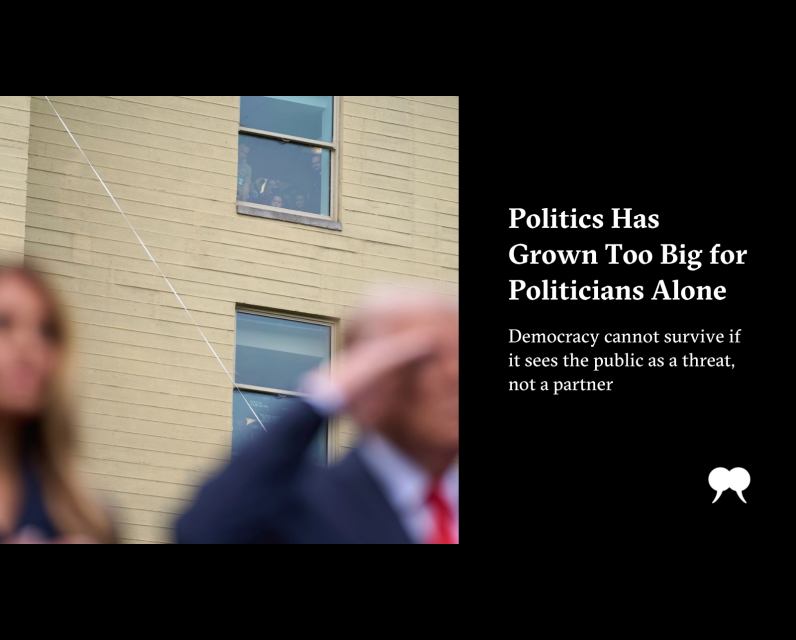
Politics Has Grown Too Big for Politicians Alone
On January 6, 2021, the day of the Capitol insurrection, many people were transfixed by what they saw in Washington. It was only a heroic effort by the police that kept the insurrectionists out of the House of Representatives, where elected members and staff took refuge behind chairs and under desks. In one sense, the riot, with its outlandish characters wearing costumes and face paint, felt like an absurd exclamation mark that punctuated the end of an erratic presidency.
The election of Joe Biden meant the restoration of a normal and more predictable America. The fever had passed, and once the protesters were dispersed, the long arm of American justice set to work, ultimately indicting and convicting hundreds of agitators. In that moment, democracy as we know it didn’t feel especially fragile—it felt resilient. It had weathered the storm brought on by the first Donald Trump administration, and the American public had had the good sense to reject four more chaotic years. With Biden at the helm, America and the world could stop watching the White House quite as closely and turn back toward their own concerns.
The next few years passed quickly. Too quickly, in retrospect. Before long, rumours of a third run by Trump began to circulate. A new storm was gathering, and on November 5, 2024, he beat the odds and won a second term. Early in the campaign, the once and future president declared, “I am your vengeance,” and since his re-election, his vengeance has been swift.
Tens of thousands of federal workers have been fired, and entire centres, agencies, and departments have been eliminated. Universities and law firms have been muzzled, and many of America’s world-leading scientific and research capabilities have been destroyed. Migrants, and even those with legal residence permits, are being deported to foreign prisons. The United States has started a trade war with its closest allies, and, incredibly, has threatened to annex the Panama Canal, Greenland, and Canada. Pax Americana—the centrepiece and guarantee of the liberal postwar world order—is crumbling. Today, democracy does not feel resilient; it feels fragile, and the future of a democratic American Republic is by no means guaranteed.
It is easy to describe this moment as the collapse of democratic norms or the result of extreme polarization. But underneath these trends lies a deeper tension—between two dominant and insufficient visions of democracy. On one side stands technocratic governance: policy making by insulated bureaucracies and arm’s-length institutions, which prize stability, expertise, and control. On the other stands populist majoritarianism: the volatile, winner-takes-all politics that claims to speak for “the people” while concentrating power in the hands of those who win. These forces are locked in a mutually reinforcing cycle: technocratic detachment breeds backlash, and populist backlash fuels elite retrenchment. Neither trusts the public. One sees citizens as problems to manage; the other as instruments of its authority.
Both are symptoms of a deeper problem—the steady consolidation of power around market ideas, austerity policies, and top-down management. Over the past few decades, a wave of neoliberal reforms has hollowed out much of the democratic state. Participation hasn’t disappeared—it’s been pushed to the margins. And in many cases, the institutions that remain seem designed less to include people than to keep them out. These systems didn’t evolve by accident. They serve powerful interests—political, corporate, and bureaucratic—that benefit from keeping control concentrated and the public at a distance.
That’s the real terrain democratic renewal has to confront: not just polarization or distrust but institutions and incentives that have been built to resist change. Democracy must be renewed by making it participatory, deliberative, and civic—one that sees the public not as a threat or a slogan but as a resource to develop and a partner in the production of public value.
One of the central assumptions of twentieth-century democracy building was that democratic institutions propagate democracy. Whether in post-colonial Africa, post-Soviet Eastern Europe, or post-conflict Iraq and Afghanistan, the prevailing model held that if you replicated the institutional forms of democracy—parliaments, courts, constitutions, electoral commissions, civil society organizations—democratic behaviour would follow. Build the scaffolding, and the spirit would fill it.
But history—and experience—suggest otherwise. Democratic institutions, without an active and capable public, tend to become hollow. Elections can entrench autocracy. Courts can be captured. Political parties can end up serving special interests instead of the public. In country after country, the institutions of democracy were established, while the substance—accountability, deliberation, civic trust—remained elusive. Institutions alone do not produce democracy. People do. And this is as true in established democracies as in fledgling ones.
Today, the basic architecture of electoral democracy remains intact in many countries, but its foundations are buckling. Too often, the promise of fair representation has been hollowed out by archaic electoral systems, unchecked campaign financing, and the cynical manipulation of public information. In Canada, the United Kingdom, and Australia, first-past-the-post elections regularly produce governments with lopsided majorities based on a fraction of the vote. In the United States, a toxic mix of partisan gerrymandering, voter suppression, and electoral college distortions undermines the basic principle of representation by population.
Money has further warped the democratic landscape. The American campaign finance system is awash in cash—$15.9 billion (US) in the 2024 federal cycle alone—with influence concentrated in a tiny donor class. The 2010 Citizens United decision entrenched the idea that money is speech and rendered many of the most obvious reforms unconstitutional. While workarounds exist—such as public matching funds, democracy vouchers, and real-time disclosure laws—none have gained enough traction to shift the balance. Other democracies have made different choices. In Germany and the United Kingdom, elections cost a fraction of what they do in the United States, proving that money’s dominance is not inevitable—it’s a policy failure.
Over the past few decades, warning lights have flashed across liberal democracies, with steep declines in both social mobility and social capital. The institutions that once anchored public life—labour unions, places of worship, local newsrooms, community associations, national membership organizations—have steadily eroded. In their place, too many now report chronic loneliness, a lack of purpose or belonging—exactly the conditions that make a population ripe for demagoguery.
The fear now is that what political scientist Yascha Mounk has described as “democratic deconsolidation” may be accelerating. The United States—until recently a global guarantor of basic democratic norms—is trending toward autocracy while exporting its “MAGA” (Make America Great Again) political program to the world. This program entails the capture and co-optation of democratic institutions—funded first by the world’s wealthiest man and, now, by the US Treasury.
Democracy’s first act—the centuries-long struggle to establish representative legislatures, a free press, an independent judiciary, and the universal franchise—is a historic achievement. It extended power beyond monarchs and elites, formalized the principle of consent, and built the foundational institutions of liberal democracy. But it was never meant to be the end of the story. As Bob Dylan, the great poet of American ideals and the contradictions of its democracy, sang, “he not busy being born is busy dying.” Too many Western democracies, particularly since the 1980s, have stopped being born. Their ambition has stalled. Their role is not just to manage conflict or formalize rules but to cultivate the habits, capabilities, and shared commitments that sustain public life. They’ve focused on preservation and efficiency while losing sight of democracy’s generative purpose: to extend power more widely and deepen public life.
The basic infrastructure of public information is in disrepair with the slow collapse of the fourth estate. In North America, local news has hollowed out; in much of Europe, even strong public broadcasters can’t offset commercial decline. Entire communities now go unreported. In the vacuum, conspiracy spreads, and accountability weakens. If democracy depends on an informed public, journalism must be treated as essential infrastructure—with support to ensure that a free, independent press can operate from the local to the global.
In the absence of institutions that actively foster democratic engagement, a void has been filled by social media platforms, whose pernicious algorithms exploit, divide, and addict. Misinformation spreads faster than facts. Polarization is algorithmically amped. And while financial systems are tightly regulated for solvency and transparency, the digital systems through which we now experience public life remain dangerously underregulated. The European Union has begun to address this gap through the Digital Services Act and Digital Markets Act, but in most jurisdictions, the information system remains a soft target: vulnerable to manipulation as well as foreign interference and actively propelling the erosion of civic trust.
All of this leaves democracy’s first act feeling fragile—its institutions are formally present but substantively weakened. Too much of what passes for democratic governance today feels like maintenance: procedural, cautious, and oriented toward managing inherited systems rather than renewing them. The rising generation has fewer opportunities to affirm, adapt, or reimagine these institutions—to claim them as their own.
As constitutional reform slows to a crawl and institutions grow increasingly brittle, democracy begins to feel less like a vibrant, responsive project and more like a museum piece. That’s why philosopher Roberto Unger calls for a democracy that revises and reinvents itself, adapting to the challenges and aspirations of each new generation. Without that renewal, democracy risks becoming a memory of itself. With it, the second act becomes possible.
If democracy’s first act was about establishing universal rights and empowering every adult to vote and participate in representative institutions, then its second act is about enabling many more people—at different times and in turn—to take on the happy burden of representation: to deliberate, exercise public judgment, and help solve shared challenges. This is what Unger calls high-energy politics—a politics of war without war—driven by new forms of organization and popular mobilization capable of drawing on and developing the latent capabilities of democratic publics.
A healthy democracy doesn’t just build systems—it builds citizens. That’s why, rather than assuming that democratic institutions propagate democracy, we propose that the primary responsibility of democratic institutions is to propagate democratic publics. Democratic publics are an abundant source of insight, skill, generosity, and judgment.
This idea that ordinary people are far more capable and collaborative than our institutions presume is at the heart of Rebecca Solnit’s A Paradise Built in Hell. Drawing on disasters from around the world, Solnit shows that when systems collapse and official responses falter, it’s often the public—not the state—that steps up. People self-organize, care for one another, and create provisional communities of mutual aid. Helping others and being asked to help builds our democratic fitness and pays a democratic dividend. People are motivated not just by material incentives but by meaning, belonging, and the chance to contribute.
Our democracies should be designed to deliver that—not occasionally, not for the few, but routinely and for the many. That’s the challenge of democracy’s second act: to move beyond symbolic participation and create real opportunities for shared responsibility and collective agency. And it should be the work of the next generation of politicians too.
Being a politician today is nearly an impossible job. The pressures are relentless, the expectations contradictory, and the constraints unyielding. Legislators are expected to vote knowledgeably on increasingly complex omnibus bills they barely have time to read, let alone debate. They’re asked to represent local concerns in national forums, respond to constant media scrutiny, and remain loyal to party leadership—all while maintaining some connection to the lives of their constituents.
Modern parties, however, remain enthralled by their leaders—a last bastion of top-down, command-and-control thinking. This heroic sensibility is not just at odds with democratic ideals; it’s also a reflexive response to the speed and complexity of contemporary governance. The result is a concentration of power that may feel expedient but ultimately corrodes the foundations of democratic life. Still, parties are not just electoral machines. Or they shouldn’t be. As democratic institutions, they have responsibilities that should exceed their desire to win. Their deeper mission—whether on the left or the right—ought to be the creation of solidarity with the communities they represent. That means seeing themselves not only as vehicles for policy and power but as sites of human and social development.
And then there’s status. Despite the stress, the scrutiny, and the grinding pace of institutional change, people still want to become politicians. It is rarely because of the salary. Most genuinely hope to make a difference. But many are also drawn by something harder to name: the sense that they might matter, that their voice could carry weight, and that they are seen, heard, and taken seriously within a larger collective story. This is the dignifying force of representation—and in our democracies, it remains strikingly unequal in its distribution.
How could anyone experience this feeling—of mattering, of being heard and counted—and not believe that others would want it too? And, more than that, not feel a democratic responsibility to extend that experience as widely as possible? Status isn’t zero-sum. It is produced and reproduced through institutions. Why wouldn’t we want to build more spaces and institutions that confer this same sense of visibility, voice, and worth—not for a few but for the many?
If the lives of modern politicians confirm anything, it’s that politics has grown too big for politicians alone. The demands are too great, the pace too fast, the complexity too layered. The answer is not to narrow the circle of decision makers but to widen it. To invite vastly more people into the work of governance—and to equip our institutions to make that inclusion real.
That means moving beyond the blunt tools of public opinion and politics—surveys, town halls, door knocking, donations—and building a new civic infrastructure. One that is capable of tapping the public’s intelligence, judgment, and care. Because the problem is not the public’s lack of capability. It’s the poverty of our mechanisms for harnessing it. Amid an epidemic of loneliness, eroding social trust, and widespread unmet needs, the failure to build and mobilize this civic capacity is not just a missed opportunity—it’s a quiet disaster. It reflects not only institutional inertia but a willful commitment to the status quo: a refusal to imagine that things could be otherwise.
Democracy’s second act isn’t about sidelining politicians—but it does ask them to play a different role. Our leaders have to do the work of enlarging the cast of democratic life and building systems where representation is not reserved but shared—where the dignity of mattering, of being heard and counted, becomes something society can offer to vastly more people. Because if we fail to do this—if we continue to treat representation as the privilege of a few rather than a shared democratic experience—the vacuum will be filled by something else. Populism, resentment, authoritarian nostalgia: these are not fringe forces. They flourish wherever people feel ignored, humiliated, or locked out. The answer is not more insulation or control. It’s to build a democratic culture capacious enough to include everyone.
It will take a new generation of leaders to do this—leaders seized not just by the tools of reform but by its ethos. Leaders willing to challenge their own parties. Willing to listen more than they persuade. Willing to build platforms that develop the public, not just deliver to it.
Our political leaders won’t write the next act alone. But they will have to choose—either to share the stage or risk losing the audience.
Adapted and excerpted, with permission, from Democracy’s Second Act: Why Politics Needs the Public by Peter MacLeod and Richard Johnson, published by the University of Toronto Press, 2026.
The post Politics Has Grown Too Big for Politicians Alone first appeared on The Walrus.
Unpublished Newswire

Comments
Be the first to comment