
Stay informed


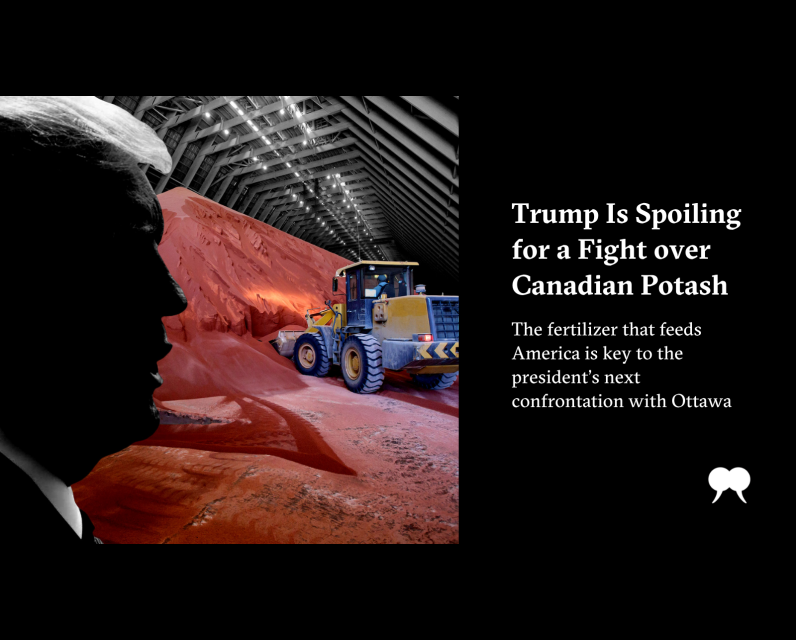
Trump Is Spoiling for a Fight over Canadian Potash
In December 2025, United States president Donald Trump struck a deal that—uncharacteristically for such a spectacle-driven politician—barely registered among the general public.
The agreement committed the Belarusian government to releasing 123 political prisoners, a significant concession from one of Europe’s most entrenched authoritarian regimes. In return, Washington agreed to lift sanctions on Belarus’s potash exports—sanctions it escalated after the country’s rigged 2020 election and later expanded, in 2022, when Belarus allowed Russia to use its territory to invade Ukraine.
Why potash? Blame Canada. The United States can live without many imports. It can’t farm at scale without our potash. In 2024, the US imported about 12 million tonnes of the fertilizer from Canada, all of it dug from Saskatchewan, where it enters the US tariff-free under the Canada–United States–Mexico Agreement (CUSMA). Cut that supply, and American agriculture could grind to a halt.
As CUSMA heads into renegotiation this summer, the mood in Washington appears confrontational. Reopening Belarusian exports would give the US access to one of the few alternative global reserves—and, with it, leverage in an area it currently has little.
I called up Matt Simpson, chief executive officer of Brazil Potash, a Brazilian company attempting to mine and produce potash fertilizer in the Amazon basin in a bid to supply more of that country’s demand. He explained why Canada has long been the backbone of the US potash supply, how reliance on Belarus introduces serious geopolitical and pricing vulnerabilities, and what this means for global food security if trade tensions escalate.
Potash is an interesting commodity. It rarely gets talked about in public but seems just as geopolitically important as oil or microchips.
I’d argue it’s even more important. Along with nitrogen and phosphorus, potash is one of three main nutrients needed to grow food. It’s one thing not having access to cutting-edge AI technology. It’s another to not be able to eat.
There’s no substitute for potash?
There isn’t. And a lot of people don’t understand what it does. One, it strengthens the stem of plants to make them resilient to stress. Think about how erratic the weather’s been lately. Twenty-degree temperature swings in a single week, flooding in places that have never seen it, drought elsewhere, and new waves of pests. Potash helps plants survive that volatility. Second, it improves taste and texture. What makes a tomato ripe and firm? Potassium. Same with bananas. Without it, they’re mushy. And no potash, no modern farming. Soil becomes too exhausted to sustain the yields agriculture now requires. The scale we take for granted would be impossible.
But usefulness is only half the story, right? The other half, as I understand it, is the supply, and how narrowly it is controlled.
Correct. Three countries source 80 percent of the world’s supply. Russia, Belarus, and Canada.
A small club.
It’s a highly concentrated market. And when conditions behave, the system works, because you’re able to buy potash from the countries that can produce it at the lowest cost. It’s a different game when the unexpected hits. The pandemic messed up shipping and logistics. Then, after Russian president Vladimir Putin invaded Ukraine, sanctions followed against Russia and Belarus, and a huge chunk of global supply was suddenly off-limits. Whenever potash is hard to get, farmers pay more, grow less, and everyone else feels it at the grocery store.
Most people don’t think about where their food comes from or the key inputs to efficiently growing it. But those events proved how vulnerable our system is when something as essential as potash gets trapped in geopolitical choke points.
How does Canada fit into that narrative?
Potash is not like other commodities—gold, for example, where you have tens of thousands of deposits around the world that vary in size. With potash, you have few deposits that tend to be absolutely massive. And the biggest deposit in the world is located in Saskatchewan.
Trump always says that he doesn’t need anything from Canada. I guess potash puts the lie to that.
Not to mention the electricity that we send to the northern US, as well as all the oil and gas. But, yes, the other thing Canada supplies them with is potash—a lot of it. Somewhere between 80 to 90 percent of what they consume. And you can track Trump’s realization of its importance almost from the moment he first put his tariffs in place back in March or April of last year. The reaction from the American farm lobby was swift and aggressive. They knew it was going to have an impact on their industry. And you might recall, right after he put a 25 percent tariff on Canada, he cut it to 10 percent on potash. And soon after, he said, no, it actually falls under CUSMA, and dropped it to zero. It shows how sensitive this topic is—farmers are a core political constituency for Trump.
It also shows the difficulty of imposing tariffs on a commodity that has no substitutes.
Yes, and this is where the lifting of the Belarus sanctions comes in. Because, should Trump decide to tear the CUSMA trade pact up and put tariffs on Canadian potash, he needs a fallback supply, and the only two countries that can displace the massive tonnage produced in Canada are Russia and Belarus.
But Belarus is so far away.
It is. If you want to displace Canadian potash, the transportation cost from Belarus is going to be exceptionally higher. Canada and the US share a border, and the potash from Canada to the US largely travels by train. But if you’re now importing it from 20,000 kilometres away, you not only have to incur ocean transportation costs, but you’re also going to hit the ports on the edge of the US. And then you’re going to have to train or truck that product much longer distances across the country. That’s going to mean much higher costs—and not only for Americans. Canadian producers are going to lose their lowest cost transportation because they’re now going to have to transport potash further distances to other countries to sell it. Globally, that means the price is likely to jump. And should that happen, there’s not a lot of elasticity for farmers to absorb that higher cost, so they’re going to pass it on to consumers at the grocery store.
Where is this heading, you think?
It’s hard to predict what’s going to happen between Canada and the US. I’m foreshadowing a rocky road ahead, at least from what I’m seeing in the recent weeks between Prime Minister Mark Carney and Trump’s reaction to his speech at Davos. That said, I think Trump will discover that it’s not possible for the US to completely remove itself from Canadian potash. They won’t be able to get enough from Russia or Belarus, who primarily supply Brazil, India, China, and Europe. They will inevitably have to buy Canadian potash or face having substantially less food grown in their country.
You don’t think Trump has a high tolerance for political pain when it comes to farmers?
You tell me. Last year, because of the US and China trade war, China stopped buying American soybeans for months, and the result was a roughly $12 billion bailout to keep farmers from going under. That gives you a sense of how much shock the system can absorb before the government has to step in. A potash disruption would be even bigger, wiping out tens of billions of dollars in farm revenue in a single season—more if it drags on.
There’s no other way for a country to reconstitute its potash needs from other places?
You can try to diversify your supply base, but you’re still basically stuck with three suppliers. There’s a bit that comes out of Germany, a bit out of Israel, and bit out of Laos, but it’s not meaningful enough, together, to displace those bigger purveyors. That’s why developing a potash industry in Brazil becomes quite relevant to the conversation, because it would provide a fourth major supply.
Is potash one more area where the world is starting to quietly hedge against America? Is this about realizing that some capabilities are simply too fundamental to outsource—that they need to be brought closer to home? And how should we understand Brazil Potash? An effort to gain more control over food security and reduce dependence on volatile trade routes?
I think that’s a fair way to put it. I call it selective globalization. Globalization is a concept that says goods and services should be purchased in the country that can do it at the lowest cost. That works well when everyone plays nice and trades fairly.
The problem is when someone like Trump comes in and disrupts the system. It suddenly turns into every man for himself, and that’s a bit dangerous, because if countries put walls up, it makes the world a very inefficient economy. To be clear, I don’t think it makes sense that every country should be trying to produce everything that’s required in house. But I do think there are certain critical things, particularly those essential for your survival, that if you can produce them domestically, you should.
And for Brazil, that’s potash.
Look, Brazil is the world’s biggest potash importer, bringing in about 95 percent of what it needs. But it’s also one of the world’s largest agricultural exporters, exporting about $165 billion (US) a year of food. As the world continues to grow, you have a middle class that also wants more protein in their diet. Where’s that food going to come from? Brazil is a huge part of that answer, because it has the land, it has the know-how, it has the water and climate. What it doesn’t have is the fertilizer. But it could be producing a great deal of that fertilizer domestically. It has access to a potash basin potentially two thirds the size of Canada’s.
This is more than just a business opportunity for you. You seem very concerned about how Trump’s moves will affect the rest of the world.
Developing domestic potash production isn’t just about Brazil controlling its fate. A fourth major supply of this critical mineral would help insulate the global food supply from geopolitical whiplash. Remember, it’s not just the US we need to be worried about. I never expected Putin to invade Ukraine, yet he did. And here we still are, four years later. When you have just under half of the world’s potash largely between Russia and Belarus, that’s a big risk. But it’s a mitigatable risk, so we should mitigate it.
Okay, the last question. Trade talks are going to be starting soon between the US and Canada and Mexico. From your perspective, do you feel that simply hinting at the US’s potash vulnerability would be enough to change the tenor of the negotiations? Has Canada underplayed its leverage by treating potash like just another commodity?
That’s a really tough one to answer. Potash is a commodity that most people have never heard of. It’s not like gold—it’s not something everyone’s talking about. But it’s something that people should be a lot more aware of, because it’s going to have a potentially really big impact on our lives later this year, depending on what happens with CUSMA. I could very much see potash coming to the forefront in those discussions.
The post Trump Is Spoiling for a Fight over Canadian Potash first appeared on The Walrus.
Unpublished Newswire

Comments
Be the first to comment