
Stay informed


Industrial carbon tax emerges as sticking point in Ottawa's energy deal with Alberta
OTTAWA — How quickly Alberta agrees to reach a higher tax for its industrial carbon emitters and what rules underpin the system emerged Thursday as one of the outstanding issues in a deal Prime Minister Mark Carney’s government is negotiating with the country’s largest oil-producing province.
Senior officials from both levels of government have been trying to hammer out an agreement, which a memorandum of understanding Carney and Alberta Premier Danielle Smith inked last November stipulated would be done by April 1.
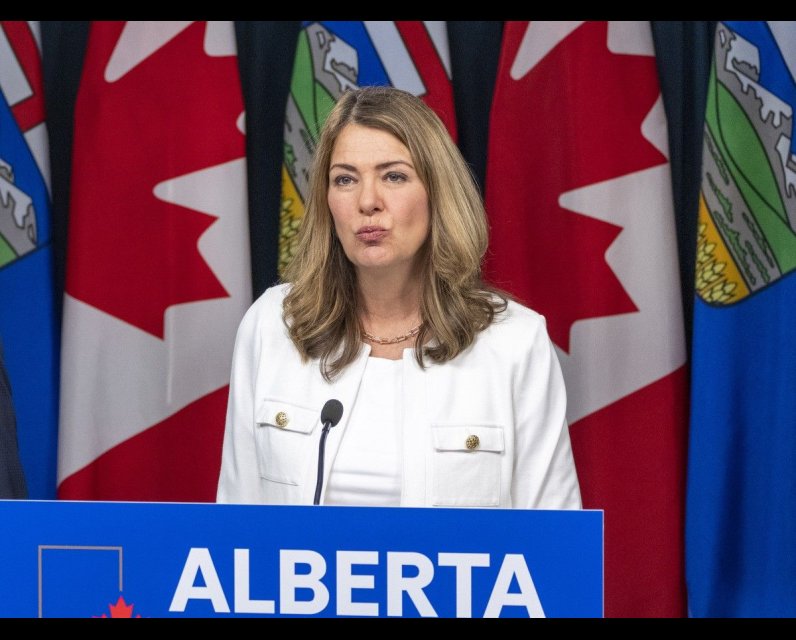
With that deadline come and gone, Smith reported progress was being made on the criteria outlined in that agreement that commits Alberta to raising the rate from $95 per tonne to reach $130 per tonne, but that more work needed to be done.
“It’s just a matter of how quickly we get there, and what the stringency will be and the benchmarking on the industry,” she said on Thursday.
“Those are kind of the things that we still just have a little bit more work to do, but we have made some some progress.”
What that final agreement amounts to is being closely watched by leaders in the oil and gas sector who argue the policy undermines Canada’s competitiveness at a time it is looking to boost its export capacity, and climate policy groups that say Canada cannot afford to be a laggard on reducing emissions, with the industrial carbon tax underpinning that strategy.
Liberal MPs are also watching, including one of the most vocal environmentalists in Carney’s caucus.
Steven Guilbeault, a former environment minister under Carney’s predecessor, Justin Trudeau, who resigned from cabinet the day the prime minister signed his agreement with Alberta, penned an opinion piece in the Toronto Star to say the country was at a “crossroads.”
“In the coming days and weeks, the federal government will decide whether the country compromises its climate commitments or embraces a more sustainable path towards a greener future,” the Quebec MP wrote.
He warned of “worrying signs” he was seeing in the deal with Alberta, beginning with the commitments outlined on the industrial carbon tax.
While the document makes no mention of when Alberta must reach its agreed to rate of $130 per tonne, Guilbeault emphasized that it must be by 2030. Under the current federal standard ushered in under Trudeau, provincial systems must progressively hike the tax to reach $170 per tonne by 2030.
“Industrial carbon pricing must be reinforced, not weakened,” Guilbeault wrote. “Carbon pricing is a pillar of Canada’s climate change strategy.”
Asked about timelines on Thursday, Carney did not commit to one, but said it was part of the discussions.
The goal, the prime minister said, was “to have an effective, functioning carbon market with respect to the competitiveness of our oil and gas sector.”
He said the country’s production of oil stood at a “record high.”
“There’s a series of measures that can further expand that,” Carney said, before adding that one of the biggest factors when it came to determining how profitable and competitive Canada’s oil and gas sector was the country’s ability to pivot away from the United States.
The U.S. stands as the Canada’s big source for crude oil exports. Carney’s pitch to diversify away from the U.S. has formed a large part of Smith’s push for his government to approve the construction of a new million-barrel-per-day pipeline from Alberta’s oilsands to British Columbia’s northern coast to increase access Asian markets.
Paving the way for such a project to go ahead is at the heart of what Alberta hopes to achieve through its deal with the federal government. Smith’s United Conservative Party government has committed to submit a proposal for approvals through a major project’s office Carney established last year to help streamline the process.
Critics such as B.C. Premier David Eby have panned Alberta’s pipeline push for its lack of any private sector proponent willing to say they would build it. First Nations along B.C.’s northern coast also say they oppose the construction of any such project and the possible lifting of an oil tanker moratorium, which the federal government in its deal with Alberta said it could agree to.
Michael Bernstein, the CEO and president of a climate policy group that promotes carbon taxes, said seeing Alberta reach a higher industrial carbon tax would be preferable sooner, the date was less important that the system itself.
“You can reach $130 (per tonne) with very weak rules, or you can reach them with strong rules.”
“How do you get a strong market, and how do you get one where investors are going to believe that the politicians will stick with the deal over the long term,” Bernstein said.
He says that involves looking at ways to boost the value of the credits themselves., Alberta’s industrial carbon tax broadly operates by requiring companies to meet emissions benchmarks, which can be done through reducing their emissions outright or purchasing credits.
Bernstein points out that those credits currently trade at a rate much lower than the “headline price” of $95 per tonne.
“In order for the carbon price to be incentivizing large decarbonization projects, you need the credits that people earn in these markets to be trading close to the headline price,” he said.
His group has advocated for reforms in the form of what are called “contracts for difference,” as a mechanism that could help create more certainty for companies earning credits.
Smith on Thursday referenced how although not mentioned in the document signed with the prime minister, the issue of such contracts have come up. “The prime minister clearly felt that that’s one way to get to effective pricing.”
She expressed caution about such a measure, saying it could leave the provincial government on the hook for paying companies to make up for price differences.
“Those are the kind of things that we’re talking about now.”
Corey Hogan, a Liberal MP from Calgary, said many options exist when it comes to designing the system.
Asked specifically about timelines, he said, “look, I’m a pragmatic guy.”
“We want to make sure that we’re reducing emissions in a way that is the most cost effective possible, but it’s very important for our planet and for access to future markets that we deal with carbon.”
Ontario Liberal MP Ryan Turnbull said the getting the deal with Alberta right was a “real tough balancing act,” considering how the goals of diversifying Canada’s economy comes down to “ensuring competitiveness.”
“The industrial carbon price is such a central component to a serious climate plan that we’ve got to protect it.”
National Post
Our website is the place for the latest breaking news, exclusive scoops, longreads and provocative commentary. Please bookmark nationalpost.com and sign up for our politics newsletter, First Reading, here.

Unpublished Newswire

Comments
Be the first to comment