
Stay informed



Can Carney reduce Canada's U.S. trade dependence? 50 years of history says 'no'
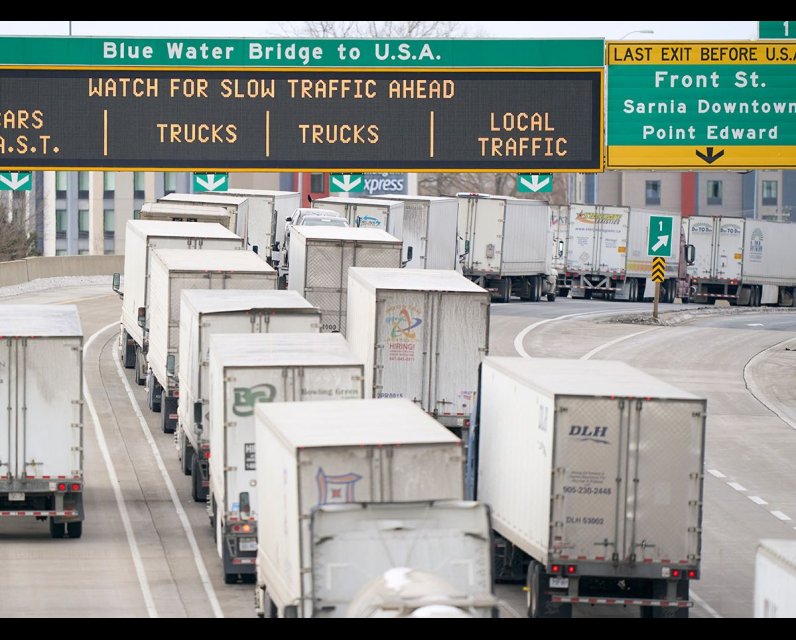
Federal governments have for decades failed to reduce Canada’s dependence on U.S. trade, according to a new report, suggesting that Prime Minister Mark Carney faces an overwhelmingly steep climb in his effort to pivot the country away from its southern neighbour.
In a new report, the Fraser Institute studied the last 50 years of Canada’s trade diversification efforts, which included the signing of 16 free trade agreements with non-U.S. countries between 1988 and 2020. For all that work, however, Canada hardly increased its exports to non-U.S. trade partners, particularly in the last 25 years. Meanwhile, China — seemingly the sole benefactor from Canada’s diversification push — has gobbled up virtually all of what was diverted away from the U.S. in recent decades, the report found.
Today, nearly 80 per cent of Canada’s merchandise exports currently go to the U.S., and Carney has made it his key campaign promise to redirect a big chunk of those sales to Europe, Asia and other regions in the face of U.S. President Donald Trump’s trade threats.
In a sharp pivot away from his predecessor in January 2026, Carney announced a trade deal with China, under which Canada agreed to cut restrictions on some Chinese EV imports in exchange for reduced tariffs on Canadian exports of canola seed and other products. The Carney government has also sought to revive trade talks with India, and Carney has expressed interest in expanding trade relations with Europe, particularly in energy, tech and defence. Included in Carney’s diversification efforts was a promise to fast-track the development of a new port in Churchill, Man., to permit exports of natural resources and other goods to Europe.
Still, those efforts could collide with the 25 years of history that suggest diversifying away from the U.S. is easier said than done.
Between 1990 and 2011, an average of 17.5 per cent of Canada’s exports landed in non-U.S. countries, according to Fraser Institute data. By the 2012-2024 period, Canadian governments and companies boosted that figure by a modest seven per cent, to an average 24.2 per cent of exports.
“Canada’s merchandise and services exports and imports have become slightly more diversified away from the United States,” the report’s authors, Jock Finlayson and Steven Globerman, wrote. “However, the extent of such incremental diversification has been limited.”
The reasons for the inability to diversify are many, but primarily revolve around the U.S. being Canada’s only neighbour, and the lack of alternative markets that equal the U.S. in terms of scale and, before Trump, shared values on free trade.
“The main insight from this study is that there are and will continue to be substantial frictions that limit the geographical trade diversification sought by some Canadian political leaders and policy makers,” the authors said.
Essentially all of that non-U.S. export growth was redirected to China, which accounted for 10.4 per cent of Canada’s exports in the 2012-2024 range, up from 4.2 per cent in 1999-2011. Exports to Japan, meanwhile, fell from 8.2 per cent to 5.4 per cent, and U.K. exports rose from 5.3 per cent to 7.8 per cent. Merchandise exports to India grew moderately from 0.7 per cent to 1.7 per cent.
The Fraser report studied four distinct periods in Canada’s trade history dating back to 1984, beginning when the Mulroney government began deepening trade ties with the U.S. through the Canada-U.S. Free Trade Agreement (CUSFTA). That agreement opened the floodgates for a new era of two-way trade between the two nations, raising Canada’s exports to the U.S. from $108 billion in 1988 to $206 billion in 1995.
Canada’s dependence on U.S. trade continued to deepen under Jean Chrétien, from 1993 to 2003. When Stephen Harper took office in 2006, Canada began in earnest to diversify trade away from the U.S., with his Conservative government entering into trade negotiations with the European Union and trans-Pacific nations; Canada signed a bilateral deal with South Korea in 2014.
Under Trudeau, Canada sought to boost non-North American trade by 50 per cent in 10 years. His government fell dramatically short of that target, but did finalize deals including the Comprehensive Economic and Trade Agreement (CETA) with the EU in 2016, and the Comprehensive and Progressive Agreement for Trans-Pacific Partnership (CPTPP) with Asian Pacific nations in 2018.
Carney has repeatedly framed Canada’s trade relationship as fundamentally altered after Trump levelled steep tariffs on several goods including autos, aluminum and steel. In March 2025, shortly after taking office, he said Canada’s former relations with the U.S., “based on deepening integration of our economies and tight security and military cooperation, is over,” and claimed that the shift was “permanent.”
However, security experts have repeatedly warned Carney against cozying up with China in his bid to reduce U.S. trade dependence, saying the move could undo years of work that sought to combat China’s anti-free market trade practices and dominance over strategic assets like critical minerals.
Our website is the place for the latest breaking news, exclusive scoops, longreads and provocative commentary. Please bookmark nationalpost.com and sign up for our politics newsletter, First Reading, here.

Unpublished Newswire

Comments
Be the first to comment