
Stay informed



As Universities Become Political Battlegrounds, They Cannot Afford to Remain Neutral
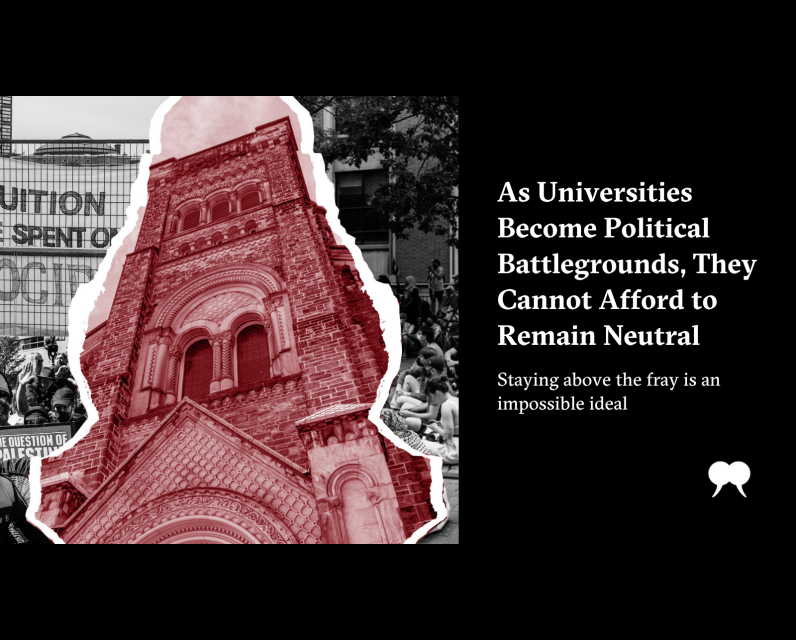
In the weeks after Hamas’s October 7 attack on Israel, universities worldwide came under close scrutiny. Several issued statements in condemnation and expressing sympathy for the victims of violence in Israel and (less frequently) Gaza. Many of them were soon accused of failing to take a strong enough stand, either in support of Israel or denouncing it.
In the December 2023 United States congressional hearing on antisemitism in colleges, then president of Harvard Claudine Gay was taken to task for the university’s refusal to fly the Israeli flag on campus following October 7 even though it had flown Ukraine’s flag after the invasion by Russia. At the University of Amsterdam, over 1,200 PhD candidates signed an open letter strongly condemning the university’s response to the crisis for having euphemistically characterized genocide as a “situation” and for its silence about the “75 year occupation of Gaza.” At my then institution, the University of Regina, a motion to recommend to the president that the university publicly call for a ceasefire in Gaza was vigorously debated before ultimately being tabled and, weeks later, withdrawn. These are just three of many examples, but they illustrate the range of ways in which university administrations were called on to respond to Gaza.
At the same time, universities were reacting to statements by student organizations, academic departments, and other groups. At York University, the administration condemned three student unions and threatened to remove their official recognition following the groups’ joint statement of solidarity with Palestine, which characterized the October 7 Hamas attack as a “strong act of resistance” and throughout referred to “so-called Israel.” At the University of British Columbia, the department of anthropology was asked to take down a statement on its website that expressed concern with “genocidal violence in Gaza,” and other departments were directed not to post any statements that could be interpreted as political.
Meanwhile, worldwide, universities continue to undergo political and media scrutiny due to allegations that pro-Palestinian protests and activities on campus make some Jewish students and employees feel unsafe. As the pressure mounted for universities to take a stand or to take a different stand than they were taking, many scholars and administrators argued that the right approach was to not take a stand at all but to maintain institutional neutrality.
Indeed, I argued for just that. In January 2024, in response to a request from a faculty member, I circulated an opinion to members of my then faculty that included the following passage:
Universities should be very cautious about adopting a particular disposition on behalf of the institution. Universities are constitutively pluralistic institutions. By design, they bring together scholars and learners with a range of positionalities and perspectives across a range of disciplines and methods. When universities rather than the individuals who constitute them adopt a particular disposition on a matter, particularly on a matter of controversy, they risk creating inhospitable working and learning environments for some of their members and chilling those members’ academic and expressive freedom.
I still think that this account is more or less right, but even as I circulated the opinion, I knew that it was oversimplified. To understand better, we need to look deeper into related issues—namely, academic freedom, freedom of expression, institutional neutrality, institutional restraint, and universities’ duty of care.
“To seek truth and advance understanding in the service of society.” For years now, in the context of my scholarship on academic freedom, I have used this phrase to characterize the academic mission of the university. But the tidiness of my usual formulation does not do justice to the complexity of the modern university.
I initially started researching academic freedom because I was deeply concerned about the ways in which the media, the public, and indeed university personnel (who should know better) were conflating academic freedom with freedom of expression—or even wilfully supplanting academic freedom with freedom of expression—in the culture wars that were rekindled by the 2016 election of Donald Trump. A particular catalyst for me was the discourse surrounding then Wilfrid Laurier University graduate student and teaching assistant (TA) Lindsay Shepherd, who had become a free speech cause célèbre for the flak she received for showing a Jordan Peterson interview in a tutorial without the professor’s permission.
Most of the discussion of the case focused on expressive freedom, with very few commentators remarking upon the academic freedom of the course’s instructor, Nathan Rambukkana, to design and oversee teaching and learning in the course. At the time, even the Canadian Association of University Teachers—plausibly, the primary guardians of academic freedom in Canada—defended Shepherd and remained silent about Rambukkana’s academic freedom.
I took the case on in various popular venues, sometimes obliquely and sometimes more directly. The main point that I sought to drive home was that the freedom proper to universities is academic freedom, not freedom of expression, and that when we privilege the latter over the former, we do so at our peril.
Here is the main argument to that effect: the purpose of universities is to seek truth and advance understanding in the service of society. To serve that purpose, university personnel need to be able to engage in risky or controversial scholarship. To ensure that they are able to do so, universities, in various ways, defend academic freedom. Academic freedom is not an innate and inalienable human right. Rather, it was devised to serve a purpose. It is conferred on the highly qualified personnel who are charged with performing that purpose to support them in that work.
By contrast, freedom of expression is a freedom extended to all persons, irrespective of their roles or credentials, and carries with it no particular responsibilities. Freedom of expression permits people to yell lies in the town square, provided that those lies do not violate the law (as, for instance, threats or defamatory speech do).
In Canada, within the classroom, only academic freedom is protected. It is enshrined in every faculty association collective agreement across the country. Canadian courts have not found Charter of Rights and Freedoms protections for freedom of expression to apply within university classrooms. Students—whether enrolled in a course or TAing it—do not have protected expressive freedom within the course. In short, professors have every right to direct how their courses are run.
That said, professors and universities should be cautious about too quickly drawing on academic freedom to overrule other freedoms, including expressive freedom. It is very often wise pedagogy and mentorship to permit students (including TAs) considerable expressive freedom to support them in their intellectual, professional, and moral development.
When we focus on the academic mission of the university, we see that academic freedom is only one of the freedoms or principles that is essential to that mission. In my role as a senior university administrator, one such principle of which I am acutely aware is the duty of care that universities owe to their students, employees, and community members. I often describe this as the duty to ensure that universities are safe workplaces for their employees and safe homes for their residents.
It is crucial to note that the duty of care is not only a moral and legal duty. It is also essential to the academic mission. If universities do not provide safe workplaces and homes for their personnel, they will be less able to recruit and retain highly qualified personnel to participate in the academic mission. Insofar as universities owe a duty of care to their personnel, it is not enough for them to avoid interfering with those personnel; rather, they have a positive duty to ensure that universities and their members are safe.
Many contestations relating to academic and expressive freedom on campus precisely concern the challenge of balancing academic or expressive freedom with the duty of care. One of the reasons that Rambukkana and others objected to Shepherd screening a Peterson video in a tutorial is that they regarded the video as making the learning environment less safe for trans students. There are myriad such examples.
The disputes that get the most uptake in both social and conventional media tend to be conflicts between the academic or expressive freedom to engage in putatively hateful, exclusionary, or harmful scholarship or speech and the duty to ensure that universities are safe places for trans, BIPOC, and other equity-denied people to live and work. A decade ago, this debate often centred on safe spaces and trigger warnings. Now, as universities struggle to respond to Israel and Gaza, the debate increasingly centres on institutional neutrality.
My view is that institutional neutrality is an unattainable ideal. It is at best a useful fiction and at worst a way of concealing universities’ commitments and reinscribing the status quo.
Princeton University’s tradition of institutional restraint is a helpful model of how universities can strike a balance. Former Princeton president William Bowen, who coined the term “institutional restraint,” held that Princeton “is a value-laden institution, and it is for that reason that I avoid using the word ‘neutrality’ to describe its aims. . . . But the University’s core values emanate from its character as a university. In this setting, the unrelenting, open-minded search for truth is itself the highest value; it is not to be sacrificed to anything else.”
For over half a century, Princeton’s senior leaders have, in various ways, threaded the needle between exercising restraint and speaking up for the values of the university. For instance, in 1963, when students hosted a racist speaker on campus, then president Robert Goheen both defended the visitor’s right to speak and condemned the invitation as out of step with Princeton’s commitment to equality.
In 2023, following recommendations by a faculty committee, Princeton adopted new guidelines for official department communications. At issue was whether departments or other units could or should issue statements on socio-political matters.
Before a department or a departmental administrator may issue a public statement, the unit must first have a written set of procedures regulating the issuance of such statements. Any statements that are issued must contain the following disclaimer: “This statement has been issued by [unit name] following its policy for issuing statements [link to policy] and does not represent the position of Princeton University” (Office of the Dean of the Faculty, n.d.). While many universities discourage administrators from making public statements, Princeton is clear that they may make public statements on their own behalf so long as they include a disclaimer that their statement represents their view, not the university’s.
By obliging departments and other units to develop their own procedures regulating public statements, Princeton ensures that any statements issued in times of controversy are not hasty and reactive but are guided by forethought. Transparent departmental procedures for issuing public statements also help to ensure consistency and provide a ready reply when the media or the public ask, “Why this statement at this time? And how is this statement consistent with your last statement/silence?”
It is worth observing that the Princeton approach also uses the model of distributed risk to provide greater flexibility for individual units to develop and articulate their own public positions. As was particularly evident in the US congressional hearing on antisemitism on college campuses, any time a university office or official makes (or doesn’t make) a public statement, there is a risk that the university as a whole will receive criticism for it. Princeton’s approach more or less confines the risk associated with public statements to the units making them by making explicit where the decision making resides for such statements. This frees the Arab studies department, for instance, to make a public statement on Gaza without having to go through the university’s communications department with the inevitable watering down of the message that would result.
But Princeton’s guidelines still leave unanswered the question of under what circumstances an academic unit should make a public statement.
Due to the power universities wield—internally over their members and externally within society—they have a duty to use that power responsibly, both in their speech and in their silence. When universities take a stand on socio-political matters, they risk interfering with the personnel charged with pursuing the core academic mission. However, complete silence on socio-political matters can reinscribe injustices that are or ought to be misaligned with universities’ values and missions.
The Kalven Report may help to fill in that gap. The classic expression of institutional neutrality occurs in the 1967 “Kalven Committee: Report on the University’s Role in Political and Social Action” from the University of Chicago. There were also two exceptions to institutional neutrality carved out in the report: first, the university may oppose threats to “the very mission of the university and its values of free inquiry,” and second, the university may need to carefully assess the consequences of “university ownership of property, its receipt of funds, its awarding of honors, its membership in other organizations” when these activities are “incompatible with paramount social values.”
The two Kalven exceptions provide the foundation for a new model for university statements that I term the “proximity model.” Public statements by universities should be undertaken with considerable restraint since they risk interfering with the academic mission. Since they need to be sparing about public statements, they should reserve such statements for proximate matters—that is, matters in which they are morally or materially implicated. For instance, public statements about truth and reconciliation are appropriate for universities that are located on treaty territories or unceded Indigenous land because those universities are morally implicated in settler colonialism on that land.
On the proximity account, though, those specific missions bring with them moral entanglements and duties. For instance, a Jesuit institution has a stronger duty than a secular university to make a public statement about child sexual abuse by priests. Similarly, an agricultural college may be more strongly compelled than a liberal arts college to make a public statement on the human rights violations experienced by migrant farm workers. Geographical location, history, operations, and investments can similarly ground proximate moral duties.
Universities will often need to be called to their proximate duties by way of advocacy and protest by their members. We saw this happening in the case of the pro-Palestinian encampments that sprang up on university campuses in the spring of 2024. Most or all of the encampments were established at least in part to put pressure on universities to divest from organizations that directly or indirectly support Israel’s war on Gaza and its human rights abuses in Palestine. Whatever one might think of the encampments, they were focused on the activities in which the universities are implicated and for which they are therefore answerable.
Proximity is relative, and universities are large, complex organizations that are implicated in many activities. Must universities take stands against factory farming or in favour of veganism in virtue of their food services operations? At what point does the connection become so tenuous that a public statement is no longer appropriate? What is to be done in the case of sincere disagreement among members? Unsurprisingly, there are no simple answers.
In the face of the trickiest challenges, we will almost inevitably get this balance wrong, but a sincere effort to balance core values will save us from the worst errors, and if we’re lucky, it will help us do a little better next time around. In the end, taking responsibility is less about achieving perfection than about moral repair.
The messy picture I am painting of university personnel engaged in difficult, ongoing, overlapping conversations about their animating values through controversy, change, and injustice—often across deep disagreement—may be unsatisfying or even frustrating for some. For me, though, it gets to the heart of what universities are for. Universities are for seeking truth and advancing understanding in the service of society, and for a million other things.
The university is always in a state of change. So its values and how they are performed are under negotiation. Along the way, we make and remake the university. Along the way, we make and remake society.
Disclaimer: The views expressed in this article are the author’s own and do not represent the views or position of St. Mary’s University.
Adapted and excerpted, with permission, from the chapter “When Should Universities Take a Stand?” by Shannon Dea in Knowledge Under Siege: Charting a Future for Universities, edited by Marc Spooner & James McNinch, published by the University of Regina Press, 2026.
The post As Universities Become Political Battlegrounds, They Cannot Afford to Remain Neutral first appeared on The Walrus.
Unpublished Newswire

Comments
Be the first to comment