
Stay informed

When the World Feels Heavy, Hope Is Radical
console.log("asd"); const foo = document.getElementsByClassName('th-hero-container')[0]; foo.insertAdjacentHTML('afterbegin',`
IN PARTNERSHIP WITH DOCTORS WITHOUT BORDERS/MÉDECINS SANS FRONTIÈRES (MSF) CANADA`);
.gallery {/*margin-bottom: 0; top: -40px; position: relative;*/} div.gallery span.hm-tagged {/* margin: 0; */} .gallery {/*margin-bottom: 0; top: -40px; position: relative;*/} div.gallery span.hm-tagged {/* margin: 0; */} .full-width { position: relative; } .full-width--text { z-index: 1; position: absolute; color: white !important; height: 100%; display: flex; align-items: center; justify-content: center; width: 100%; flex-flow: column nowrap; } .full-width--text p { color: white; } .full-width--imgContainer { z-index: 0; } .full-width--img { width: 100%; display: block; margin: 30px 0; width: 100vw; margin-left: 50%; -webkit-transform: translateX(-50%); -moz-transform: translateX(-50%); -ms-transform: translateX(-50%); -o-transform: translateX(-50%); transform: translateX(-50%); max-width: 100vw; } .full-width--img::before { content: ""; display: block; position: absolute; top: 0; left: 0; width: 100%; height: 100%; background-color: rgba(0, 0, 0, 0.5); /* Change the color and opacity as needed */ } @import url('https://fonts.googleapis.com/css2?family=Barlow+Condensed:ital,wght@0,100;0,200;0,300;0,400;0,500;0,600;0,700;0,800;0,900;1,100;1,200;1,300;1,400;1,500;1,600;1,700;1,800;1,900&display=swap'); @import url("https://use.typekit.net/anr4psv.css"); @import url("https://use.typekit.net/anr4psv.css"); @import url("https://use.typekit.net/anr4psv.css");On a recent spring morning, the weight of the world’s crises unexpectedly gripped me in a crushing chokehold. I’m used to logging in to work and being confronted with the worst of the world’s news, but this day’s cascade of nightmarish updates felt suffocating.
At 9 a.m., a colleague in South Sudan wrote to say that a looming attack forced 17,000 people to flee a single town, with no safe place to turn. At 11 a.m., I learned that war in the Middle East uprooted the lives of many of my colleagues in Iran, Lebanon, Iraq, Syria, and Palestine. By noon, I was scrolling through news stories of deadly landslides in the Democratic Republic of Congo and reports of a migrant boat crash off the coast of Türkiye. We were only a few hours into the day, and I was already shaking with rage and sadness for the lives lost so callously by rampaging humanitarian crises everywhere.
As the executive director of Doctors Without Borders/Médecins Sans Frontières (MSF) Canada, I’m no stranger to the relentless tide of despair and horror that unfolds with the world’s wars and disasters. In both my personal and professional lives, I’ve witnessed the worst humanity has to offer and still held on to the conviction that change is possible.
Yet, that day, something inside me broke. I locked my office door, drew the curtains, and wept in a way I hadn’t in a long time.
Holding on to hope in the face of today’s overwhelming humanitarian crises feels like running a marathon with no finish line. The human brain and heart were never designed to process this much chaos, grief, outrage, and moral vertigo all at once. With new tragedies popping up in the news every day, it’s understandable why so many Canadians are grappling with feelings of helplessness and numbness at staggering rates. According to a 2025 survey from Abacus Data, a quarter of respondents say that global events contribute to their worry and anxiety about their family’s future; it’s the fourth leading factor “keeping Canadians up at night” after cost of living, housing, and health care concerns. Another survey from Global Affairs Canada found that only 12 percent of Canadians believe they can as individuals make a meaningful impact.
But we don’t need surveys to capture the quiet heartbreak many of us have been feeling while scrolling past global news stories. For most Canadians, the signs of a collective emotional brokenness surround us in plain sight. We see foreign correspondents choke back tears in shaky voices as they relay the rising count of casualties in Gaza, Sudan, and elsewhere. We hear parents at school drop-offs exchange strategies to explain the day’s horrible tragedies in gentler terms to their children. We feel the heavy fatigue that weighs us down on daily commutes when our phone buzzes in our pocket with the latest breaking news. You read in a magazine that the Canadian head of one of the world’s largest humanitarian organizations is now weeping in her office.
You’re not alone.
In the middle of this suffocating weight, and all the moments we chose comfort over conscience and just scrolled past, hope can feel like a strained muscle that is weak from disuse. It is raw, uncomfortable, and often exhausting to choose to care and believe that your actions can still matter in a world that seems intent on breaking us. For a feeling that has for too long been dismissed as soft and naïve, hope today is anything but; hope is radical.
I see this radical embodiment of hope every day in my colleagues who show up to provide medical care amid unimaginable levels of suffering. I see them finding moments of color in the grey, poetry in the prose, healing in the heartache. I see it in Khassan El-Kafarna, a Ukrainian-Palestinian surgeon who holds his hand steady to stitch wounded patients back together as drones screech just outside his hospital’s walls. I see it in Naomie Lubin, a Haitian midwife who passes gang violence every day on her way to work to deliver babies in the same maternity hospital where she was born fifty years ago. I see it in Mercedes Alarcón, a doctor in Mexico City who treats survivors of torture and violence who fled their homelands in search of safety. If they can continue to grip tightly to hope against all the fear and hate that often surrounds them, why shouldn’t we?
Hope rejects the lie that nothing we do matters. It rejects apathy. It rejects silence. It insists on change, even in the face of impossible circumstances.
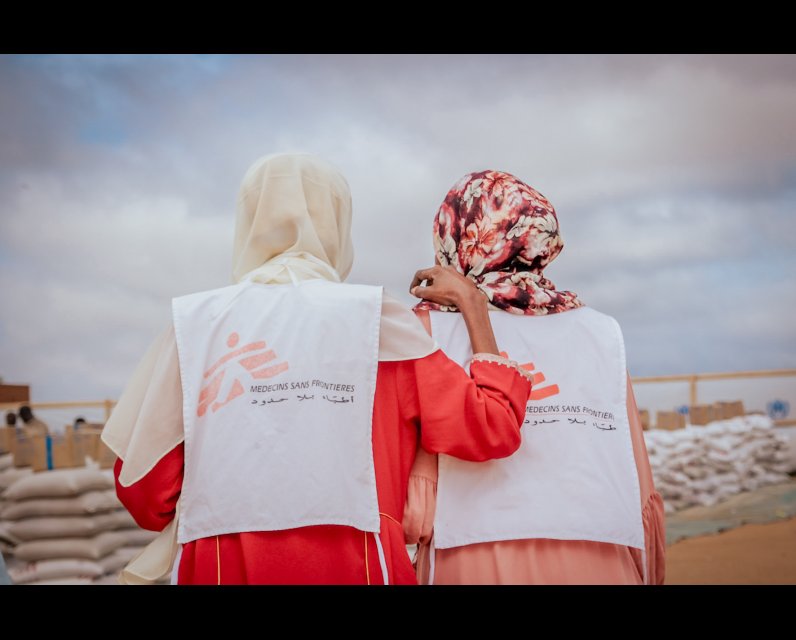
At MSF, we often see how hope can help us defy the impossible. It is our relentless hope that fuels us to believe it is still possible to provide lifesaving medical care for Sudanese refugees in a remote border town in Chad, even if that means setting up an inflatable hospital that is now a lifeline for thousands of people. It is our stubborn hope that insists we stay and provide health care in Gaza for as long as we are able, even while Israeli authorities constrain our work in so many ways. When the world collapses into chaos, hope is all we have. It irritates our despair, mocks impossibility, and drives us to turn that belief into real change.
It was precisely these kinds of stories that inspired us to launch a movement that invites Canadians to pledge their hope when it matters most. Because this moment, as disorienting as it, offers a choice. At a time when helplessness creeps closer to us all, I’m asking you to reclaim hope as a radical choice, even and especially when it feels hard or out of reach.
Choosing hope in this way is not always easy. But it doesn’t need to always show up in grand acts of defiance and resistance to the status quo (though, at MSF, we’ve embraced a fair few of those too in our history). There are quiet ways to embody hope even when you’re feeling depleted—ways you can refuse to accept intolerance, refuse to numb your sense of alarm, refuse to stop being human. These can include sharing and amplifying underreported stories from global crises or participating in movements that create momentum for collective action. It can also mean simply asking questions that confront the policies and systemic failures that worsen human suffering, demanding, “Why is this happening?” and “Who is responsible?” in a world where it may feel simpler to look away. Above all, choosing hope is about declaring compassion and empathy out loud in a society that often rewards polite apathy instead. It is saying loudly and boldly: We are radically hopeful. We speak out. We act. We refuse to look away.
Canadians have a long legacy of standing up for humanity in moments of major global upheaval. We have marched en masse for a ceasefire in Gaza, pushed forward campaigns to demand safe passage for refugees, and used our voices to call out injustice wherever it occurs. Across generations and political lines, Canadians have shown that our voice as a “middle power” matters and can make a difference. And, in the homes of immigrant families like mine, we relay the same hopeful message in different mother tongues to our loved ones bearing the brunt of crises in distant countries: “Our hearts are with you.”
This is who we are. Hope is who we are.
So, on that spring afternoon, I put myself back together. I opened the office curtains, unlocked my door, and sipped the cold coffee still at my desk. Beneath the devastating headlines, I reminded myself of the invisible, repeated actions of local health workers who keep choosing hope over despair: a surgeon holding a child’s hand, a nurse delivering babies in a dangerous city, a community speaking out when silence is safer.
And, somehow, against the force of my own indignation and sadness, I held the duality that the world can break alongside the quiet insistence that it doesn’t have to stay broken. I chose hope, and, with all the power and weight that this word carries, I hope that you’ll join me.
Visit hopeisradical.ca for more information.
The post When the World Feels Heavy, Hope Is Radical first appeared on The Walrus.
Unpublished Newswire

Comments
Be the first to comment