
Stay informed


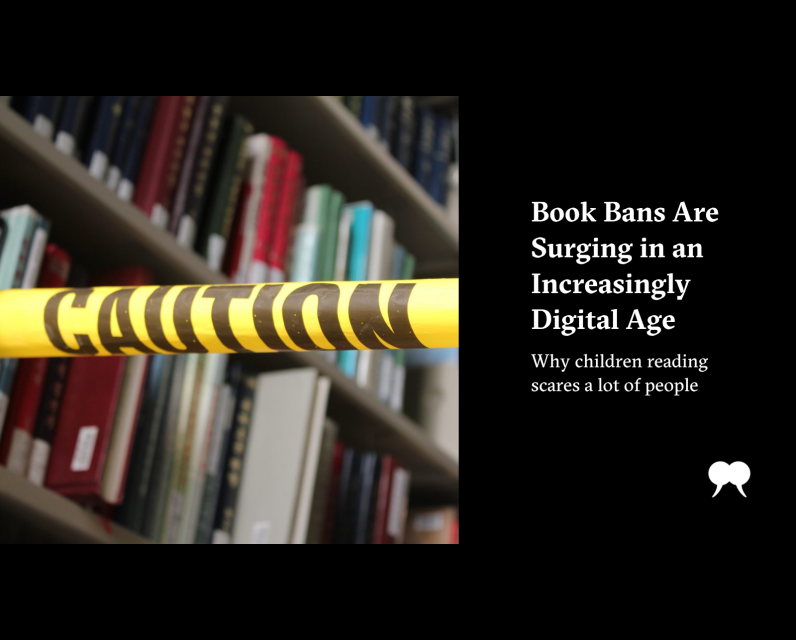
Book Bans Are Surging in an Increasingly Digital Age
Ira Wells is a writer whose most recent book, On Book Banning: Or, How the New Censorship Consensus Trivializes Art and Undermines Democracy, was a finalist for the 2026 Writers’ Trust Shaughnessy Cohen Prize for Political Writing. I spoke to Ira about the sense of cultural fear and helplessness that seems to be behind the resurgence of book banning and about how his book was inspired not by a conservative drive to ban books but by a so-called library audit at a school in the heart of progressive Toronto.
Right now, we’re under the potential threat of a nuclear war. Cases of measles are rising, and book banning has become more and more of a mainstream thing. It doesn’t feel like the 2026 that we were anticipating. What is it about book banning, specifically, that this idea that we used to regard as a symbol of backward thinking has become so popular again?
I couldn’t help but notice that in that litany of apocalyptic factors, you didn’t mention artificial intelligence, but we might just throw that in there too. I saw an interesting chart the other day that sketched out three different trajectories that AI might take. One was that it would eliminate X number of jobs and that this would, going even further, eliminate humanity. The other trajectory was that it would increase productivity and bring us to some sort of technological Eden. And then the third trajectory was that it might increase productivity by 0.02 percent. In other words, we might end up in some sort of utopia, we might just all die, or things could get fractionally better than they are now. All that seems to be in play right now. That’s part of the feeling of uneasiness and uncertainty—of feeling that there really isn’t a ground beneath our feet right now. And I think that sense of distrust and loss of control is maybe beneath a lot of the factors you mentioned.
Certainly, with book banning, there is a kind of desire for control that I see in many of the initiatives. If you look at what’s happening in Alberta, there are a lot of people who are upset by what they see as child porn, or they sometimes call it LGBTQ indoctrination, that is on the shelves of libraries. In fact, the internet and cellphones—which is really where kids spend most of their time these days—are a far greater source of sexually explicit material. I think they get that. But it all just feels so ephemeral. Like, where do you go to protest that? Where do you wave your flag? It’s in your feed one second; it’s off your feed the next. It all just feels so uncontrollable.
I think the library feels like a place where you can do something concrete. You can go to an actual library; you can pull books off the shelves. And I think maybe that’s behind this strange resurgence of book banning.
We’re both authors, and we both love books. Neither of us would agree that any one book could have the same immediate influence—progressive or toxic—as a fifteen-second TikTok video watched by 16 million people in a day. So, it’s kind of grabbing at the thing that’s nearby, that can be controlled.
I do think that the accumulation of views does represent something quite insidious. When you look at the reach that those TikTok videos can have, it is shocking compared to how many people will read. At the same time, you and I both probably also want to think that there’s something special about reading and that books can impact your life in a really concrete way. You can read a paragraph and never forget it. You can read a line, and it’ll change your life. But I think it’s absurd to say that a book could, you know, turn your kid gay or whatever the book banners believe. I think that’s ridiculous.
It’s funny, because I will sometimes interview authors who are primarily freelance writers for magazines. They write a lot of magazine articles that will be read by potentially tens of thousands of people. But then they write a book, and in the Canadian context, they’re lucky if it’s read by 5,000 people, and yet they feel very differently about the book. There’s something concrete and definitive. There’s something a little more authoritative about putting your ideas into a book and putting a cover around it than a magazine article or a newspaper article.
Everyone just feels the stakes a little bit more when it’s between covers. You want to make sure that every sentence is your best. The stakes are a little higher when you know it’s not part of any kind of ephemera, that this is going to have your name on it for good.
Well, that actually anticipates a question I have for you about the process of writing this book on book banning, because normally, the book writing process is fairly slow. It takes months and months, if not years and years, to pull together a book, especially nonfiction. And then it goes into the editorial process. Maybe within a year, that book appears.
This book was closer to a magazine timeline in terms of how quickly it came about. You’ve said you actually pitched it in June of 2024 and then turned in the book later that summer. It was out early the following year, which is pretty unheard of in the book world, except for when a celebrity dies and they do a quickie biography. Were you prepared for that? Did you panic as part of that? Did you ever feel like, Oh, I need another eighteen months?
The Biblioasis “Field Notes” series is sort of based around this old idea of an eighteenth-century pamphlet, where the idea is to intervene in a debate right away. It also happened that this was an issue that I’ve been thinking about for a long time. I’d been asked to give a series of lectures on book banning the winter prior, so I was really in the zone and had done a lot of the research and had a lot to say. By the time I was at the proposal stage, my research was done. At that point, I could focus on crafting. I still didn’t have the structure in terms of the chapters, or didn’t quite know the shape of it. But just the fact that the research was done set me free to think more about how I can artfully lay this out.
With that accelerated timeline, even though you had done those talks and your research, since the book came out, are there things where you’re like, Oh, I wish I could have got that in; or, That happened just a little too late in the process; or, That would have exemplified a point I was trying to make?
The book came out just before or just as Alberta was starting to ramp up their various book-banning initiatives. There was a phase where it seemed to be somewhat maximalist. A school board in Edmonton came out and said, Well, you know, according to how you’ve phrased this directive, dozens or even hundreds of books would have to be removed, including all these classics. Then the government came back and said, Well, we’re not trying to ban classics. We just want to get rid of the sexually explicit books. And then that sort of reframed it toward graphic novels. And then the province has left it up to individual school boards. But I think the Edmonton school board has pulled, if I’m remembering correctly, some forty graphic novels. Calgary pulled some thirty. And so, we are now into this full book-banning moment in Alberta.
Just recently, the province also passed a bill that appointed library inspectors. These would be provincial inspectors into public libraries. It always starts but never ends with schools. It ends up in public libraries. All that stuff was still in the future, and I wish that I could have got that in. That does feel like an important chapter.
I’m from Alberta. I feel that very intimately, and I feel like it’s a complicated province with a lot going on. I wish I could have unpacked some of that in the book. At the same time, I do feel like every book is a snapshot of a moment in time, and mine ended where it ended. The messages are still broadly applicable.
That whole issue in Alberta looms large in your book. But what’s interesting is that the origin doesn’t come necessarily from Alberta. Alberta sometimes gets used as a convenient villain for progressives in Canada. But it was really a more well-intentioned effort that you encountered—this message from your school principal that your school was going under this library audit. And this was in Toronto. You talk about that in the book, about how you were very curious. You joined the effort. You signed up to be one of the people volunteering to help with that audit.
This was an elementary school that I’m writing about, and my kids have now aged out of that school. But this was an entry point for me, personally. I’d certainly been aware of the kind of book banning going on at that point. I had read a lot about these raucous school board meetings in Florida or in Texas. And then I was reading about this library audit that was happening in Toronto. And I was just like, If book banning were to come to Toronto, it would have that kind of a boring, technocratic flavour to it. They would call it a library audit, right? It wouldn’t be something big and fiery.
We were given this thing called an equity toolkit to pull books off the shelves and evaluate according to this set of criteria—all of which was well meaning but which, in total, tended to reduce the conversation around books and our thinking around books to seeing books themselves as kind of propaganda. Some of the questions on the checklist would say, Does this text provide students with the opportunity to combat injustice? Or Does this text represent all points of view? Some questions like that, which clearly are well intentioned, and I don’t necessarily think that they’re the wrong questions to ask at an individual level. But across a whole library?
Yes, we should have books that are doing those things. But then, when I just think back to the most important experiences that I had reading to my own children—some wonderful books by E. B. White or C. S. Lewis or any number of others—are those books providing children with the opportunity to combat injustice? I think it’s too great a load to put on any given book and to expect books to perform that kind of ideological function. That’s not what art is for.
Again, we revere books. We revere book culture. We’re immersed in it, and we love it. But that approach to books—of putting that kind of criteria on their impact, that they must perform these other functions beyond simple entertainment—it speaks to almost the dark side of our love of books. You shouldn’t be just amused. It shouldn’t just be four or five hours sitting in a chair where you’re lost to the world. Books are important enough that they have to do something. They have to affect change, and they have to bring about social movements.
I totally understand where that argument comes from, especially because STEM (science, technology, engineering, and math) has been ascendant over the last twenty-five or thirty years. Certainly, for as long as I can remember being aware of currents in education, it was all about how we need to teach children how to code, because the future is coding. That’s the set of competencies that our children will need to succeed in the world. And I feel like it’s for those of us who are skeptical of that to say that, well, literature actually performs good in the world and that we should teach kids how to read because it’ll make them better citizens, or it’ll make them more tolerant, or it’ll make for a more socially just or more equitable world. Unfortunately, that’s not the world that I live in.
There’s this thought experiment by Robert Nozick about an experience machine. You could put yourself into a machine and program it to have rapturous, wonderful, amazing experiences. And you would actually think you’re in that thing. The point is that you wouldn’t do that, right? You’d rather actually live in the real world even if you’re not going to experience the level of pleasure that you would in this experience machine. And so, I guess I want to claim that reading isn’t just another version of that experience machine. In other words, it’s not just pleasure, right? This is an old philosophical conundrum.
There’s a writer named Walter Pater, who, in his book The Renaissance, says that every human heart has a predetermined number of beats. And he’s not saying that metaphorically. He’s not saying it symbolically. He just means that the literal organ in your chest has a number on it, and every time that your heart beats, that number goes down by one. And art’s job is to provide as much meaning to any given moment, to fill your life with meaningful moments. And that we don’t ask art anything else. It’s not going to make the world a better place. It’s not going to do things for us. All it can do is provide your life with the most meaningful moments possible.
What I’m thinking is, in an educational context, especially with elementary schools where a lot of this is happening, we don’t necessarily interrogate or put the same criteria on what kids do in gym class or what they do in music class. We don’t ask that every piece of music they encounter in a music class work toward eliminating injustice, or any of those other criteria. We allow for the music to just be music.
I mean, we prefer that they not listen to Nazi skinhead music or something like that. We do have certain criteria, and we don’t let them beat the crap out of each other in a gym class. And there are schools of thought that you eliminate all competitive sports in gym classes. But no one would say, Okay, kicking a soccer ball against a wall? What does that do? What does it do to play tag? And yet we put a moral value on books—for them to do that one thing that we don’t ask of almost any other activity in the school.
One of the things that kids are learning when they learn how to read is that they’re learning how to be persuasive under certain contexts. They are learning how to think critically. At a certain point, they will understand when something sounds suspect. When they hear their own inner voice arguing back against the page, they can start to refine their own thoughts in conversation with the thinking of others.
But there’s just something even deeper than that, which is that we are as close as we can get to being in communion with the mind of another human when we’re reading, and we are taking on some of the grain of their thinking and their mind. And that’s just a very difficult point to make to politicians when they are coming up with their funding formulas—that what we read helps fashion our own soul.
That’s just not an argument many technocrats would accept. But today, when you look at where AI is leading us, maybe we need to start to think about those older arguments a bit more seriously.
Adapted from the podcast What Happened Next, produced and hosted by Nathan Whitlock in partnership with The Walrus. Listen to the full conversation here.
The post Book Bans Are Surging in an Increasingly Digital Age first appeared on The Walrus.
Unpublished Newswire



Comments
Be the first to comment