
Stay informed
Unpublished Opinions


The Jasper Wildfire Produced More Energy than a Nuclear Bomb
.main_housing p > a { text-decoration: underline !important; }
.th-hero-container.hm-post-style-6 { display: none !important; }
.text-block-underneath { color: #333; text-align: center; left: 0; right: 0; max-width: 874.75px; display: block; margin: 0 auto; } .text-block-underneath h4{ font-family: "GT Sectra"; font-size: 3rem; line-height: 3.5rem; } .text-block-underneath h2{ font-size: 0.88rem; font-weight: 900; font-family: "Source Sans Pro"; } .text-block-underneath p { text-transform: uppercase; } .text-block-underneath h3{ font-family: "Source Sans Pro"!important; font-size: 1.1875rem; font-weight: 100!important; }
.flourish-embed { width: 100%; max-width: 1292.16ppx; }
.th-content-centered .hm-header-content, #primary.content-area { width: auto; } .entry-content p, ul.related, .widget_sexy_author_bio_widget, .widget_text.widget_custom_html.widget-shortcode.area-arbitrary { margin-left: auto; margin-right: auto; } .hitmag-full-width.th-no-sidebar #custom_html-45.widget { margin: auto; } @media only screen and (max-width: 768px) { .img-two-across-column{ flex-direction: column; } .img-two-across-imgs{ width: auto !important; max-width: 100%!important; padding:0px!important; } .main_housing, .text-block-underneath { margin-left: 25px !important; margin-right: 25px !important; } .text-block-underneath h4{ font-family: "GT Sectra"; font-size: 35.2px; line-height: 38.7167px; } } @media only screen and (min-width: 2100px) { .main_housing, .text-block-underneath { /* margin-left: 32% !important; margin-right: 32% !important; */ } } @media only screen and (max-width: 1200px) { .main_housing, .text-block-underneath { /* margin-left: 25px !important; margin-right: 25px !important; */ } } @media only screen and (max-width: 675px) { .main_housing, .text-block-underneath { margin-left: 10% !important; margin-right: 10% !important; } } .hero-tall {display: none;} .hero-wide { display: block; } @media (max-width:700px) { .hero-wide { display: none; } .hero-tall { display: block; } } ENVIRONMENT The Jasper Wildfire Produced More Energy than a Nuclear Bomb What happens when infernos become “unsuppressible” WORDS AND PHOTOS BY JESSE WINTER
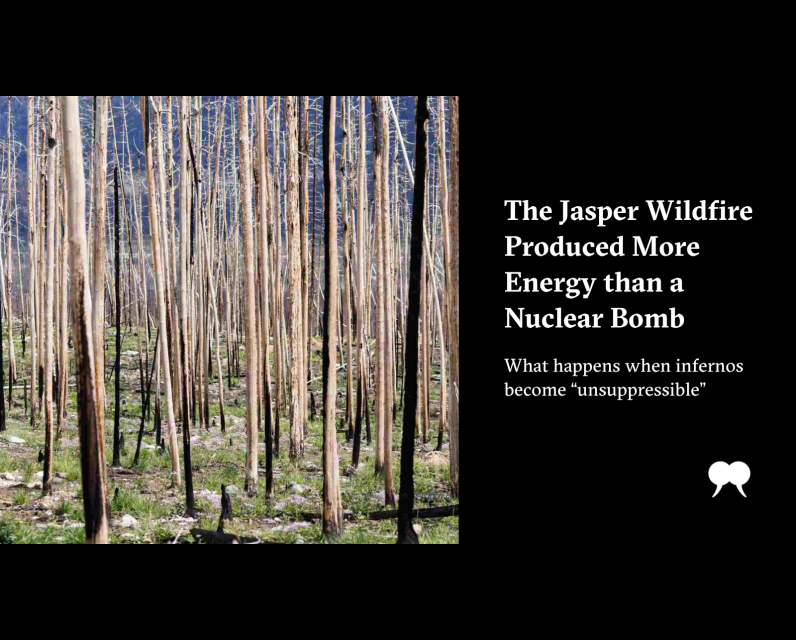
Published 6:30, MAY 30, 2026 Trees with their bark stripped away by wildfire stand in the Athabasca Valley of Jasper National Park on August 5, 2025. The wildfire of July 2024 left the trees so disfigured, forestry experts struggle to tell their species.
When dawn broke over Jasper, Alberta, on Thursday, July 25, 2024, after a historic wildfire, it revealed the terrible cost of a hard-fought victory that, at first, was difficult to see through the lingering haze.
The southwestern end of town was a smoking ruin, with dozens of family homes reduced to ash-filled pits. Firefighters would spend days drowning basements. The Cabin Creek neighbourhood, which had taken the brunt of the ember storm, was almost completely gone. The historic Anglican church, which had sat at the corner of Geikie Street and Miette Avenue since 1928, was now just a lonely stone chimney reaching toward a grey and cloud-filled sky.
But as heartbreaking as those losses were, it could—and in some ways should—have been far worse. Of the town’s 1,113 structures, an incredible 755 were still standing. More than two-thirds of the town, and all of its critical infrastructure, had been saved in a battle against odds so long, it’s a miracle no one was killed.
Out in the valley, the destruction was even more intense. On the mountainside below Marmot Basin ski resort, one of the most important tourist draws in the national park, evidence of the fire’s savagery left Landon Shepherd, a wildland firefighter and a fire behaviour expert for more than three decades, speechless. Sometimes, if a wildfire burns hot enough, it can sterilize the soil, killing the micro-organisms, the seeds, the root structures, and the mycelium networks that fire-adapted ecosystems rely on to recover. At Marmot Basin, the soil wasn’t just sterilized; it was completely gone, burned to ash by thousand-degree heat and then blasted away by hurricane-force winds. Across a huge swath of mountainside where the suspected fire tornado touched down, not a single tree was left standing. It didn’t look like a wildfire at all. It looked like the site of a nuclear blast.
Other parts of the park now resembled an alien landscape. In areas around the Edith Lake cabins, where fuel treatments had helped tame the fire’s behaviour at least a little, some of the trees appeared to have developed leopard spots. This can happen when the temperature in a forest rises so fast that the sap in the trees boils before the tree burns. The boiling sap causes sections of the blackened bark to erupt in little jets of steam, leaving behind round pockets of white.
On the slopes of Signal Mountain and the Maligne Canyon lookout, an even weirder sight remained. When super-heated gases driven by the fire’s ferocious winds ripped through stands of fir and lodgepole pine, they stripped the bark from trees completely and bent them forward almost ninety degrees in smooth, graceful arcs. The extreme temperature differential between the windward and leeward sides of the trees caused their cell fibres to dry out at different rates, locking them in place. Experts call it fire freeze. Whole mountainsides of gleaming, white tree trunks now appeared frozen in time, cursed to stay bent forever before the fury of a phantom wildfire.
A GPS device and a flag mark the centre of a sample-collection plot used by wildfire researchers on August 5, 2025, to understand the uniquely devastating impacts of the wildfire of July 2024.Faced with a fire like this, Jasper had been almost certainly doomed. The fact the town had survived at all was an incredible success—but one that was, at first, hard for many to recognize. As the fire ripped into town on Wednesday night, snippets of video and a few photos showing horrifying scenes began rocketing around the internet. They left thousands of people with the impression that the whole town had been destroyed, a perception that persisted for days.
With the wildfire itself still burning beyond the townsite, Parks Canada and the municipality struggled at first to meaningfully rebut this. Early statements by officials at a press conference on Thursday were vague, saying somewhere between one-third and one half of the town had been lost.
Professional press access could have helped provide crucial context, but journalists couldn’t get into town. Parks Canada largely refused to allow journalists into Jasper for nearly a month after the fire. Unlike previous fires, these restrictions continued even after the evacuation order was lifted and town residents were allowed to return. When asked about this by understandably frustrated journalists, Parks Canada claimed it was protecting the privacy of Jasper at “a time of profound loss, devastation, and grieving.”
This bears underscoring. In sixteen years as a journalist, I’ve never seen a public agency deny reporters access to the site of a major public disaster on the grounds of privacy alone. I’ve also never seen the news media subject to more restrictions than residents themselves, and the precedent it sets is alarming.
For weeks, the only meaningful press photos to emerge from Jasper were taken for the Canadian Press by photojournalist Amber Bracken, who was briefly allowed into the town days after the fire front had moved on. Her visit was as part of a media tour arranged by Alberta premier Danielle Smith, who was photographed alongside emergency managers looking suitably mournful as she surveyed destroyed homes.
In the absence of robust independent coverage, misinformation around the Jasper fire swirled into a political storm. In October 2024, parliamentarians questioned everyone they could during hearings in Ottawa, slicing the disaster up into their own self-interested angles. The federal Conservative Party was keen to pin blame for the fire on then prime minister Justin Trudeau’s Liberal government, accusing it of having mishandled the pine beetle infestation that left so much dead fuel across Jasper’s landscape.
Others accused Parks Canada of refusing the aid of firefighters who could have helped, including those hired by private insurance companies who, critics claimed, were forced to stand by and watch while the town burned. (According to firefighters who actually fought the Jasper fire, the majority of these private firefighters arrived Thursday morning, too late to have been any real help. At that point, the town was already full of fire crews from nearby communities, most of whom had little left to do.)
Smith complained that her government had been shut out of the fight to save the town, even though Alberta Wildfire crews and aircraft had been critical in the battle’s early hours. (A report later commissioned by the Municipality of Jasper found that Smith and her cabinet members’ interference during the fire had made things worse, not better. Smith publicly disputed the report, characterizing it as “unfair” and demanding an apology.) Incredibly, hardly any of the critics mentioned the cedar shake roofs, which were a holdover from official Parks Canada policy stretching back decades.
It got so bad that Jasper mayor Richard Ireland decried the political infighting, telling local media it was exacerbating the pain felt by residents who’d already lost everything. “The present atmosphere of finger pointing, blaming, and both partial and misinformation is, from my perspective, beyond merely an annoying distraction,” Ireland said. “It delays healing. It introduces fresh wounds and fosters division, precisely at a time when we need recovery and unity.”
Public officials in Jasper found themselves fighting a new battle for the narrative of the fire. And despite the hours of testimony and litres of ink spilled, virtually all of this public debate missed the point.
As heartbreaking as the damage to Jasper was, what happened there was not a failure. The biggest lessons we should take from it aren’t about what went wrong. Jasper represents our new reality, one in which losing only a third of a beloved town amid the extreme conditions firefighters faced should be seen and celebrated as an incredible, if implausible, win.
The town had vulnerabilities before the fire. Jasper’s fire hydrants used a different thread pattern than virtually every other municipality in British Columbia and Alberta, and the small number of adapters they had on hand were quickly used up. This meant that as hundreds of firefighters poured into town to help, they were unable to connect to the town’s main water supply.
Thankfully there was a saving grace in the form of a lone purple fire hydrant, sitting just east of the Cabin Creek neighbourhood. Its purple paint denotes non-potable water, in this case because it connected directly to the stream of pipes feeding untreated water from the intake wells by the river to the city’s reservoir in the hills above town. This meant that the consistently strong water pressure inside the purple hydrant kept up even as other hydrants across the town began to fail—a virtually unlimited supply.
As fire crews across town fought to keep the flames from spreading, drivers of special tanker trucks called water tenders raced back and forth from this one lone purple hydrant, filling their rigs and then resupplying crews directly, allowing the fight to continue.
Jasper’s many cedar roofs were another clear weakness, and like the forest conditions themselves, one that developed over decades. Much as they’d have liked to, town council couldn’t simply rip off every cedar roof and replace it with metal all at once.
Even with these chinks in its armour, unlike most other Canadian towns, Jasper had been comparatively well prepared for a fire. Over the course of several years, Jasper fire chief Matthew Conte and others had built a robust wildfire protection plan. Their system of fuel treatment areas around the town was more complete and extensive than any other Canadian city ever hit by a wildfire. They proved invaluable to its defence.
Officials in Jasper had practised emergency wildfire evacuation scenarios, including running a tabletop evacuation drill just six weeks before the fires struck. On top of that preparation, they also got extremely lucky. Aside from the cedar shake roofs and chaotic, last-minute fire smarting around people’s homes, almost everything that could have gone right did. If a single dice roll had gone the other way, the town could have been easily wiped off the map.
University of British Columbia professor and wildfire expert Lori Daniels examines the scorch marks on trees in a heavily burned area of Jasper National Park on August 5, 2025.The biggest lesson of all from Jasper isn’t political; it’s a message about the type of fires now possible in our current climate-heating world. As research by Lori Daniels, a professor at the University of British Columbia, shows, wildfire has always been a presence in Jasper’s valleys. But 100 years of obsessively extinguishing these healthy fires deprived the forest of its critical self-regulation. It allowed a build-up of trees that changed the park’s forests. What was once a healthy mosaic, dotted with meadows and stands of trees all varying in age, became wall-to-wall conifers packed close together, an unbroken expanse of fuel stretching the length of the Athabasca River valley. Essentially, eliminating wildfire from the landscape helped create the conditions of something far worse. The severity of the 2024 fire was something new.
When I first saw the burn scar below Marmot Basin, photographing it from above in a helicopter in July 2025, I could not believe what I was looking at. I’d seen the aftermath of high-severity fire before. Hiking through the burn scar of the Elephant Hill wildfire, an enormous blaze that levelled a mobile home park in Boston Flats, near the Village of Ashcroft, in 2017, I saw the ghostly white ash piles reaching like giant skeletal fingers across the forest floor—all that remained of whole trees completely incinerated.
In 2021, I slipped and slid my way across greasy, hydrophobic soil left behind on hillsides in the aftermath of the White Rock Lake wildfire. That particular fire had torched most of Monte Lake, BC, before running more than forty kilometres, all the way to the shores of Lake Okanagan, where it levelled more houses in the hamlet of Killiney Beach. Witnessing that kind of destruction is always unsettling, but what I saw flying over Marmot Basin left me rattled.
Across an area nearly ten square kilometres, hardly any trees were left standing. Most were torn from the ground and left strewn in smooth, circular rings, their trunks pointing into the fire, not away from it. As Shepherd explained to me, the blowdown pattern indicates they were uprooted by the sheer force of the fire’s indraft. Those that weren’t ripped clean out of the ground were snapped off two or three metres above the ground. And these were not small trees.
“Some of the trees are these 300-year-old Douglas firs that survived the valley burning wall to wall at least twice in the past 250 years,” Shepherd told me.
The first major fire happened when the trees were young, sometime in the 1700s. Then in 1889, more than half the entire park burned, and still the trees survived. There are several reasons the same trees weren’t so lucky in 2024. Many politicians pointed toward the valley full of dead pine beetle–killed trees—and while politicians misdiagnosed the problem, it’s true that those trees contributed to the fire’s intensity.
In what’s called the “red phase” shortly after a beetle outbreak, those dead trees are still covered with their dead, rust-red needles. When a fire takes hold in a forest like this, the fuel load of dead needles in the canopy causes the forest to act like so many matchsticks, packed close together. Light one of them, and the fire races ahead across the match heads, launching galaxies of embers as it goes. It’s fast, but it’s not as intense as the Jasper fire. Under normal conditions, traditional firefighting methods can still be effective.
Over time, branches break off, dead trees fall over. The majority of available fuel is no longer in the forest’s canopy; it’s on the ground. With the forest canopy now naked, the extra sunlight dries out all that downed fuel even more, making more of it available to burn. This process can contribute to a fire’s residency time—how long it stays burning in one place before moving on in search of more fuel. In normal conditions, a fire’s residency time is relatively brief, sometimes only thirty to sixty seconds. But when grey-phase beetle-killed trees are present, the fire has more material on the ground to burn. It stays in place many times longer, burns hotter, and—as happened at Marmot Basin—can create the conditions for a fire tornado, bringing the fire back over the same ground again and again, consuming more fuel, feeding itself.
On the six-point fire behaviour classification scale, a fire becomes a rank-six blaze when its energy output exceeds 10,000 kilowatts per metre. At this point, fire suppression is essentially impossible. The McDougall Creek wildfire, which destroyed nearly 200 homes near Kelowna, BC, exhibited fire intensity of 100,000 kilowatts per metre. A Canadian Forest Services study that took detailed plot samples and reconstructed the Jasper fire’s behaviour found that, at its height, it was generating more than 386,000 kilowatts of energy per metre, over thirty-eight times hotter than the top of our existing scales and seven times more energy than the nuclear bomb dropped on the Japanese city of Hiroshima across a flame front more than eight kilometres wide.
But for any of this to happen, the fire first needed the kind of extreme conditions that climate change is making more common. It needed two whole weeks of high heat and frighteningly low humidity to parch even the coarse surface fuels, the ten- and hundred-hour fuels, like branches and logs, getting them dry enough to make them, and everything else in the park, available to burn. Next, the fire needed—and got—high winds. And once it ignited under those conditions, no force on heaven or earth could stop it. Fires in these conditions are, as many firefighters put it, “unsuppressible.”
“It should set off alarm bells for everyone concerned about the impacts of climate change,” Daniels told me.
To have stopped the Jasper fire from reaching the townsite, Parks Canada would have had to clear-cut enormous swaths of a beloved national park—or somehow undo more than a century of wildfire suppression. Jasper, like the rest of the country, is now dealing with the problems that took more than a hundred years to manifest. Overcoming that legacy is going to take hard work, a lot of money, and a lot more time. There are no shortcuts.
Excerpted, with permission, from Wild Fire: Dispatches from a Country Ablaze by Jesse Winter, published by HarperCollins Canada, 2026. Photos courtesy of Jesse Winter and HarperCollins Canada.
The post The Jasper Wildfire Produced More Energy than a Nuclear Bomb first appeared on The Walrus.
Unpublished Newswire



Comments
Be the first to comment