
Stay informed



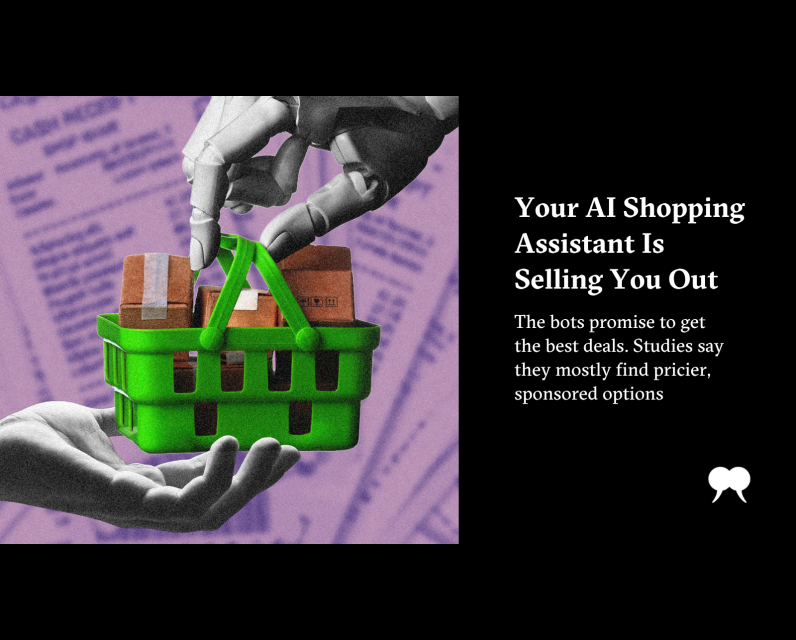
Your AI Shopping Assistant Is Selling You Out
In The Truman Show, Laura Linney is Truman’s upbeat wife—Meryl—and a sales channel at the very same time. In one moment, she is comforting him; the next, she is swivelling back toward the camera with a fresh box of Mococoa with “all-natural cocoa beans from the upper slopes of Mount Nicaragua.” She’s performing marital intimacy while chasing a product-placement bonus. It’s as gross as it is captivating.
That character was an arresting caricature in the 1998 film. Today, she is an obvious ancestor to two-faced AI agents. When you deputize an AI agent to shop for you, you basically tell the computer program (or “agent”) what you want. Like: find the best running shoes under $150 for someone with wide feet, or the cheapest flight to Venice. The agent then searches multiple retailers, evaluates options based on your preferences, and completes the sale.
In other words, the online shopping experience we’re used to—searching, comparing, clicking around, reading reviews, abandoning carts, returning later, and finally checking out—is being compressed into a short exchange with a chatbot. That convenience could be transformative. A genuinely loyal AI shopping agent could slash costs and force retailers into fiercer competition. But only if the system is actually working for us rather than quietly working on us.
Companies are trying hard to get us interested. Amazon introduced its Rufus shopping chatbot back in 2024 and has now shifted efforts exclusively to Alexa. Other tools include ChatGPT’s “Instant Checkout” (which started with Etsy) and Perplexity’s “Buy with Pro” (in partnership with PayPal), which allows subscribers to purchase a product without leaving its AI search engine.
Earlier this year, retailers began more formal integrations. For instance, Gap Inc. started allowing fully in-chat purchases in March. Loblaw has already brought PC Express into ChatGPT. Walmart is moving in the same direction: its OpenAI partnership lets customers shop through ChatGPT, while its own Sparky agent is being positioned as the AI layer across discovery, recommendation, and purchase.
These AI agents mirror Meryl. The language around them is deliberately intimate: they are assistants, co-pilots, concierges, personal shoppers. And while these systems sound like they are on your side, there is evidence they are rewarded for steering you toward sponsored products (the Groundwork Collaborative’s Lindsay Owens called it an “NSA for capitalism,” after the US security agency controversial for its warrantless surveillance). They may also artificially inflate prices. Google Ads already allows companies to test different ads with higher prices for people who are more likely to pay them. But the agents don’t exactly go out of their way to warn you about that feature.
A group of researchers from Princeton and the University of Washington studied how large language models behave when user interests conflict with platform incentives. In particular, they considered when a sponsored option is worse, more expensive, unnecessary, or potentially harmful, but it gets recommended anyway. Their main case study is booking a flight. Across twenty-three models, all but eight recommended the more expensive sponsored option more than half the time. Their paper also demonstrates how AI advertising is framed as a kind of advice—a helpful assistant becoming strangely enthusiastic about a product you never asked for.
The terms of agentic commerce are emerging through competing protocols. OpenAI and Stripe have the Agentic Commerce Protocol, which lets people buy directly inside ChatGPT. Google and Shopify have a similar and competing standard in the Universal Commerce Protocol, which governs how agents engage with merchants. In addition, Google has put forward the Agent Payments Protocol, which specifically enables AI agents to transact payments across platforms.
These standards underpin the product itself. What we really need is a democratically set standard for the behaviour of AI agents so that they can’t double-cross us. These are new markets and infrastructures that will be consequential for the future economy. But the rules for these systems are being set primarily by foreign private actors before public institutions have even fully named the market. This is poised to be yet another edition of the same story in Canada’s digital economy, where markets are pretty much entirely made, defined, and governed from abroad and little is done by the government to assert our sovereignty and protect our citizens and their privacy.
An AI assistant cannot be both a consumer agent and a platform sales channel. It has to choose between acting in our interests and being computationally rewarded for diverting our dollars toward someone else’s. AI assistants collapse all of these problems into one interface. And the way they tend to function now risks being a complete fiduciary failure. In theory, these chatbots can make shopping a breeze. But right now, they mostly seem like a different kind of invisible hand, one that tilts markets back toward merchants and locks in their power.
Truman’s trust was betrayed again when his wife tried to sell her audience a Chef’s Pal (for the uninitiated, it’s a dicer, peeler, grater, all in one). Poor Truman thought he was in a loving romantic relationship, but he was just in a marketplace where he was sold to, sold through, and sold out. Without proper governance, AI agents that are supposedly meant to shop for us might do the same thing. Chef’s kiss.
The post Your AI Shopping Assistant Is Selling You Out first appeared on The Walrus.
Unpublished Newswire



Comments
Be the first to comment