
Stay informed


A PR Hoax Created the Year’s Hottest Rock Band. Imagine What It Can Do in Politics
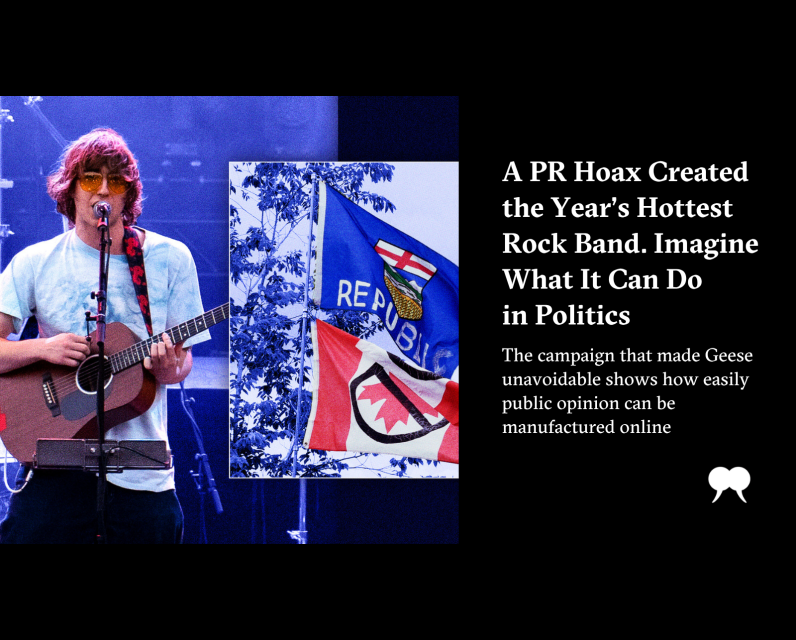
If you identify as being into “quality” music, you have likely heard of Geese. This Brooklyn indie-rock band was the critical darling of 2025. They landed on virtually every “best album the year” list, played Saturday Night Live, and are currently on a world tour.
Key points- Social media campaigns are being used to influence everything from personal taste to political beliefs
- Ideas tied to our sense of identity are easier to manipulate
- These campaigns are effective because they don’t feel like propaganda; they feel organic
I got into Geese last year too. What filtered into my brain was this: If you are an insufferable music snob (hey, that’s me!) Geese’s new album, Getting Killed, is an absolute must. If you are too “sophisticated” to unironically enjoy a Top 40 playlist (also me!), then you will love this band’s unique sound. And I did. And, presto, Geese seemed to be everywhere in my life.
But here’s the thing. Their ascension wasn’t organic. It wasn’t quirky quality rising to the top. Yes, the band had built up some momentum under its own steam, but their stratospheric hipness was all due to algorithmically manufactured buzz. Fake fans. Fake comments. Fake reviews. Bots pushing social media posts. The entire public discourse was seeded by a PR company to make Geese look as uncompromising and grassroots as possible.
For most, the controversy swirling around the band Geese likely feels very low stakes. If music brings you joy or comfort or connects you to a broader community, does it matter that a sophisticated “psy-ops” operation shaped your perceptions of the artist? The music industry has always used questionable strategies to create buzz. In the 1940s, Frank Sinatra’s publicist allegedly paid young women $5 to scream at his concerts. In the 1950s and 60s, there was a big payola scandal involving record companies bribing DJs to play specific records. And in 1989, there was the Milli Vanilli lip-synching humiliation, which, it must be said, seems tremendously tame in this current era of auto-tune and AI-generated music.
But if our information environment can fool us into thinking an indie band is brilliant, cool, and, most insidiously, authentic, imagine what it can do to our understanding of things like vaccines, climate change, or political parties. Any beliefs or preferences tied to identity—how we see ourselves and how we want to world to see us—are far easier to steer, because people are no longer just reacting to the thing itself. They are reacting to what that thing signals about them.
Music is a classic example of taste as social performance. Studies consistently show identity is the key factor in our stated preferences, more so than the actual sonic qualities of the music. Put another way, we don’t like songs because they sound good. We like them because they are in tune with the kind of person we believe ourselves to be.
That may explain why our favourite artists and albums are often frozen in adolescence, when many of us are forging our identities. According to a 2021 YouGov survey, most people believe the best decade for music was the one they experienced as teenagers. Tastemakers exert a similarly powerful influence (hence the success of the Geese PR gambit). The results from a study from University of Redlands “showed that a critic’s review had a greater influence on people’s opinions of a song” than listening to the actual song!
Not surprisingly, the link between music and identity bleeds into politics. Conservatives, for example, are far more likely to say they enjoy country music. In contrast, one recent study found democrats and liberals were “repelled” by the genre, which the researchers characterized as extremely polarizing. In intensely tribal times—like right now—we are more conscious of the signals we send, likely because we want to be clearer about the team we are on.
And, again, this is all about self-image and not the music’s actual sound or quality. Many liberal-leaning cognoscenti love the indie artist Waxahatchee, whose songs are steeped in country tradition. But a large chunk of those same fans would likely say, as highlighted by the above study, they hate most country music (me: guilty). Waxahatchee represents a “cool discerning music fan” and, rightly or not, the current big country stars, like Riley Green and Morgan Wallen, feel MAGA. (Important caveat: everyone rightly loves the unifying Dolly!)
The Geese controversy is more than a gotcha moment for pretentious gatekeepers. It’s a vivid demonstration of how easily all of us—fans, critics, even the bookers at SNL—can be manipulated by memes, algorithms, influencers, peer groups, and online subcultures.
These same tactics—which, research tells us, are hugely successful—are being used to influence beliefs on topics far more consequential than an indie band. Similar strategies have been deployed to sideline expert voices or to spread and normalize lies about vaccines, climate change, immigrants, abortion, and contraception.
These campaigns are effective because they rarely feel like propaganda. They work not by forcing people to believe something outright but by slowly altering the emotional atmosphere around an issue—making certain views feel either cringe or suspicious or reasonable or accurate. Repetition hardens into intuition. People mistake a manufactured consensus for common sense. (During their highly publicized trial in 2022, did you, for some oddly hard-to-explain reason, find yourself believing Amber Heard was a bit unhinged and Johnny Depp unfairly demonized?)
The platforms themselves, exquisitely built to keep us scrolling and reacting, can also reinforce certain worldviews. A 2026 study, published in Nature, found that exposure to X led users to follow more conservative political content over time. As one media scholar put it, “X’s algorithms are not neutral tools. They are an editorial force, shaping what people know, whom they pay attention to.”
Another 2026 analysis, also in Nature, reached a similar conclusion about TikTok’s recommendation algorithm. Using hundreds of test accounts, researchers found that Democratic users saw more Republican content during the 2024 United States election, while Republican users were more often shown videos that matched their political views. But perhaps the best example, and the one that closely mirrors the Geese strategy, is the campaign being run by foreign actors, including Russia and the US, to influence the Alberta separation movement. A recent study found a “network of inauthentic YouTube accounts,” including fake influencers pretending to be salt-of-the-earth Albertans, repeating the same frustrations, slogans, and grievances across multiple platforms. As with Geese, coordinated hype is used to inflate a small phenomenon into something that feels culturally unavoidable.
So where does this leave us? Here’s a good rule of thumb: if you go online—especially if a social media platform is involved—assume there is an attempt to exploit your fears, grievances, beliefs, personal identity, and sense of community. Whether you are an elitist music nerd or an aggrieved Alberta separatist, assume you are being manipulated.
Okay, that advice sounds stressful and paranoid. What might help is some soothing music. I hear the latest album from Cameron Winter, the lead singer of the band Geese, is awesome!
The post A PR Hoax Created the Year’s Hottest Rock Band. Imagine What It Can Do in Politics first appeared on The Walrus.
Comments
Be the first to comment