
Stay informed



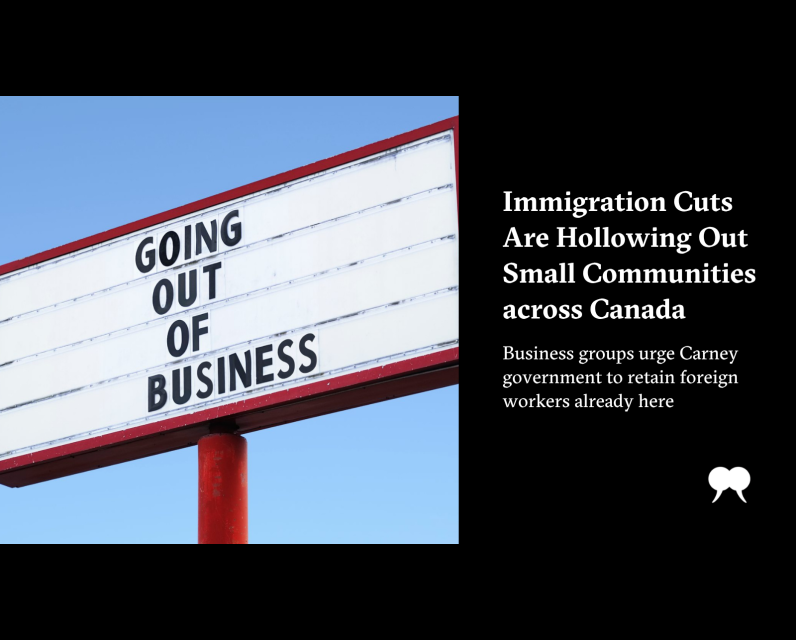
Immigration Cuts Are Hollowing Out Small Communities across Canada
Voters in five provinces and one territory will head to municipal polls in the remainder of 2026, but one of the issues shaping local economies will not be decided inside city halls.
Immigration remains a federal file, yet mayors, chambers of commerce, and local business groups say Ottawa’s cuts to permanent and temporary immigration targets are being felt at the local level, impacting municipal labour markets, housing systems, property tax collection, transit, local economic development, and a range of services.
Nationally, Ottawa lowered its target for new temporary worker arrivals from 367,750 in 2025 to 230,000 in 2026, a 37 percent reduction. Within that total, the target for arrivals through the Temporary Foreign Worker Program has dropped from 82,000 to 60,000.
At the provincial level, another pathway used to retain foreign workers was also sharply reduced. British Columbia, for instance, was permitted to nominate 8,000 workers and entrepreneurs for permanent residence in 2024, but its Provincial Nominee Program allocation was cut to 4,000 in 2025, despite BC asking Ottawa for 11,000 spots. The province said the reduction significantly affected its ability to meet workforce needs in areas such as health care, child care, construction, and housing.
In the town of Sechelt, on BC’s Sunshine Coast, Mayor John Henderson says the problem now is finding enough workers to keep the community running. In 2021, 3,975 people in Sechelt were aged sixty-five and over, up from 3,455 in 2016. Over the same period, the working-age population, aged fifteen to sixty-four, was essentially flat, moving from 5,600 to 5,580. That means more than a third of Sechelt’s residents were seniors in 2021.
With an aging population, near-zero unemployment, and employers struggling to replace retiring staff, Henderson says federal immigration cuts are landing differently in smaller communities like his, where the local economy depends on a workforce Ottawa controls. The consequences range from restaurants shortening hours, care homes struggling to staff shifts, and construction firms delaying projects to small businesses being unable to replace workers who retire or move away. In larger municipalities with high numbers of temporary residents, the impact can be more complex, with implications for rental housing, household finances, and property tax collection.
Brampton, Ontario—where voters will choose a mayor, city councillors, regional councillors, and school board trustees in October—is navigating a range of similar local issues.
Mortgage specialist Rakhi Madan told The Pointer the dramatic drop in the city’s large international student and foreign worker populations due to federal policy changes has reduced rental incomes for homeowners who relied on students and workers, primarily from India, to help carry their home-financing costs.
The reduction has been particularly steep in Ontario, which has historically been the destination for more than half of Canada’s international study permit holders. The province’s target for study permits fell from 141,000 in 2024 to 116,740 in 2025 and to 70,074 in 2026. Nationally, Ottawa’s latest immigration plan sets a target of 155,000 new international student arrivals in 2026, 49 percent below the previous year’s figure. These numbers reflect a dramatic decline from 2023, the peak year when Immigration, Refugees and Citizenship Canada issued 684,000 study permits.
In Brampton, where international students have long relied on rented rooms, basement apartments, and shared accommodations, federal changes have created challenges not only for landlords and renters but also for the tax base that funds roads, transit, policing, garbage collection, stormwater systems, and community facilities.
The Pointer reported that the number of Brampton property tax accounts assigned to a bailiff for collection (meaning, an unpaid tax bill being escalated for collection) rose from 234 in 2023 to 1,170 in 2024, a roughly 400 percent increase. Another story reported that the city’s mortgage delinquency rate reached 0.6 percent in the fourth quarter of 2025—the worst of all major cities in Canada; the national rate stood at 0.24 percent for the same period. For municipalities, a rise in such accounts matters because property taxes are the main source of revenue to fund the entire municipal budget.
No public data directly links Brampton’s rise in tax arrears to federal immigration changes, but the timing is hard to ignore: the spike came as Ottawa began tightening rules for international students, post-graduate work permits, and temporary foreign workers.
In Saskatchewan, it’s the farm sector that has raised similar concerns. The Saskatchewan Association of Rural Municipalities has warned that agricultural employers are struggling to find enough skilled and reliable workers, citing a shortage that left 28,200 agricultural jobs unfilled during the 2022 peak season. Those pressures could also become part of a local election conversation, with councillors for some divisions in rural municipalities going into an election in November.
In a statement to New Canadian Media, IRCC said municipalities play an important role in identifying local labour market needs, supporting newcomer integration, and informing immigration policy. It added the 2026–2028 Immigration Levels Plan was developed after consultations with provinces and territories about their regional and labour market needs. IRCC also said the plan increases admissions through the Federal High Skilled and Provincial Nominee Program categories. It did not directly address whether reductions in temporary residents could contribute to the municipal financial pressures emerging in places such as Brampton.
In a June 3 letter obtained by New Canadian Media, a coalition of chambers of commerce and local business groups from across the country urged Prime Minister Mark Carney to create a permanent immigration pathway for lower-skilled workers and labourers. The letter argues that Canada’s economy depends not only on highly educated workers but also on lower-wage or entry-level roles that may require a high school diploma, on-the-job training, or short work demonstrations but which are essential to restaurants, hotels, care homes, food processing, construction support, and other local services. The coalition warned that businesses, particularly in rural and remote communities, risk losing foreign workers they have recruited and trained.
Among the coalition’s recommendations: allowing employers to keep foreign workers already in Canada, letting spouses and dependent children remain, extending low-wage work permits to up to two years, removing caps for small rural employers, expediting processing, enhancing settlement supports, and working with local governments, employers, and unions on a long-term rural immigration plan.
Employer groups are making a similar argument nationally. A policy paper called “Reimagining Immigration: The Canadian International Workforce Program” proposes a new immigration program with separate streams for seasonal and year-round lower-skilled work and calls for regional pilots to be expanded so low-wage workers can qualify where local labour market needs justify it.
IRCC said such pathways already exist through regional economic immigration programs where labour shortages can be demonstrated. It pointed to the Atlantic Immigration Program, the Rural Community Immigration Pilot program, the Provincial Nominee Program, and the Francophone Community Immigration Pilot.
The Rural Community Immigration Pilot (RCIP) offers permanent residence to skilled workers who want to work and settle in rural and more remote communities. For communities that were not selected for the pilot, including Sechelt, IRCC pointed to other routes such as the Provincial Nominee Program and streams managed through Express Entry. The department did not indicate whether the RCIP would be expanded.
Asked whether Sechelt would want access to a program like the RCIP, Henderson said his municipality is open to new immigration initiatives, including the RCIP and other proposals contained in the Reimagining Immigration policy document backed by employer groups. But, he said, the more pressing issue is keeping workers who are already in the community.
“The urgent message for now is that we MUST keep the people we have here: TFWs, spouses, families,” Henderson said in an email. “Extend their work permits for two years to give all of us time to settle on a new approach to immigration that, among other things, meets the needs of rural communities.”
IRCC pointed to measures intended to retain some workers who are already established in Canada. Its one-time In-Canada Workers Initiative is expected to accelerate the transition of up to 33,000 workers to permanent residence in 2026 and 2027, beginning with eligible work permit holders who have already applied through regional programs and occupation-based pilots.
The department also cited temporary flexibilities introduced for rural employers under the Temporary Foreign Worker Program in March. But IRCC continues to describe that program as an extraordinary and temporary measure intended to address short-term labour shortages when Canadians or permanent residents are unavailable.
“One size does not fit all,” is how Henderson puts it.
Originally published as “Immigration is a federal file. Municipalities say Ottawa’s drastic changes are landing locally” by New Canadian Media. Reprinted here with permission.
The post Immigration Cuts Are Hollowing Out Small Communities across Canada first appeared on The Walrus.
Unpublished Newswire

Comments
Be the first to comment