
Stay informed


Can the Birthplace of Confederation Catch Up to the Times?
In 1864, amid ongoing threats of American annexation, delegates representing the British colonies of Prince Edward Island, Nova Scotia, New Brunswick, and the Province of Canada met in Charlottetown to debate the merits of political union. Originally meant to be a small gathering of maritime leaders in Province House, the seat of PEI’s legislature, the meeting ballooned when politicians from what would soon become the separate provinces of Ontario and Quebec invited themselves to the party. By the end of the conference, these so-called Fathers of Confederation—all middle-aged and older white guys—had agreed in principle to unite, making Charlottetown the cradle of a fledgling new nation, even if PEI itself ultimately passed on joining Canada until 1873.
Since then, Province House has been a point of pride for many Islanders, a source of shame for others. As the birthplace of Canada, the building is a constant reminder of the complicated work of nation building but also a potent symbol of the ongoing harm unleashed against Indigenous communities by the Canadian colonial project. Among the twenty-three delegates attending the Charlottetown Conference was Sir John A. Macdonald, Canada’s first prime minister and architect of the residential school system. As leader, Macdonald championed policies that stripped Indigenous children of their languages, cultures, and familial ties—what the Truth and Reconciliation Commission and the House of Commons have both acknowledged as genocide.
Province House was already out of commission when the TRC released its landmark final report back in 2015. For over a decade, the national historic site has been undergoing a massive retrofit. Swaddled in dense scaffolding and a protective cover, it’s been hidden from public view during some of the most consequential reckonings in recent history, including the Black Lives Matter protests and the discovery of scores of unmarked graves at former residential schools around the country.
After a much-delayed restoration project that has spiralled wildly over budget and is years behind schedule, Province House is set to finally welcome visitors to its grounds again later this year. But what does such a fraught landmark mean to Canadians in 2026? And how can a monument so steeped in colonial baggage speak to the current moment?
Positioning itself at the beating heart of our nation’s origin story has been a reliable cash cow for PEI for well over a century. Tourism accounts for 6 percent of the Island’s gross domestic product, and for better or worse, the Confederation story is entwined in the Island’s DNA. As early as 1914, the provincial government was billing itself Canada’s Cradle of Confederation as a way to lure visitors to its shores. Here on the Island, Confederation is emblazoned everywhere: the Confederation Bridge connects us to the mainland, we hike and bike the Confederation Trail and shop at the Confederation Court Mall, a few blocks up from Confederation Landing Park. I even work part-time at Confederation Centre of the Arts, a national arts centre and living memorial to the Fathers of Confederation.
Edward MacDonald, a well-known Island historian and a professor emeritus at the University of PEI, traces all this concerted branding back to a rapidly burgeoning tourism industry in the early twentieth century. In a small, out-of-the-way place, Province House became a way to leverage our history for financial gain and solicit attention from outsiders. “It is pretty much ingrained in Islanders that the Confederation story is part of who we are and what we have to sell to visitors,” MacDonald explains. “It’s not necessarily all a great story, depending on which Canadians we’re talking about.”
MacDonald is one of many researchers, heritage experts, and community members Parks Canada consulted during the conservation project as a way to update exhibition material with more inclusive perspectives. Parks Canada has operated Province House in coordination with the government of PEI since 1974. MacDonald says the dominant narrative of its mission has, until recently, focused solely on celebrating the founding of Canada and the implausibility of a peaceful political union among colonies. But the reckonings of the past decade have underscored a more widespread recognition that “commemoration and celebration are not synonymous.” And that puts the role of historical sites like Province House under a heightened microscope. “What does this building hold now? For us, as a symbol, as a teacher?”
Aaron Sardinha was a member of the museum writing committee, tasked with making sure exhibitions reflect the needs of diverse Islanders; he later stayed on as an EDI consultant for the project. (He’s now the executive director of BIPOC USHR, an advocacy group for Black, Indigenous, and people of colour communities on PEI.) The museum’s process requires that writers direct public or media questions to Parks Canada for a response; as such, Sardinha doesn’t speak about the deliberations or possible inclusions into the new exhibition space. He says while Islanders have many things to be proud of, Province House should not be front of the line.
“Who feels connected to that symbol?” Sardinha says. “For many communities, especially those who were historically excluded from Confederation, there is that gap between what it represents and what is experienced.”
In addition to consulting members of Mi’kmaw, Acadian, Scottish, and other cultural communities, the Parks Canada team collaborated with L’nuey (a Mi’kmaq advocacy organization) and members of the Epekwitnewaq Mi’kmaq community, as well as with members of Parks Canada’s Indigenous Cultural Heritage Advisory Council (ICHAC) to try to better present Indigenous experiences within Province House. In 2024, Parks Canada and the Mi’kmaq Epekwitnewaq Kapmntemuow signed a historic agreement to co-manage national parks and historic sites on PEI moving forward.
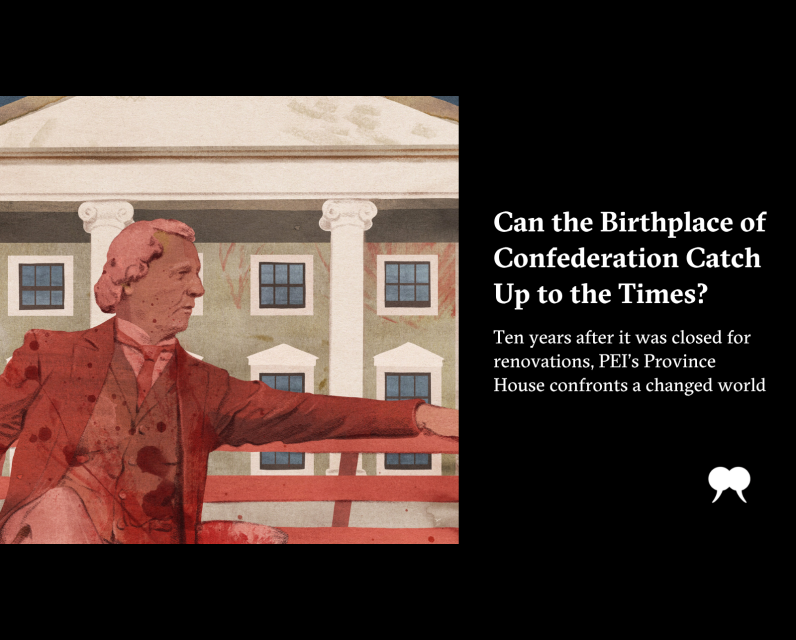
This evolving relationship follows a period of tension and debate surrounding the fate of a local statue of Sir John A. Macdonald, which, until a few years ago, was perched on a prominent bench in a popular entertainment district in Charlottetown. In 2020, the statue was repeatedly defaced by red paint as a symbolic act of condemnation against the former prime minister. The statue drew other acts of protest: in 2021, demonstrators placed pairs of children’s shoes around it in honour of the victims of the residential school system, days after what were thought to be the remains of 215 children were discovered at an unmarked burial site on the grounds of a former residential school in Kamloops, British Columbia. Shortly afterward, the statue was removed by city officials overnight and placed in storage.
Coming to terms with the ongoing legacy of this dark history and charting a path forward has been a work in progress for Parks Canada. In 2022, Mi’kmaq leaders, Parks Canada, and the PEI government held a ceremony at Province House to acknowledge its colonial history. A smudging ceremony was led by Mi’kmaq Elder Methilda Knockwood Snache to cleanse the building’s energy, and a symbolic offering of a woven basket handmade by Keptin Jim Bernard containing four sacred medicines (sage, cedar, tobacco, sweetgrass) will be placed inside its restored walls for generations to come.
In a written statement, Darlene Bernard, chief of Lennox Island First Nation at the time, said, “It is important that as we write a new shared history moving forward, as we rebuild the foundation of a National Historic Site, we must also rebuild the foundation of our relationships with one another, from Government to Government and Nation to Nation.”
The lawn of Province House today is still a bit of a mess, but new paving stones have been laid along outdoor walkways and landscaping work is underway. Conservation work involved replacing the slate roof and windows, installing a geothermal heating system to reduce its carbon footprint, and the painstaking refurbishment of 3,800 original exterior stones. Originally set to be completed by 2020 at a cost of between $30 and $40 million, the project’s price tag has ballooned to over $138 million. Parks Canada has pushed back the official opening—yet again—to this fall, though the agency vows the exterior of the building will be photograph-ready in time for this summer’s busy tourist season.
Given the complicated balancing act involved in recalibrating the Confederation narrative, it’s not surprising that Parks Canada remains tight-lipped about what to expect when the building is ready. The agency would not answer questions about what updated exhibitions might contain. A series of online newsletters begun in 2021 to chronicle community outreach has recently gone silent. Even those involved in writing the new material for Province House’s exhibits have not heard about final inclusions or timelines.
In a 2022 newsletter, Parks Canada admitted, “Figuring out how to tell the stories of Province House isn’t easy.” While a 2024 update suggested all exhibition elements would be finalized and delivered by 2025, the most recent public update now states that the exhibition phase of the project has been put on hold until after restoration work is complete.
The grounds adjacent to Province House, meanwhile, have not fallen silent. They continue to be a vital staging ground for protest and celebration. The Black Lives Matter demonstration in June 2020—one of the largest in PEI’s history, which saw thousands of people march against police brutality—began here. Community groups supporting temporary foreign workers have staged hunger strikes on a nearby lawn. Gorgeous drag queens on towering stilettos sashay past the building every July in the city’s annual Pride parade. These scenes of resistance and joy would probably shock the Fathers of Confederation. But as Canada evolves—and our stories refuse to fade into the shadows of history—Province House bears witness to it all.
The post Can the Birthplace of Confederation Catch Up to the Times? first appeared on The Walrus.
Unpublished Newswire

Comments
Be the first to comment