
Stay informed

What Trump Did to Venezuela Should Terrify Ottawa
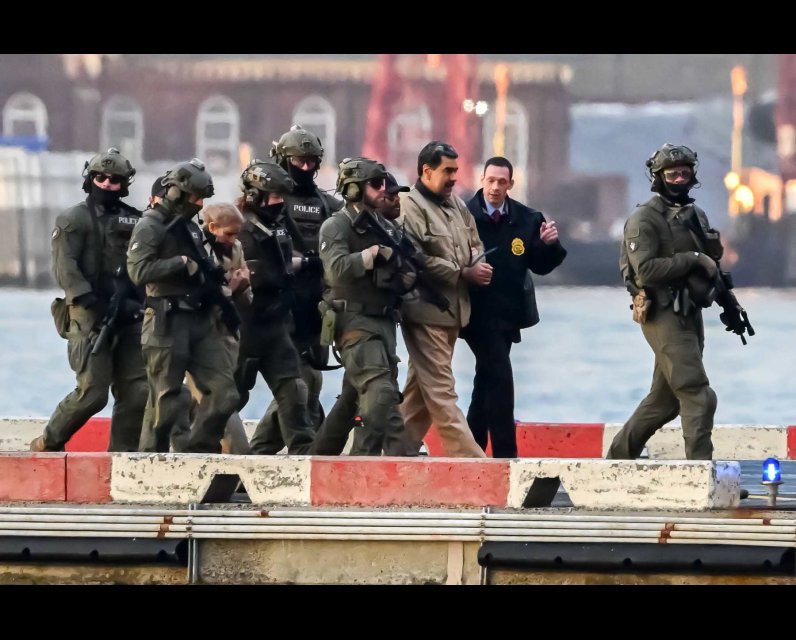
Some of the terms used to describe Prime Minister Mark Carney’s statement on the United States’ illegal military extraction of Venezuelan president Nicolás Maduro in Caracas included words like “weak,” “slow and lethargic,” and even “impotent.”
Diya Jiang, a researcher who specializes in international trade with a focus on US–Canada economic relations at McGill University, however, believes the prime minister’s response was measured and pragmatic. Carney’s statement had to be suited to our times, Jiang reasons. “The first thing he said was that Canada never recognized the legitimacy of Maduro’s presidency—that has a lot to do with timing because we have CUSMA currently up for review. There are a lot of uncertainties associated with that.”
Jiang is referring to the Canada–United States–Mexico Agreement, the trade pact that replaced NAFTA during President Donald Trump’s first term. How the US will approach the upcoming review is a major concern. Much will depend on the administration’s political will—and on any unexpected demands from Trump, which could further complicate negotiations already strained by recent tariffs and trade disputes. The volatility in Canada–US relations has made Ottawa especially cautious. “Because of the turbulence we faced last year, Canada really needed to consider a response that wouldn’t anger the US,” Jiang said.
The Walrus spoke to Jiang about our government’s position on the US’ capture of Maduro, what Trump’s sights on Venezuelan oil—the same type of crude oil that Canada produces for the US—mean for energy interdependence, and whether Venezuela’s fate is a kind of warning.
The prime minister seemed to tiptoe around the fact that Maduro’s capture is a serious breach of international law.
Canada is caught in the middle—especially in comparison to the European leaders’ responses. We are well-integrated with the US and very dependent on the US economy. That’s going to be the reality for a very long time. Canada is known for upholding international law on the global stage. But I feel Carney’s response shows there is an immediate, more pressing concern with our relationship with the US. It’s imperative not to anger Trump; it doesn’t help the Canadian economy to get another tariff or have CUSMA go completely the other way.
Are we entering a world where middle powers, like Canada, have to choose between ethics and economic survival? And what does that mean for our foreign-policy identity?
We are moving into a period where that tension is becoming much more visible. Under former Prime Minister Justin Trudeau, Canadian foreign policy was strongly framed around values like human rights, democracy, and multilateralism. But as global instability grows and Canada becomes more concerned about its economic and strategic vulnerability—especially in relation to the US—those values are no longer the only or primary driver of foreign policy. Instead, they increasingly have to be balanced against hard economic and security interests. That shift doesn’t mean Canada has abandoned its values, but it does mean its foreign policy identity as a values-first middle power is being tested.
Since Venezuela produces the same kind of crude oil that Canada supplies to the US, should we be worried?
It is a special type of heavy crude oil—a thick petroleum that requires a very special kind of refining. Over 90 percent of it currently goes to the US to get processed and then, later on, sold. Not a lot of countries produce this oil, so we occupy the market quite a bit. There are a lot of concerns that Venezuelan oil could undercut Canadian supply in the US market, even though the prime minister said it wasn’t a major concern.
I think Venezuela completely taking over the US’ dependency on Canadian oil is not going to happen in the short-to-medium term. There is the concern that Venezuelan oil will be a lot cheaper, which can threaten our dominance in the market. That’s a long-term structural concern. That’s something Canada has to adapt to. It’s alarming because Canada’s energy relationship with the US is built on mutual dependence: we supply a large share of their crude, and they provide the refining capacity that we lack. If cheaper Venezuelan oil were to displace supply over time, that would weaken our leverage, reduce export revenues, and expose how little control Canada has over its own energy chain.
How long will it take for Venezuela to be a potential competitor?
It’s based on a lot of things. It’s not just about how much money the US will be able to invest but whether there will even be a stable regime change. During any transition period, political control, regulations, and security can all shift—any of which can make it very difficult to build or expand major energy infrastructure. Even with US investment, those domestic uncertainties inside Venezuela would slow things down at the very least.
The facility in Venezuela may be underdeveloped, but could Trump’s focus on Venezuelan transformation nonetheless weaken Canada’s position in the CUSMA review?
I wouldn’t say that. Other than oil, Canada has a lot of resources that the US needs, including critical minerals. So, I wouldn’t say this is a situation where Canada needs to have immediate concern, but it does push our politicians to think of a long-term plan. We don’t currently have enough capability to process a lot of these critical minerals. We also don’t have a lot of capability to process our oil.
Explain why we need domestic refining and processing.
It significantly increases Canada’s long-term leverage and flexibility. Without domestic refining and processing, Canada is forced to sell most of its heavy crude to a small group of foreign buyers that have the right facilities, such as the US. That limits who we can trade with and leaves us exposed to external political and market pressures. It also means we give up higher-value parts of the supply chain, since refining and processing generates far more economic return than simply exporting raw oil.
What are some of the short-term effects of the Venezuela action on Canada?
I think it will generate significant momentum around major infrastructure. We’re seeing it in the new pipeline and the push to accelerate project approvals. It also strengthens the case—for both federal and provincial leaders—to expand processing capacity and diversify trade beyond oil. Canada has already begun to pivot toward Asia, signing new free trade agreements that cover goods, services, critical minerals, and energy. Last year’s deal with Indonesia is a key signal, as is the prime minister’s trip to China this week, both pointing to a broader strategy of deepening economic and diplomatic ties beyond the US and traditional allies.
How realistic is Canada’s Asia-Pacific pivot as a counterweight to US dependence?
I would say it’s realistic for Canada to grow its Asia-Pacific trade—and it’s the right place to look given the region’s population, growth, and long-term demand. But it won’t replace the US. Even a large increase in Asia-Pacific trade would still be small compared to the scale of Canada–US trade. Also, geography and integrated supply chains mean the US will remain Canada’s dominant partner for the foreseeable future.
Is Venezuela’s fate a warning for Canada—the idea of an imperial America?
I do think this sounds an alarm, especially with all the talk of the Monroe Doctrine, which points to how the US wants to be the original hegemony in the entire continent. I think this puts Canada in a hard-to-resolve position. We will always be dependent on the US because of the sheer size of their economy and geographical proximity. Whether this means the US wants to annex Canada is a separate issue. But I do think Trump seeks dominance over the continent—that’s undeniable and increasingly explicit. Every decision of ours needs to take that into consideration.
The post What Trump Did to Venezuela Should Terrify Ottawa first appeared on The Walrus.
Unpublished Newswire
Comments
Be the first to comment