
Stay informed


Inside the Stunning Collapse of the Quebec Liberal Party
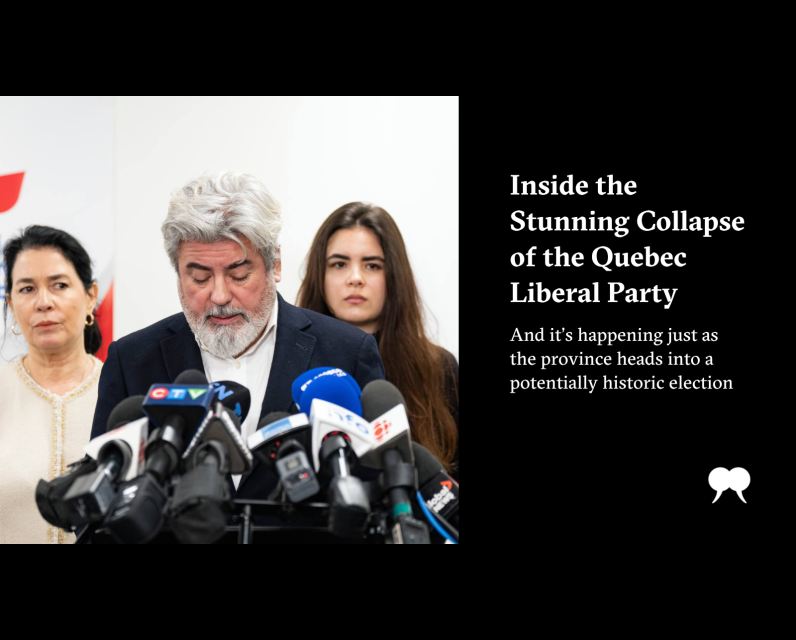
After two-and-a-half years without a permanent leader, the Quebec Liberal Party finally elected one last summer. Now, they’re leaderless again. A week before Christmas, Pablo Rodriguez resigned amid allegations of vote buying, plunging a once-dominant political machine back into crisis. The Liberals are polling around 20 percent and scrambling to rebuild trust with a base that’s fed up with the disarray and fleeing. Meanwhile, support for the governing Coalition Avenir Québec (CAQ) has collapsed; according to recent polls, François Legault is Canada’s least popular premier.
In this vacuum, the Parti Québécois (PQ) has surged ahead, dominating the polls for the last two years, even as it pledges a sovereignty referendum that most Quebecers say they don’t want. All this with a provincial election scheduled for October. “I say this without hyperbole,” says poll analyst Philippe J. Fournier, “but this election has no precedent in Quebec history, at least in the last fifty years.”
At stake is more than one party’s fortunes. The Liberals have been Quebec’s federalist anchor for generations, but their unravelling comes precisely as the PQ is positioned to win a majority and trigger that referendum. If the Liberals can’t rebuild by October, voters will be left with a tricky choice: a vote on sovereignty, a governing party they’ve soured on, or alternatives that remain electorally marginal. When the referendum comes, it’s not clear who will be left to make the case for Canada.
It hasn’t been a stellar millennium for the Quebec Liberal Party, as Daniel Béland, director of the McGill Institute for the Study of Canada, says. After governing for much of the 2000s, the Liberals entered the final years of former premier Jean Charest’s tenure deeply weakened. Despite winning three successive mandates, Charest’s approval had sunk to 27 percent by 2012.
That collapse accelerated amid two destabilizing shocks: the Maple Spring—months of mass student strikes sparked by Liberal-proposed tuition hikes—and the Charbonneau commission, which exposed widespread corruption and illegal party financing across Quebec politics, staining the Liberals in particular. The party returned to power in 2014, under Philippe Couillard, but quickly imposed deep austerity, slashing health and education budgets, laying off hundreds of health care workers, and igniting new rounds of protest.
“Those were not shining years for them,” says Béland. By 2018, after nearly fifteen years in power with only a brief interruption, voters were ready for change, clearing the way for François Legault and the conservative CAQ to win a majority, bringing about a realignment the Liberals have yet to recover from.
Things went from bad to worse in the next election. In 2022, led by Dominique Anglade—an engineer, deputy premier under Couillard, and the first Black woman to lead a major provincial party in Canada—the Liberals suffered their worst result since the party was founded in 1897, earning less than 15 percent of the popular vote. Anglade resigned that fall. Veteran member of the National Assembly Marc Tanguay took over as interim leader, but the party didn’t launch a leadership race for over two years, likely hoping the delay would attract a wider field of credible candidates willing to revitalize a party polling in the teens.
Enter Pablo Rodriguez. Born in Argentina, he came to Canada as a refugee at eight, learned French playing hockey in Sherbrooke, and joined the Quebec Liberal youth wing at sixteen. A skilled organizer, Rodriguez built his reputation behind the scenes before winning the federal riding of Honoré-Mercier in Montreal in 2004, eventually serving as transport minister and Quebec lieutenant under former Prime Minister Justin Trudeau. Then, in September 2024, he walked away from his federal career to take a shot at reviving the provincial party. Last June, he was elected leader of the Quebec Liberal Party. “This is the beginning of a new chapter,” Rodriguez told party members at the leadership convention in Quebec City.
That chapter, it turned out, was a short one. In mid-November, just five months into Rodriguez’s tenure, Liberal parliamentary leader Marwah Rizqy fired her chief of staff, Geneviève Hinse, without consulting the party leader. Rodriguez responded by suspending Rizqy from caucus, citing her decision to dismiss Hinse—a long-time collaborator of his—without approval. Then the Journal de Montréal published allegations that Rodriguez supporters had offered $100 bills—“brownies”—to party members in exchange for votes during the June leadership race. It’s unclear whether the fundraising allegations were connected to the internal rupture, but the events unfolded over the span of just a few days. Over the next few weeks, more bombshells from the Journal de Montréal—reports of cash reimbursements to donors at fundraisers, a scheme banned under Quebec law.
Rodriguez has denied any personal wrongdoing—there’s no indication he was involved, and he even threatened the Journal de Montréal with legal action—but the damage was done. Quebec’s anti-corruption unit, UPAC, opened a criminal investigation, and Liberal opponents drew the inevitable comparisons to Charbonneau Commission–era scandals, which included cash reimbursements to dummy donors. On December 17, six months and three days after he was elected, Rodriguez announced he was stepping down as party leader, insisting he’d done nothing wrong but acknowledging he’d become too great a distraction.
Marc Tanguay is back as interim leader, and yet another leadership race launched on January 12. The deadline for candidates to sign up is February 13, with a new leader to be chosen March 14, just over six months ahead of the next provincial election. For a beleaguered party with leadership problems polling at 20 percent, it’s the kind of compressed timeline that rarely works. Except that the federal Liberals just pulled it off, jettisoning Trudeau and electing Mark Carney to erase a twenty-six-point deficit to win the federal election this past spring—and nearly win a majority.
But as Fournier points out, the Quebec Liberals face a very different situation. “Today, the provincial party has a much smaller base than the federal one did, even at the end of Trudeau’s leadership,” he says. “They also have a ceiling that’s really low.” The party has been hemorrhaging francophone support since the CAQ’s breakthrough in 2018. According to a Pallas Data poll from this month, just 13 percent of francophones say they intend to vote Liberal, leaving the party stranded in Montreal with anglophone and allophone voters.
The party now receives single digits in ridings it used to win, Fournier points out, and that kind of collapse normally takes years—not months—to recover from. Some voters may never return. “Those students who protested Liberal tuition hikes in 2012 are now in their mid-30s,” says Fournier, who also teaches physics and astronomy at Montreal’s Cégep de Saint-Laurent. “And I can tell you that they’ll never, ever vote Liberal.”
That’s what distinguishes this moment from the federal Liberal comeback. Voters may have been fed up with Trudeau, but, in Quebec, leadership is not the party’s core problem. Structural mistrust remains, and any new leader inherits the same vulnerabilities.
So far, two candidates have stepped forward. The early front runner is Charles Milliard, former chief executive officer of Quebec’s federation of chambers of commerce and a pharmacist by training. He ran in last year’s race, finishing a close second to Rodriguez with 47.7 percent of the vote, and began this one with a commanding lead. By the first day of the contest, the Montreal Gazette reported that Milliard had secured the backing of eleven of the party’s eighteen MNAs—five are barred from endorsing candidates because they hold party offices—while 200 members of the Quebec Liberal youth wing signed a letter supporting him.
Also back in the running is Mario Roy, a farmer and economist from Beauce, south of Quebec City. He, too, competed last year, but was eliminated in the first round with less than 1 percent of the vote. It’s not clear yet whether Roy will even be cleared to compete this time. He still carries an $18,000 debt from the last race, and must raise another $15,000 to qualify for this one. The party has said Roy’s outstanding debt will be taken into account when its electoral committee reviews whether to authorize any new bid.
Milliard has a bit of a Carney-lite profile: a well-connected outsider-insider with a business background—and, so far, little political scar tissue. That’s a double-edged sword. He has yet to be truly tested by the media maelstrom that comes with provincial politics, but neither does he arrive with obvious liabilities for opponents to seize on.
Last year, his campaign emphasized economic growth and infrastructure—more local content in Hydro-Québec’s wind-power development, modernizing transportation, improving public services—while explicitly trying to move the party away from the divisive identity politics that have defined Legault’s government. This time, he told CTV News, he wants to double down on what he calls “bread and butter” issues: health care, education, agriculture, mining, forestry, and transportation.
“It’s not sexy, but it could reach voters who want stability and prosperity,” says Fournier. “I don’t know that it’s enough to win over those who’ve scratched the Liberals off their lists forever, but it could bring the party back to forty seats and that would be a win for them.”
Whether that’s enough, however, depends less on the Liberals than on the landscape they’re navigating. And that landscape has been radically reshaped.
The CAQ, which swept to power in 2022, with the largest majority in decades, is now deeply unpopular. At one point this past September, Fournier projected that, if an election were held that week, the CAQ could walk away with zero seats. (He currently has them winning two.)
Their voters have decamped en masse to the PQ, which has led the polls for two years and is currently projected to win a majority government. Leader Paul St-Pierre Plamondon has pledged that, if elected, his government would hold a sovereignty referendum within its first term. And that pledge, which he’s unlikely to walk back, introduces a paradox: the PQ is leading with the referendum as their defining issue, but few support having a referendum now—just one out of four Quebecers want a vote on independence in the next four years, according to a Leger poll for the Journal de Montréal. Béland says that that paradox could offer a path forward for the Liberals.
There’s a core group of committed sovereigntists, who will always support Quebec’s independence, regardless of what else is going on in the world. That’s why support for independence has hovered around 35 percent for the last twenty years. The challenge for the “yes” side lies in persuading the next 15 to 20 percent they would need to actually win.
That swing group—the cautious middle—is acutely sensitive to risk. “And the timing for a referendum is far from optimal,” says Béland. Quebecers would be weighing a constitutional rupture amid global instability, including the renegotiation of the Canada–United States–Mexico Agreement and a volatile geopolitical climate. With US president Donald Trump’s military action in Venezuela and renewed bellicose rhetoric toward Greenland—an existential threat to NATO—many Canadians, Quebecers included, feel more vulnerable than ever. As David Coletto, the founder of Abacus Data, put it in a recent newsletter, “In that context, Canada looks less like a constraint and more like a shield.”
Recent voting behaviour reflects the instinct towards safety. In the federal election last year, many suburban Montreal ridings that traditionally voted for the Bloc Québécois backed Carney’s Liberals, a signal that risk-averse voters were in search of stability. None of this moves the committed base, but it raises the bar significantly for converting undecided or soft “no” voters once the referendum question becomes real rather than theoretical.
All of which helps explain the strange duality of the coming election. Realignment and vote-splitting could still deliver the PQ a majority government, even without majority support for sovereignty. According to Fournier, currently more than half of Quebecers are predicting a victory for the Parti Québécois. But if the campaign becomes more explicitly framed as a referendum-triggering event, the political math could shift. Federalist voters would have an incentive to coalesce, the Liberals could regain strategic relevance, and support—now parked elsewhere—could drift back. Either way, Quebec is heading into an election that looks fragmented, unpredictable, and constitutionally consequential. Or, as Fournier put it: “It’s going to be a strange one.”
The post Inside the Stunning Collapse of the Quebec Liberal Party first appeared on The Walrus.
Comments
Be the first to comment