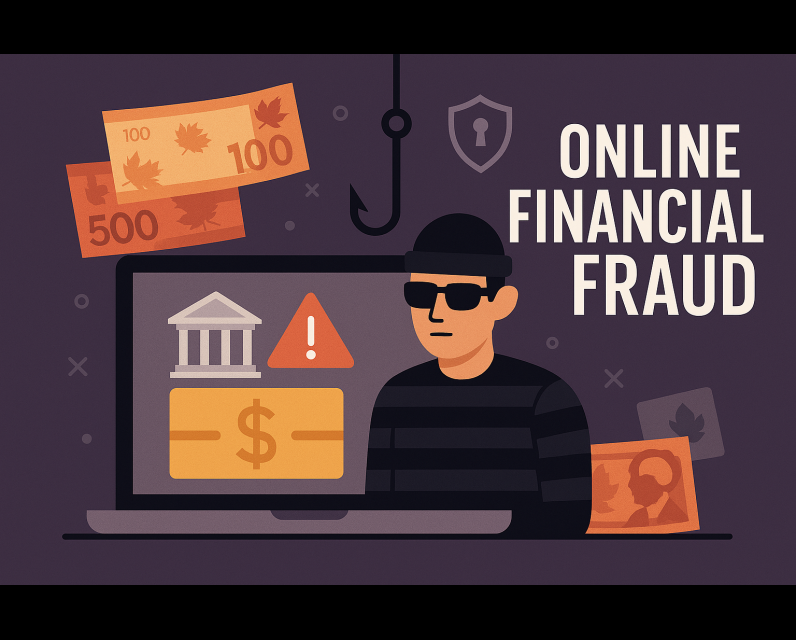
Financial fraud in Canada is often treated as an individual issue — a scam targeting unsuspecting victims, a romance hoax, or a bad investment gone wrong.
But could these fraud schemes be creating conditions that allow broader foreign influence efforts to flourish?
Foreign interference is typically associated with political meddling, covert lobbying or espionage, but financial fraud presents an overlooked vulnerability. Deception-based scams do not just cause financial losses — they also exploit and deepen distrust in institutions, making individuals more susceptible to manipulation and disinformation.
Canada’s response to fraud is fragmented, with regulatory oversight and enforcement operating in silos.
On the regulatory side, the Financial Consumer Agency of Canada (FCAC) monitors banking practices but lacks authority to dismantle or disrupt fraud networks. Its role is largely limited to ensuring institutional compliance, not protecting consumers from complex, evolving threats.
Similarly, the Canadian Anti-Fraud Centre provides public education and collects reports, but has no enforcement power.
On the enforcement side, agencies like the RCMP and Canadian Security Intelligence Service (CSIS) face jurisdictional, legal and operational barriers in addressing fraud, especially when schemes originate abroad. Cross-border fraud networks thrive in this vacuum. Victims are often left without legal recourse, while fraudsters operate beyond Canada’s reach, exploiting gaps in both domestic co-ordination and international co-operation.
There is also little systemic collaboration between financial regulators and national security agencies.
While CSIS monitors threats to Canada’s economic security, it cannot act directly on financial fraud intelligence. Instead, it must pass its findings to enforcement agencies like the RCMP.
This hand-off is often slow, fragmented and under-resourced, allowing fraud schemes to persist with little resistance.
Consider a co-ordinated scam campaign where thousands of Canadians receive messages claiming to be from the Canada Revenue Agency or immigration authorities, requesting urgent payments or personal data. Beyond the immediate financial harm, repeated exposure to these impersonation tactics can lead people to doubt legitimate communications from government bodies.
Foreign actors can exploit this erosion of trust — not just to defraud, but to drive disinformation, delegitimize institutions and reduce public compliance with democratic norms.
Reforms must go beyond new mandates or expanded budgets. Canada has repeatedly failed to enforce meaningful consequences for financial misconduct, corporate fraud and public sector failures.
Scandals surface regularly, yet few face prosecution. Investigations drag on, and even when wrongdoing is confirmed, they often end in quiet settlements instead of public accountability.
Without credible deterrents, these schemes thrive in plain sight, while public trust continues to erode.
At the same time, individuals must also remain vigilant, informed and proactive in protecting themselves. While stronger enforcement is necessary, personal responsibility remains a crucial line of defence.
Fraudsters thrive on misinformation and manipulation, making financial literacy and digital awareness essential tools in prevention.
If Canada is serious about tackling financial fraud and its potential intersection with foreign influence, reforms must go beyond symbolic measures. Strengthening oversight bodies is crucial, but true independence means ensuring regulators are not appointed by the very political leaders they are meant to scrutinize.
Independent fraud enforcement could help prevent regulatory capture and ensure investigations are free from political interference.
Intelligence-sharing between financial and national security bodies must be enhanced, but without expanding state control over digital platforms. Instead, public awareness efforts must highlight fraud not just as personal deception, but as a tool that weakens national resilience and democratic cohesion.
If Canada continues to treat financial fraud as a private misfortune rather than a systemic threat, it risks inviting greater foreign interference through the cracks of public distrust. This is not just about recovering lost money — it’s about defending the integrity of our democratic institutions.
Fraud is no longer just a financial issue. It’s a front-line vulnerability. And ignoring it may cost more than dollars.
Mimi Lee is a financial advisor working with numerous financial institutions for over 20 years and lives in York Region.




Comments
Be the first to comment