Synopsis / Plot Overview: The film’s central spine is its attempt to map Xi Jinping’s ascent to power — not through sensationalism or dramatization, but through extended dialogue, historical explanation, and reflective commentary. Interwoven with this political narrative are two additional threads:
- the director’s own spiritual and philosophical reflections
- the intermittent presence of his daughter, whose appearances hint at deeper personal histories
These threads coexist rather than fully merge, creating a layered but sometimes disjointed narrative structure.
Thematic Analysis:
1. Political History as Narrative Backbone
The strongest and most coherent part of the film is its explanation of Xi’s rise. Few documentaries walk through the mechanics of how he consolidated power, and this film provides a clearer trajectory than what is typically available in mainstream media. It’s informative, accessible, and genuinely illuminating.
2. Dialogue‑Driven Rhythm
The film leans heavily on conversation and reflection. This creates a contemplative rhythm, but also a static one. At times, it feels more like listening to a long dialogue than watching a cinematic narrative unfold. The pacing becomes meditative, but also inert.
3. Underdeveloped Hong Kong Thread
The film gestures toward Hong Kong but never fully integrates it. If the intention was to build a bridge between Xi’s rise and Hong Kong’s contemporary experience, the film would have needed to explore beyond mainstream historical records. As it stands, the Hong Kong connection feels implied rather than examined.
4. Spiritual Layering
The religious and spiritual elements are unusual for a fictional-documentary about China. They may resonate with Japanese audiences, but within the film’s structure they sometimes feel like a parallel track rather than a fully woven thematic strand.
Visual Language: Interestingly, the animations and illustrations are among the film’s most effective moments. They offer clarity, movement, and emotional texture — qualities that the dialogue‑heavy structure sometimes lacks. A stronger reliance on this visual language could have elevated the storytelling without resorting to dramatization.
Character Presence & Performance
The Daughter
- Her presence is intriguing but incomplete. She appears tied to the director’s own emotional arc — especially with references to the mother’s death and the father’s imprisonment — yet her storyline never resolves. She enters and exits without narrative closure, leaving her role ambiguous.
The Director as Character
- The director’s introspection is sincere, but it sometimes competes with the political narrative rather than enriching it. The film seems torn between being a political documentary and a personal spiritual diary.
Structural Strengths & Weaknesses
Strengths
- Clear explanation of Xi’s rise
- Unique blend of political and spiritual themes
- Effective use of animation
Weaknesses
- Static pacing due to dialogue‑heavy structure
- Underdeveloped Hong Kong connection
- Ambiguity around the daughter’s role
Audience Fit
This film will resonate most with viewers who appreciate:
- political analysis delivered through reflection rather than dramatization
- philosophical or spiritual framing in documentary work
- slow, contemplative pacing
It may frustrate viewers who expect:
- strong visual storytelling
- clear narrative arcs
- tight thematic integration
Conclusion
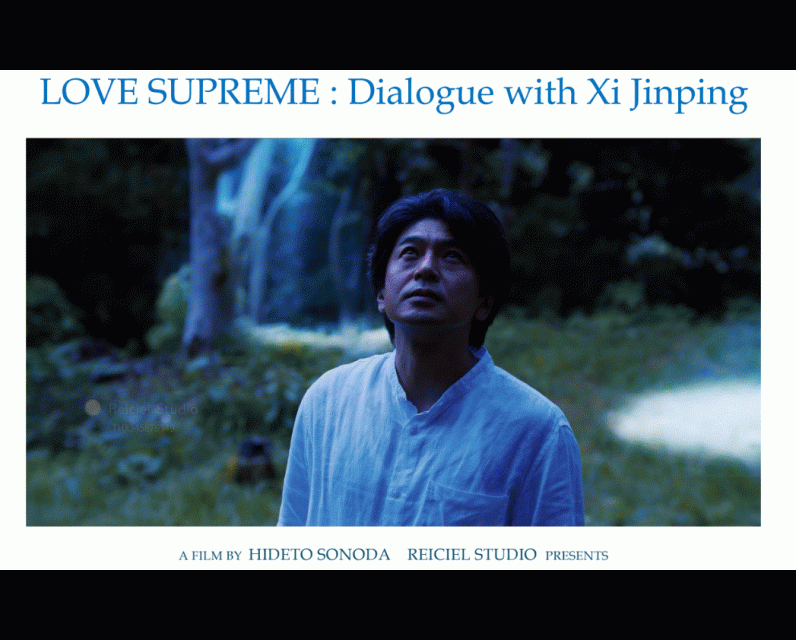
Love Supreme: A dialogue with Xi Jinping is a thoughtful and unconventional documentary. It blends political critique, personal introspection, and spiritual aspiration in a way few films attempt. With stronger visual storytelling and tighter thematic integration, it could become an even more compelling work. As it stands, it offers a unique perspective — one that invites viewers to reflect not only on political history, but also on the inner life of the filmmaker behind it.
This film brings out my interest in watching the previous work from Reiciel Studio — The Philosopher King: A Dialogue with Lee Teng-hui — it sits in a similar space of political reflection through personal conversation.
★★★1/2




Comments
Unpublished Media will be hosting a screening of Love Supreme this coming March in Toronto. Stay tuned...