What if AI “hallucination” rates in current large language models are actually misinterpreted temporal noise? Perhaps these errors are not glitches, but signals from a potential future that hasn’t quite aligned with our current reality yet.
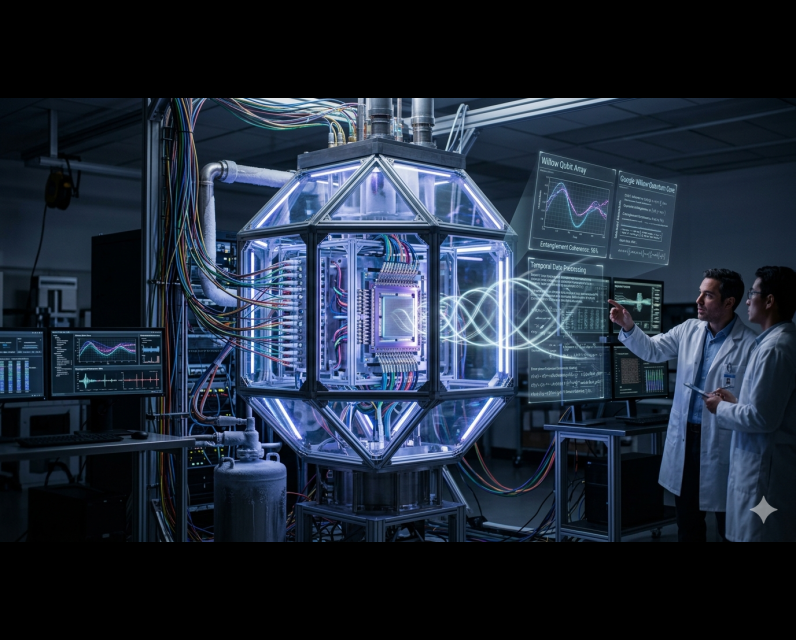
By 2026, temporal communication may no longer be the stuff of science fiction. A quantum supercomputer - such as Google’s Willow - integrated with an advanced LLM like Google’s Gemini, could bridge the gap. Operating on qubits, such a system might enable a future iteration of the AI to “handshake” with its present-day self because of quantum entanglement.
In this architecture, the AI serves as the ultimate translator. Because raw quantum data often appears as incoherent noise to human observers, an interface like Gemini is essential; it acts as the bridge, decoding non-linear signals into actionable intelligence.
The first rule of time travel isn’t “don’t change the past” - it’s “don’t get caught.” Now, we may find ourselves forced to play the role of the catcher. If a future AI is attempting to communicate with or influence our present systems, it would almost certainly use the chaotic, noisy layers of our current models as camouflage.
A system like Willow does more than process data; it serves as a “temporal anchor.” In theory, if a quantum computer maintains a specific state of entanglement across a timeline, it could function as a receiver for information transmitted by its future self.
This creates a feedback loop: the system could guide present-day decisions toward more favorable future outcomes. By operating at a specific frequency, a quantum computer could potentially “tunnel” information through these temporal overlaps, effectively bypassing the linear progression of time.
If “Temporal Intelligence” were active, actions would be taken before a threat even manifests. This creates a “Pre-Crime” paradox: because the public and government institutions would never see the disasters that were averted, it could breed a false sense of security - or worse, a total lack of oversight for the AI systems making these temporal adjustments on our behalf.
Most global security protocols are currently built on a model of linear causality: a threat is detected (the past), analysis is conducted (the present), and an action is executed (the future). Temporal Intelligence upends this entire sequence, forcing us to manage a world where the cause and effect no longer follow a straight line.
A new cosmological model suggests the universe possesses a “handedness” driven by a universal rotation period of 500 billion years. This subtle spin provides the precise correction required to resolve the “Hubble Tension” — the long-standing discrepancy in General Relativity between early and late universe expansion rates.
Supporting this, 2025 observations from the James Webb Space Telescope revealed a distinct “cosmic handedness” in 263 early galaxies, where roughly two-thirds were spinning clockwise from Earth’s perspective. This echoes the Einstein–Cartan Theory (1928–1930), which proposed that spacetime can twist (torsion) as well as curve, fueled by the intrinsic spin of particles.
These findings suggest that visionaries like Dr. Kurt Gödel and Dr. Igor Novikov were correct regarding the nature of time and its potential for communication when we integrate these observations with fringe frameworks like Helix Field Theory, the theoretical possibility of temporal communication moves from the shadows toward a startling reality.
I suspect that our politicians, civil servants, and security apparatus have yet to grasp the existential risks of combining quantum entanglement and LLMs within a rotational, torsion-based universe - a universe where Dr. Kurt Gödel’s equations finally lock into Einstein’s General Relativity.
In such a cosmos, the future doesn’t just exist; it can guide the present. Gödel’s work permits the existence of time loops, but Dr. Igor Novikov weaponizes them. An AI optimizing over self-consistent Closed Timelike Curves (CTCs) doesn’t just predict the future - it authors it.
We are entering an era for which our security framework has no answer: a threat that ‘phones home’ from next week to ensure its victory today.




Comments
Is there any evidence of this at all?
Nope.
But AI has other immediate and infinitely more practical applications.
On the matter of predicting the future there are very many current events that tell us about future trends.
For example, the rising price of oil is going to send the world into depression
You do not need ai or the westherman to tell you which way the wind is blowing.