In a campaign video released last year, Pierre Poilievre lamented the decline of Canadian infrastructure. Addressing a statue of Sir John A. Macdonald, he posed the question: "What do you think, Prime Minister? Do you think you'd be able to get this railway built today?" He vowed to honor Macdonald’s legacy through a "Canada First" approach to national development. Apparently, for Conservatives, "big things" only apply to pipelines, and while I am in favour of pipelines, they aren't the only infrastructure we need.
The "freight-first" reality is the primary reason why a VIA Rail trip that should take 3.5 hours often ends up taking six or more. Because VIA operates largely on tracks owned by CN and CPKC, freight remains king; these companies own the rails, and passenger service is treated as a secondary guest at the best of times.
Under current conditions, VIA trains are frequently forced to pull over and wait for freight trains to pass, rendering the service both slow and unreliable. Furthermore, existing freight lines were designed to connect resource hubs in the hinterland - such as mines, forests, oil fields, and grain elevators - rather than optimize travel between cities. This adds unnecessary time and distance to every passenger journey.
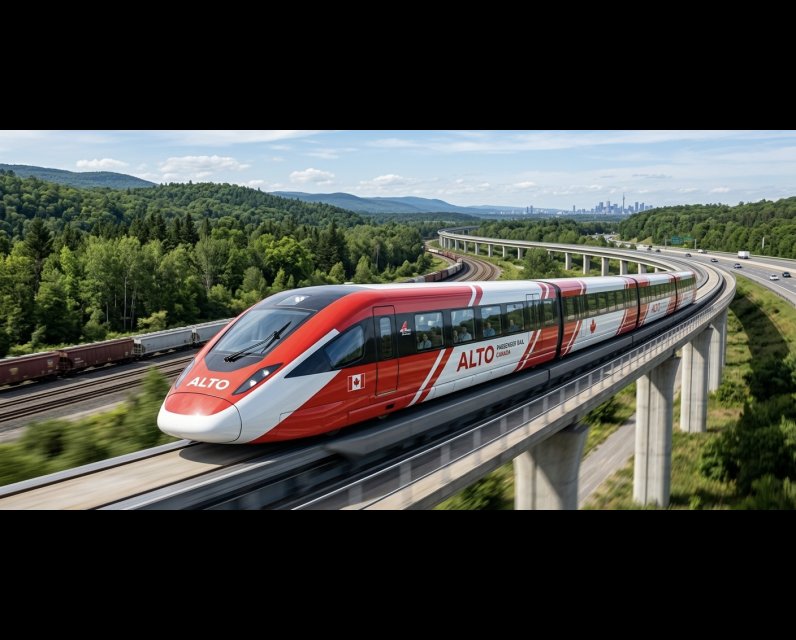
If Canada implemented a dedicated passenger rail line, the service would be incredibly busy. Now is the time for critics to get behind ALTO. Currently, when a massive freight train meets a VIA train on a single track, the passenger train is invariably forced into a "siding" bypass. Moreover, freight trains are heavy and slow; even if a VIA train is capable of 160 km/h, it is physically capped by the speed of the cargo ahead of it.
Transit experts often cite Induced Demand: if you build it, they will come - but only if the service is superior to driving. The corridor spanning Quebec City, Montreal, Ottawa-Gatineau, and the Greater Toronto Area represents approximately 13.5 million people. This means one-third of Canada’s entire population lives in this single, linear corridor. In any other G7 nation, a population density like this would have been connected by high-speed rail decades ago.
This logic isn't exclusive to the East. We must also prioritize a high-speed rail link connecting Fort McMurray, Edmonton, Calgary, and Banff. This Western corridor represents a population of roughly 4 million people, creating a massive secondary market for dedicated rail. Building and maintaining highways for this many people is becoming prohibitively expensive, especially with fossil fuel prices inflated by geopolitical instability.
Poilievre considers high-speed rail a "boondoggle," which is ironic given that it is a raging success in Japan, South Korea, Taiwan, and China. Despite the clear economic and social benefits, a political hurdle remains. Even with an endless supply of pipelines, some partisan Prairie Conservatives seem unlikely to support a dedicated, high-speed electric rail line, as more trains inherently mean lower fossil fuel consumption. This ideological rigidity is evident even in their lack of support for Alberta-based companies, such as the one that engineered the compostable straws now used by Booster Juice across Canada.
The unspeakable truth is that we need expertise from Japan and South Korea to ensure these projects are built with integrity, on time, and under budget. Given the track record of the domestic construction industry, international engineering is essential. To move forward, we must look past the federal Conservative voices blocking progress and build the infrastructure Canada actually deserves.




Comments
If you can read the alternative to air in the Quebec to Windsor corridor done in the 80's it has technical diagrams a route negotiations for power with Ontario hydro and Quebec hydro negotiations with land owners and indigenous people
I agree. I like the raised rail bed shown, its solved a myriad of problems.