

Unpublished Opinions

The Torontonian Hong Kongers Action Group has been organizing events since June 2019 in Toronto to raise awareness and support for the pro-democracy movement in Hong Kong sparked by the amendment on the extradition to China bill fiasco. #antiELAB #antiNSL
When Fear, Not Dialogue, Guides University Decisions
During a Hong Kong solidarity rally in 2019, hundreds of counter‑protesters flooded Old City Hall. They arrived in coordinated groups, waving flags and shouting slogans. The tension was unmistakable. I learned then how quickly political pressure can mobilize, especially when international student networks and diaspora politics are involved.
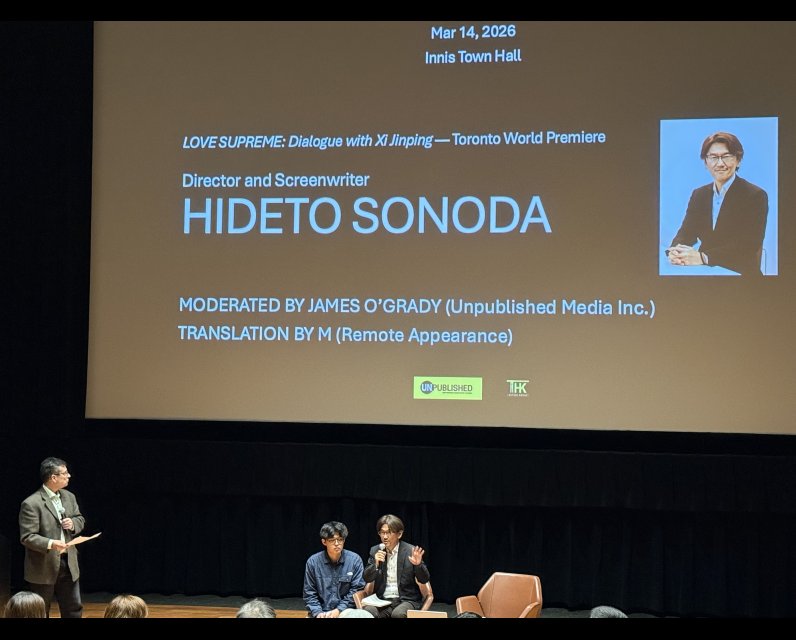
Seven years later, I was preparing a film screening at the University of Toronto—scheduled for March 14—featuring a Japanese film built around the idea that “love can overcome fear.” It was meant to be a simple cultural event: a room booking, a film, and a conversation. I expected some political sensitivity; the title alone, Love Supreme: Dialogue with Xi Jinping, could evoke strong reactions. What I didn’t expect was how the institution would respond when it didn’t know how to handle that pressure.
The first sign came in early March, when I noticed our event listing had quietly disappeared from Innis Town Hall’s website. No notice, no explanation. I asked for it to be restored, and it reappeared a couple of days later. I assumed it was a technical glitch. In hindsight, it could have been the first tremor.
A sudden shift in tone
On March 5, we received a demand letter from a Texas law firm. Later that same day, we informed the venue. That was the moment everything changed. The Assistant Director of the Community Liaison & Support Team reached out offering “security help,” even though we were already arranging professional security. Innis Town Hall suggested we consult campus security. The tone had shifted from neutral to anxious.
Escalation without explanation
Late on March 9, at 9:56 p.m., a senior academic left a message saying security requirements had been “updated” and now required a $2,200 package. We were told to confirm by the next day. No rationale. No details. Just a deadline.
By March 10, Innis Town Hall was pressing for a decision. In between the time, we were told the university got “complains” on the screening. By March 11, it became an ultimatum: confirm by noon, pay by 4 p.m. The Assistant Director insisted the requirements were “consistent with other planned events of this nature,” though no examples were provided. We explained the Japanese team was mid‑flight and unreachable. It didn’t matter. The invoice arrived anyway. We paid late that night—not because we agreed, but because we didn’t want the event cancelled.
The political pressure surfaces
Early March 12, Innis Town Hall confirmed payment. At our press conference that day, a reporter from a pro‑China outlet stated openly that international students at U of T were “concerned” and that there had been “many discussions on WeChat.” For the first time, the source of the mysterious “complaints” became visible. The university had never explained what the concerns were, but now it was clear they were coming from private, Chinese‑language student networks.
Later that day, the event was unlisted again.
The justification that revealed everything
On March 13, we finally received the security details. Then came the explanation for the unlisting: our screening supposedly did not reflect “the University’s purpose, mission and values—including our commitment to freedom of expression and open dialogue.”
The film is literally about dialogue.
What began as a simple screening had become a case study in how institutions respond when political pressure arrives through channels they do not understand. Instead of transparency, we received shifting explanations. Instead of conversation, we received deadlines. Instead of support for open dialogue, we received a bill.
A familiar pattern
The pattern I saw in 2019 reappeared in 2026, but in a quieter, administrative form. Political pressure did not arrive through official channels. It arrived through private WeChat groups, diaspora networks, and student communities that universities rely on financially but do not fully understand. When that pressure surfaced, the institution reacted with avoidance and overcorrection.
At no point did anyone at the university watch the film. At no point did anyone explain the complaints. At no point did anyone articulate a specific safety concern. Discomfort was treated as danger. Ambiguity was treated as risk.
Soft censorship through process
This is how soft censorship works in Canada. It rarely announces itself. It appears as sudden fees, disappearing listings, contradictory instructions, and value‑based language that sounds neutral but functions as a barrier. It is not a ban; it is a series of small decisions that make something difficult enough, costly enough, or invisible enough that it might as well not happen.
And it is almost always justified as “safety.”
Safety without evidence
Nothing about our screening suggested a safety risk. The protesters who eventually showed up were disruptive—they moved and knocked over chairs and tried to interrupt the screening—but they did not harm anyone and did not damage property. They held signs, chanted briefly, and left the venue altogether. There were no threats, no confrontations, and no escalation. The only real tension came from the institution itself.
Universities can plan for the possibility that someone might object. But no reasonable interpretation of a 199‑person screening justifies nine security professionals. That level of staffing is reserved for events with known threats or large crowds. None of those conditions existed here. The scale of the response was not precaution; it was disproportionate.
A shrinking space for dialogue
The university’s final explanation—that our screening did not reflect its commitment to “freedom of expression and open dialogue”—reveals the contradiction at the heart of this incident. If a film about dialogue can be deemed inconsistent with a university’s commitment to dialogue, then the issue is not the content. The issue is the climate.
The cost of institutional fear
What I saw was not malice. It was fear: fear of controversy, fear of misinterpretation, fear of upsetting a politically sensitive group of students. But fear is a poor foundation for decision‑making. It leads to overcorrection, opacity, and the quiet erosion of trust.
Why this matters
Incidents like this shape the broader environment for public dialogue in Canada. When universities respond to political pressure by narrowing the space for conversation, they send a message that certain topics are too risky to engage with and that a small group can reshape institutional behaviour simply by objecting early and loudly.
A film about dialogue should not be treated as a liability.
A handful of complaints should not outweigh academic principles.
And a university committed to open inquiry should not hide behind language that contradicts the very content it is trying to avoid.
What happened over those twelve days was not a crisis. It was a test of whether a university would stand by its stated values when they became inconvenient. And it failed—not because the situation was difficult, but because the easiest path was to overreact to the loudest voices.
Dialogue requires courage. Institutions should have some too.
References

Comments
Be the first to comment