
Stay informed



Avi Lewis Wants to Save the Planet. It’s Tearing His Party Apart
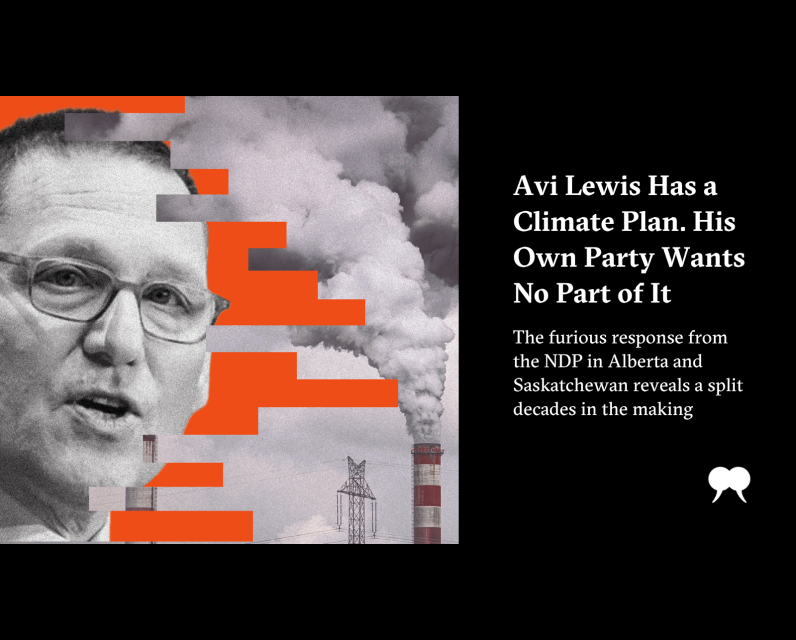
On March 29, Avi Lewis, the veteran left-wing journalist and activist, defeated four rivals to take the helm of the federal New Democratic Party. His honeymoon was brief.
Key points- NDP leaders in Alberta and Saskatchewan have clashed with federal leader Avi Lewis’s anti–fossil fuel stance
- The feud reflects a larger dilemma of how to transition away from oil without abandoning the communities that depend on it
- Canada’s reluctance to move beyond oil is leaving it out of step as the world races toward a clean-energy economy
About an hour later, Carla Beck, the head of the Saskatchewan NDP, released a missive on official letterhead, declining to meet with the new national leader unless he disowned pretty much every position on climate change he’d ever taken. “It’s impossible to support—and respect—working people without respecting the jobs they have, not the ones you think they should have,” she wrote.
Not long after, Naheed Nenshi, the NDP’s leader in Alberta, reacted similarly, describing Lewis’s election as “not in the interests” of the province. “We believe in more pipelines and in reducing emissions,” he said. The message was clear: in Alberta and Saskatchewan, at least, the provincial NDP can’t get far away enough from its federal counterpart.
What accounts for such swift hostility? It’s true that Lewis’s platform is a threat to the oil and gas sector, which is concentrated in Alberta and Saskatchewan and is the largest single source of Canadian greenhouse gas emissions; Lewis supports an end to new fossil fuel development and a transition to sustainable energy. Inconveniently for the industry, this happens to be the only rational response to the existential threat of climate change. Inconveniently for Nenshi and Beck, Lewis’s position risks alienating the voters and interest groups whose economic fortunes remain tied to fossil fuels.
The attacks on Lewis, in other words, didn’t just represent internecine party sniping. They also helped illustrate the Anthropocene’s most fundamental political problem. Leaders across the spectrum may claim to accept overwhelming scientific consensus and to understand what must be done to avoid catastrophic levels of warming. They just aren’t willing to act on it.
Tensions between the provincial and federal NDP are nothing new. In the prairies, the Liberal brand never recovered from the Pierre Elliott Trudeau era, with its bitter wars over oil-export taxes and the National Energy Program, which means the NDP occupies the centre-left space that would otherwise belong to the Grits. Even though Western Canada was the birthplace of the NDP, the party there is now more liberal technocratic than social democratic. Just like Nenshi and Beck today, past provincial leaders have sometimes taken pains to distance themselves from their federal comrades, particularly on issues of energy and the environment.
Something about this spat, though, feels different. One reason is the sheer speed and vehemence with which Beck and Nenshi threw Lewis under the bus. Although this might be partly explained by legitimate ideological differences, on closer examination, it looks more like desperation.
Neither Beck nor Nenshi are in power—they’re both opposition leaders and unpopular ones at that. According to an April Angus Reid poll, Beck’s approval rating sits at 32 percent to Saskatchewan Party premier Scott Moe’s 52 percent, while Nenshi has seen a long, steep decline since leaving the Calgary mayor’s office and becoming leader of the Alberta NDP.
The same poll found that only 20 percent of Albertans say they’re “very impressed” with Nenshi, down seven points from last year and way behind United Conservative Party premier Danielle Smith, at 34 percent. Even with the gift of a looming secession referendum, his numbers continue to plummet. The same poll suggests that, were an election held today, Nenshi would lose by double digits to Smith—a soft separatist, admirer of Donald Trump, and all-around weirdo.
Nenshi was always an awkward fit for the NDP. He’s long cultivated a post-partisan image, marketing his first run for mayor, in 2010, as a “Purple Revolution”—a muddled midpoint between Liberal red and Conservative blue. He only joined the NDP two years ago in order to run for its Alberta leadership, and one of his first orders of business was pushing an ultimately successful vote to make membership in the federal party optional. It was a move designed, in part, to attract Albertans who might have soured on decades of right-wing provincial rule but still recoiled at the federal NDP’s environmental stance.
Some might describe that decision, as well as Nenshi’s break with Lewis, as canny political manoeuvring. It’s also a good way to alienate the rank and file and to expose yourself to accusations of opportunism. Even as he’s failed to connect with average voters, it seems, Nenshi has failed to inspire the NDP grassroots. As the progressive Alberta political commentator David Climenhaga recently wondered, “When will the knives come out for Naheed Nenshi?”
For Beck’s part, in her letter to Lewis, she tried to shore up her party credentials by drawing on its proud prairie history, pointing out that NDP founding leader and Saskatchewan premier Tommy Douglas supported the pipeline that would later become Enbridge Line 5. The problem is that this was more than seventy-five years ago, decades before the science behind climate change was widely understood. Then there’s the fact that Douglas was an avowed champion of nationalizing key industries, which is also a component of Lewis’s platform: the creation of publicly owned companies in areas like telecommunications, pharmaceuticals, and groceries. For all the hyperventilating about Lewis’s radicalism, he’s the closest the party has had in years to an inheritor of its founder’s mantle.
There’s no doubt that Beck and Nenshi are in a difficult position. Their supporters might argue that they need to defeat their conservative opponents and get elected in order to make meaningful progress on emissions reduction. But, if recent history is any guide, that strategy is both bad politics and bad policy.
Despite then premier Rachel Notley’s much-ballyhooed climate-change strategy, emissions under the last NDP government in Alberta, from 2015 to 2019, kept rising; tar sands development continued, and she got booted out after four years anyway. In Saskatchewan, the NDP hasn’t been in power in nearly two decades, but provincial emissions skyrocketed during the party’s long stint in government from 1991 to 2007.
So how do you combat climate change without turning off voters whose livelihoods rely on fossil fuels? The sole honest answer is a sustainable-energy transition that prioritizes job creation for those currently employed in oil and gas. As it happens, that’s another core piece of Lewis’s platform: a “Green Jobs Transfer” explicitly aimed at Western Canada. According to his website, “The funding would be front-loaded to protect workers in fossil fuel reliant provinces first: no one who works in the industry will be left behind.”
Is that an easy sell to the average tar sands worker? Probably not. But given their current polling numbers, whatever pitch Beck and Nenshi are making to voters isn’t landing either. Their energy and environmental platforms are similar: they both promise a shift to renewables for their provinces’ electrical grids while promoting further oil and gas development. You can pick your cliché: drop in the bucket, fiddling while Rome burns, rearranging the deck chairs on the Titanic.
Elsewhere in the world, the green revolution is already under way. The twin shocks of the Ukraine and Iran wars have revealed—as if any further proof were needed—the folly of continued dependence on fossil fuels; oil companies are reaping record profits, while the rest of us pay sky-high gas prices and suffer downstream increases to the costs of basic goods. This has had the unintended effect of accelerating the green transition in places like China and Europe—already global leaders in sustainable energy—as governments and consumers increasingly opt for the stability and efficiency of renewables.
Thanks to the power of the fossil fuel lobby, though, Canada is lagging far behind. The fact is that expanding the oil and gas sector makes neither economic nor environmental sense. Bitumen is prohibitively expensive to extract and transport from the tar sands, which has historically made Canadian heavy crude vulnerable to the volatility of international oil prices. That’s why the tar sands experience such deep busts after such soaring booms. It may also be one reason the Canadian oil industry—which is mostly foreign owned—is among the most heavily subsidized in the world, all while employing about 1 percent of the country’s working population.
Which is to say: Canadian taxpayers are bailing out American companies so they can keep cooking the planet.
Tellingly, in their statements on Lewis’s election, neither Beck nor Nenshi made any reference to climate change. They did both pay lip service to “lowering emissions,” but neither province is anywhere close to doing so at the rate required to avert disaster.
Alberta’s carbon-emission rate is basically stagnant and is expected to remain so through at least 2050. Saskatchewan has managed to moderately reduce emissions, but that’s mostly due to methane capture rather than any serious effort to move away from fossil fuels. And overall, Canada is nowhere near reaching its legislated carbon-reduction goals. Contrary to his image as an eco-warrior, Liberal prime minister Mark Carney has abandoned any pretence of action on climate, slashing regulations and backing new fossil fuel projects. Last month, his own environment minister quit in disgust.
Right-wing leaders and fossil fuel interests might not feel the need to take climate change seriously; refusing to accept basic science has that advantage. For the rest of us, there’s no getting around the deeply studied, well-documented truth: a habitable future on this planet requires a complete transition away from the carbon economy. Lewis, at least, is honest on this point. Indeed, despite caricatures to the contrary, his position represents the baseline: an end to new oil and gas development paired with the gradual drawdown of existing extraction. Any politician who suggests otherwise—who claims to understand the science of climate change but supports the expansion of the fossil fuel industry—is lying. That might be stating the obvious, but considering how rarely one hears anything like it from our elected representatives, it’s worth repeating.
Meanwhile, the consequences of our current path become more sobering by the day. Global emissions continue to increase. Sea levels continue to rise. The past eleven years were the hottest eleven on record, and 2029 will likely see the planet exceed 1.5 degrees of warming above pre-industrial levels—the temperature established in the Paris Agreement as the point of no return. In his 2021 book Values, Carney himself wrote that, “to meet the 1.5 C target, around 80 per cent of remaining fossil fuels would need to remain in the ground.”
In Canada, there’s no clearer or more tragic symbol of climate change than wildfire season, which is beginning now. The past three years have already set records; in fact, these precedent-shattering fires have caused the country’s forests to start releasing more carbon than they absorb, kicking off a devastating feedback loop. Last summer, forest fires forced the evacuation of more than 85,000 people. The devastation was especially brutal in the Western provinces, with their massive swathes of forest and disproportionate number of large, remote First Nations reserves.
It takes a callous heart to write all this off as the cost of economic growth. Apparently, it also takes a surprising amount of political courage to tell the truth about what’s required to stop it from happening again—and again and again. In the war of words between the provincial and federal wings of the NDP, it’s worth remembering that the stakes are far higher than the party’s electoral prospects.
The post Avi Lewis Wants to Save the Planet. It’s Tearing His Party Apart first appeared on The Walrus.
Unpublished Newswire

Comments
Hey Nenshi, you can’t suck and blow at the same time…
This illustrates perfectly why the NDP is not an environmental party. My line from the 2007 Ontario provincial election for the Green Party of Ontario still holds true: There’s only one Green Party if you want real change…